

CBTG1BG Push-Pull Connector for Ultrasonic Flaw Detectors 2026: 1B Series 7-Contact 7 A Plug for Portable NDT Instrument Interfaces
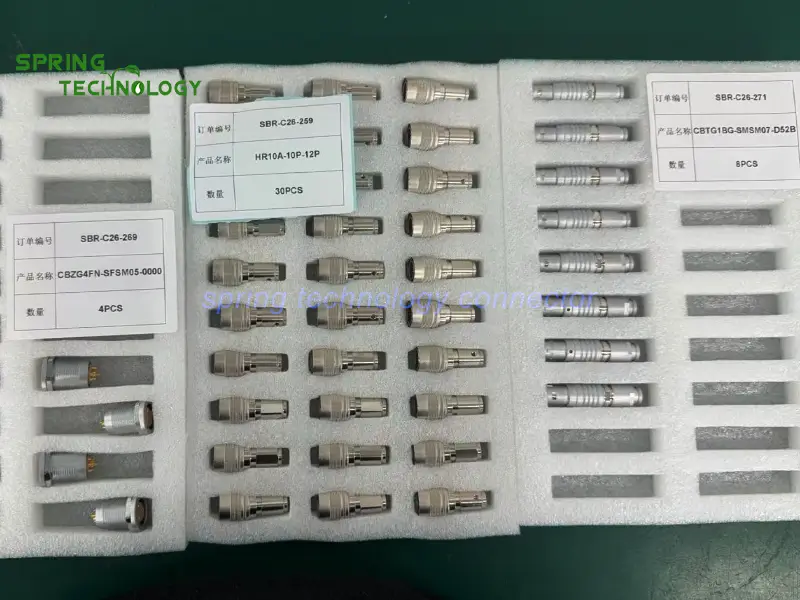
The CBTG1BG-SMSM07-D52B is a CBTG1BG push-pull connector for ultrasonic flaw detectors — a 1B series straight cable plug with 7 low-voltage contacts, a push-pull self-latching mechanism, solder termination, 30–22 AWG wire compatibility, a cable jacket diameter of 4.30–5.20 mm, a 7 A rated current and maximum contact resistance of 6.1 mΩ. Every specification in this guide is backed by the non-destructive testing interconnect engineering of Spring Technology.
Pain point: Wiring a portable ultrasonic flaw detector — where transducers, encoders, external control devices and alarm systems all connect and disconnect as inspection jobs change, and instrument signals must stay clean in industrial environments?
Core answer: Spring Technology supplies the CBTG1BG-SMSM07-D52B, a 1B series straight cable plug serving as a CBTG1BG push-pull connector for ultrasonic flaw detectors, particularly for auxiliary I/O, encoder, synchronization, control and other multi-signal interfaces. Portable ultrasonic flaw detectors are widely used for non-destructive testing of welds, pipes, plates, pressure vessels, aircraft structures and other components, and the instrument needs to connect with transducers, encoders, external control devices, alarm systems and other inspection accessories. With seven contacts, this cable-mounted connector carries multiple control and signal lines through a single compact circular interface, making it useful for designing detachable cables between the instrument and external accessories.
1. Technical Parameters & Engineering Standards
This flaw detector connector is built on the 1B series push-pull platform, a compact circular connector family classified for technical domains including test and measurement, industrial, medical, semiconductor, transportation, aerospace and UAV applications.
- Latching Mechanism: Push-pull self-latching system (straightforward push-pull operation, no threaded coupling)
- Recommended Hardware: Spring Technology Circular Connector
- Key Metric: 7 low-voltage contacts; 7 A rated current; max. 6.1 mΩ contact resistance; 5,000 mating cycles
| Parameter | Value |
|---|---|
| Connector (this order) | CBTG1BG-SMSM07-D52B — TG plug, 1B shell, key G, 7 contacts, straight cable plug |
| Contacts | 7 low-voltage contacts |
| Rated current | 7 A |
| Contact resistance | Max. 6.1 mΩ |
| Wire gauge | AWG 30–22 |
| Cable diameter | Jacket 4.30–5.20 mm (platform cable opening 2.2–7.5 mm) |
| Termination | Solder termination, cable-mounted plug |
| Insulation material | PPS |
| Housing material | Chrome-plated brass shell |
| Shielding | Min. 75 dB at 10 MHz, 40 dB at 1 GHz |
| Mating cycles | 5,000 mating cycles |
| Shock resistance | 100 g · 6 ms |
| Vibration resistance | 10~20000 Hz, 15 g |
| Protection | IP50 (for controlled or protected industrial environments) |
| Operating temperature | -45 °C ~ +125 °C (1B platform) |
2. Ultrasonic Flaw Detector Connector Design Highlights
NDT instruments travel to the asset under inspection. The design advantages below explain why this CBTG1BG push-pull connector for ultrasonic flaw detectors suits portable inspection equipment:
2.1 Seven Contacts for Multi-Signal Connections
- With 7 low-voltage contacts, a single interface can carry encoder signals, trigger signals, alarm outputs, control signals, auxiliary I/O, ground or reference connections and external accessory interfaces — combining several signal paths into one detachable cable interface.
2.2 Push-Pull Locking for Fast Connection
- The push-pull self-latching system locks with a straightforward push-pull operation rather than a threaded coupling mechanism. Technicians frequently connect and disconnect inspection cables when changing accessories, transporting equipment or setting up an inspection system at a new testing location, so quick locking simplifies these operations and reduces setup time.
2.3 Low Contact Resistance for Stable Signal Transmission
- With a maximum specified contact resistance of 6.1 mΩ, the connector maintains a consistent electrical interface between the instrument and its cable or accessory — important because the system processes timing, trigger, encoder and alarm signals.
2.4 7 A Rated Current for Additional Electrical Capacity
- Although many flaw detector signal interfaces operate at much lower currents, the 7 A rating provides additional electrical capacity for designers — useful when the same connector architecture must accommodate both signal circuits and auxiliary low-voltage power or control circuits, subject to the complete system design requirements.
2.5 Suitable for Compact Instrument Cable Assemblies
- Belonging to the 1B size family and accepting cable jackets from approximately 4.30 to 5.20 mm, the connector suits compact cable assemblies for portable instruments. For handheld or portable flaw detectors, a compact circular interface helps designers organise external cables without a large connector footprint.
2.6 5,000 Mating Cycles for Long-Term Serviceability
- Portable ultrasonic testing equipment is repeatedly connected to probes, scanners, encoders and external accessories during inspection work, so a 5,000 mating cycle specification supports repeated setup and maintenance over the product’s service life.
2.7 Shielding Supports Electromagnetic Compatibility
- Shielding performance of 75 dB at 10 MHz and 40 dB at 1 GHz helps designers manage interference at the cable connection point — especially useful on signal and control interfaces of instruments that generate, receive, amplify and process inspection signals.
2.8 Suitable for Industrial Inspection Environments
- With IP50 environmental protection, 100 g shock resistance and 15 g vibration resistance (10~20000 Hz), the connector suits equipment designed for controlled or protected industrial environments and for systems frequently transported between inspection locations. The 1B platform specifies an operating temperature range of -45 °C to +125 °C.
3. 1B Series Connector Family Overview
The 1B shell is part of Spring Technology’s push-pull self-locking connector family, classified for test and measurement, industrial, medical, semiconductor, transportation, aerospace and UAV technical domains. The same platform serves this flaw detector connector and scales across pin counts and termination variants.
3.1 Available Configurations
- Shell: 1B shell size, with 0B, 00B and 2B siblings for smaller or larger layouts.
- Pin counts: 2 to 16 contacts, including the 7-contact configuration in this order.
- Termination: solder termination with cable collet and bend relief options.
- Materials: chrome-plated brass shells with PPS insulators and shielded structures.
3.2 Customization Services
- Custom contact allocations and part numbers (such as the CBTG1BG-SMSM07-D52B) matched to each instrument’s I/O and encoder plan.
- Detachable inspection cable assemblies for probes, scanners and accessories.
- Shielding and EMC verification for measurement and control circuits.
- Pre-wired encoder and alarm harnesses.
4. Applications: Portable Ultrasonic Flaw Detectors
Inspection work happens at welds, pipes and airframes. This CBTG1BG push-pull connector for ultrasonic flaw detectors supports the instrument’s external interfaces.
4.1 Auxiliary I/O and Encoder Interfaces
Encoder, trigger and auxiliary I/O signals travel through the 7-contact interface, with pin allocation set by the instrument architecture.
4.2 Control, Synchronization and Alarm Connections
Control signals, synchronization lines and alarm outputs share the same compact connector, reducing the number of separate interfaces on the instrument.
4.3 Detachable Accessory Cables for NDT Systems
Cables linking the instrument to external accessories can be detached and refitted quickly, supporting equipment transport and inspection setup between sites.
5. Frequently Asked Questions (FAQ)
Conclusion & Call to Action
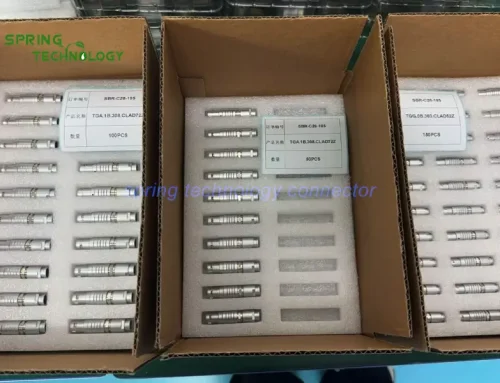
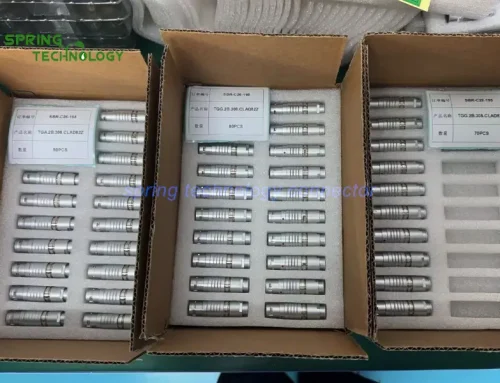
This 1B connector delivery shows how Spring Technology serves non-destructive testing equipment — from the seven contacts and 6.1 mΩ resistance of the CBTG1BG-SMSM07-D52B to its shielding and compact cable interface, every detail was aligned with the customer’s ultrasonic flaw detector requirements. Spring Technology also provides professional customization services for both push-pull connectors and cable assemblies, offering tailored solutions to meet your specific technical requirements.
For more information about our 1B series connectors or to discuss your requirements, contact us at [email protected] or [email protected], or visit our website.
Building a portable ultrasonic flaw detector or NDT system? Send us your I/O and encoder requirements — our engineering team will respond with a tailored CBTG1BG push-pull connector proposal for your ultrasonic flaw detectors within 24 hours.
Further Reading
- CBTG1BG Push-Pull Connector for Video Borescope Processors 2026: 1B Series 8-Contact 1 Gb/s Ethernet Connector for Industrial Inspection Equipment
- Push-Pull Connector for Automated Test Equipment 2026: CBZC1BG-SFSM07-0000 and CBTA1BG-SMSM07-0000 for High-Precision Test, Measurement and Industrial Robotics for US Customers
- CBTG2FN Push-Pull Connector for Precision Machine Tools 2026: CBTG2FN-SMSM09-D520 and CBZL2FN-SFPM09-S000 for Multi-Channel Miniature Sensor Aggregation for Russian Client
- Push-Pull Connector for Data Acquisition 2026: CBZG0BG-SFSM06, CBZG1BG-SFSM06 and CBZG0BB-SFSM06 for Test, Measurement and Industrial Data Acquisition for Russian Customers
- CBZE1KG Push-Pull Connector for GNSS Surveying Receivers 2026: 1K Series 10-Contact IP68 PCB Socket for Outdoor Positioning Terminals for US Customers
- TGG.1B Connector — Product Page
- 1B Series Connector