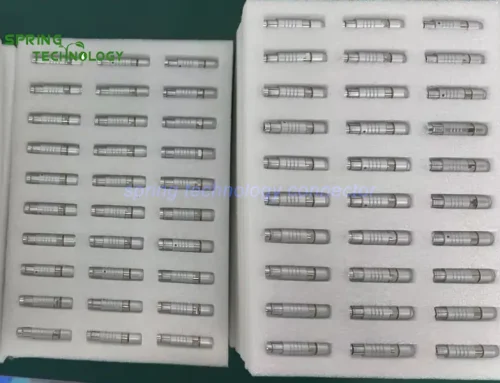


CBTF00SA-TMS250-D32B Push-Pull Connector for Portable Gamma-Ray Spectrometers 2026: 50-Ohm 00S Coaxial Cable Plug
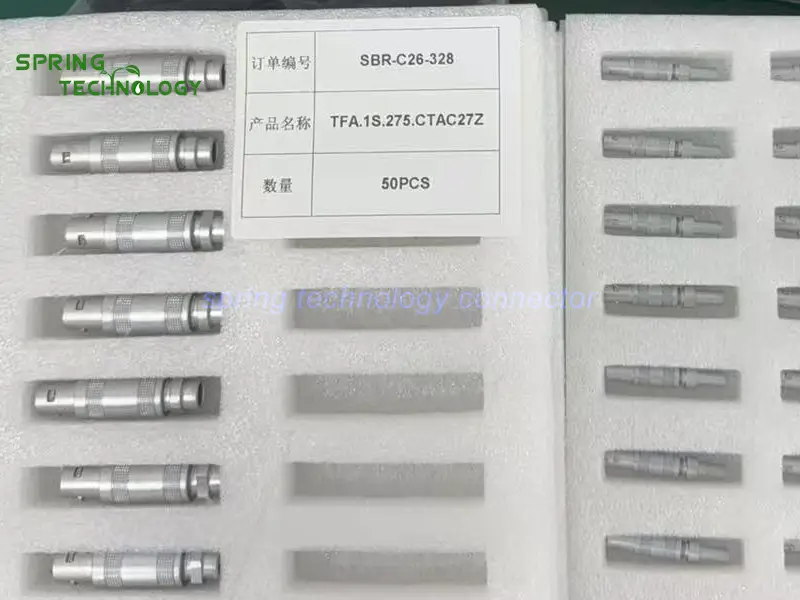
The CBTF00SA-TMS250-D32B push-pull connector is a single-contact coaxial cable plug from the 00S series: a 250 coaxial contact rated 50 Ω with solder termination, a 0.7 mm contact on AWG 22 conductor capacity, PTFE insulation, a chrome-plated brass shell, push-pull self-latching coupling, IP50 protection and 5,000 mating cycles. It is the plug half of a detachable detector cable.
A portable gamma-ray spectrometer is a counting instrument, not a waveform instrument. Each gamma photon that interacts in the scintillation crystal produces a light flash, the photosensor turns that flash into a charge pulse, the preamplifier and shaper turn the charge into a voltage pulse, and the multichannel analyzer sorts the pulses by height. The pulse height is the gamma energy. Anything that distorts a pulse moves counts from one channel to another.
Core answer: CBTF00SA-TMS250-D32B carries that conditioned pulse from the detector assembly to the analyzer over a 50-ohm coaxial line. The connector’s job is modest and specific: keep the line at 50 ohm through the panel transition, keep the screen continuous, and let the detector cable be unplugged and replaced in the field without opening the instrument.
1. Technical Parameters & Engineering Standards
Every electrical value below for the CBTF00SA-TMS250-D32B push-pull connector is taken from the 250 coaxial contact row of the published 00S series P/N table and the 00S platform documentation. Values that belong to other variants of the family, or that depend on the order configuration, are called out explicitly.
- Latching Mechanism: push-pull self-latching — the plug seats with an axial push and releases by pulling the outer sleeve, so no torque is transmitted into the instrument panel when a detector cable is changed.
- Mating Hardware: the ZRA.00S fixed unipole coaxial socket on the instrument or detector housing, and a 00S coaxial cable plug on the signal lead — both from the Spring Technology unipole coaxial range.
- Key Metric: one 50-ohm coaxial contact, 0.7 mm contact size, AWG 22 conductor capacity, 1,200 V test voltage, 4 A rated current, ≤12.5 mΩ contact resistance, IP50 and 5,000 mating cycles.
1.1 Configuration Summary
| Parameter | Value / Status |
|---|---|
| Part number | CBTF00SA-TMS250-D32B |
| Manufacturer | Spring Technology |
| Series | 00S (unipole coaxial) |
| Connector type | Straight cable plug (TF body style) |
| Coaxial contacts | 1 |
| Impedance | 50 Ω nominal |
| Contact size | 0.7 mm |
| Conductor size | AWG 22 |
| Contact termination | Solder |
| Insulator | PTFE |
| Rated current | 4 A |
| Test voltage | 1,200 V |
| Contact resistance | ≤12.5 mΩ |
| Locking system | Push-pull self-latching, key A |
| Housing material | Chrome-plated brass |
| Ingress protection | IP50 |
| Mating cycles | 5,000 |
| Mating receptacle | CBZR00SA-TFS250-0000, listed as ZRA.00S.250.CTL |
Note: the collet code in the part number sets the accepted cable outer diameter. Confirm the collet, the solder cup and the cable construction together before the assembly is built — the 00S shell accepts only small-diameter coaxial cable, and a collet chosen for a different cable will either not grip or not fit.
1.2 Shared 00S Platform Specifications
| Parameter | 00S platform value |
|---|---|
| Insulation | PTFE (polytetrafluoroethylene) — low loss, stable dielectric constant |
| Mating cycles | >5,000 |
| Humidity | up to 95% at 60 °C |
| Temperature range | -45 °C ~ +125 °C |
| Vibration | 10–2,000 Hz, 15 g |
| Mechanical shock | 100 g, 6 ms |
| Salt spray | >48 h |
| Protection index (mated) | IP50 |
| Screening | 360° shell screening |
Note: these are shell-level values for the 00S family. The electrical ratings in section 1.1 belong to the 250 coaxial contact specifically; other inserts in the same shell carry different current and voltage figures.
2. Where the CBTF00SA-TMS250-D32B Push-Pull Connector Sits in a Gamma-Ray Spectrometer
A scintillation spectrometer is a chain of conversions: gamma energy → light → charge → voltage pulse → channel number. The coaxial cable joins the last two stages, and it is the only part of the chain that an operator can replace with a screwdriver and a spare.
2.1 The Signal Chain and the Connector Boundary
A typical portable instrument runs: NaI(Tl) or other scintillator → photomultiplier tube or solid-state photosensor → preamplifier and pulse shaper → 50-ohm coaxial cable → CBTF00SA-TMS250-D32B cable plug → ZRA.00S panel socket → multichannel analyzer.
The connector sits where the conditioned pulse leaves the detector assembly and enters the analyzer. Everything upstream of it has already been shaped; everything downstream is counting. That boundary is what makes a detachable plug sensible — the cable is exposed to handling, the electronics are not.
2.2 Why 50 Ohms, and What It Protects
With the CBTF00SA-TMS250-D32B push-pull connector the information is in the pulse height, and the connector exists to protect it. A reflection on the cable does not merely add noise: it adds a delayed copy of the pulse that can superimpose on the leading edge, changing the measured amplitude and therefore the apparent gamma energy. The effect shows up as degraded energy resolution and as peak broadening in the spectrum.
The CBTF00SA-TMS250-D32B push-pull connector presents the 50-ohm member of the 00S coaxial contact family. That keeps the mating plane from becoming the discontinuity — but the cable, the termination and the analyzer input all have to be 50 ohm as well, or the connector’s contribution is irrelevant.
2.3 Shielding and the Noise Floor
Gamma spectroscopy detects small pulses in a hostile electrical environment: motor drives in a survey vehicle, inverters in a portable power pack, radio transmitters at a nuclear facility. The 360° shell screening of the CBTF00SA-TMS250-D32B push-pull connector keeps the screen continuous across the connector, and the coaxial construction keeps the return current on the shield rather than on the instrument chassis.
A cable assembly is only as good as its worst shield bond. The connector-to-cable joint and the connector-to-panel seat are the two places where screening is usually lost.
2.4 Push-Pull Latching in Field Work
Radiation survey work involves changing detectors, swapping cables after a snag, and packing the instrument between sites. The CBTF00SA-TMS250-D32B push-pull connector seats with a push and releases with a pull on the outer sleeve: no rotation, no torque into the panel, and a positive click that confirms engagement without the operator having to inspect a thread.
2.5 PTFE Insulation
The CBTF00SA-TMS250-D32B push-pull connector uses PTFE around the center contact. PTFE has a low and stable dielectric constant, negligible moisture absorption, and it does not soften at soldering temperatures — the three properties that matter for a hand-terminated coaxial plug. It also keeps leakage current low, which matters when the pulse being carried is small.
2.6 Replaceable Detector Cables
The practical value of the CBTF00SA-TMS250-D32B push-pull connector as a detachable assembly is that a damaged cable does not become a repair job on the detector. In the CBTF00SA-TMS250-D32B push-pull connector configuration the trailing B denotes the version supplied with a nut for fitting a bend-relief accessory, which keeps the bending load away from the solder joint at the point where a portable instrument’s cable is most often abused.
2.7 The High-Voltage Boundary
A photomultiplier needs a bias supply in the high-voltage range. That supply is a separate circuit from the conditioned pulse path, and this connector is specified for the latter.
Do not assume the 00S coaxial plug is suitable for the photomultiplier anode or dynode supply. Its contact row is documented at a 1,200 V test voltage and 4 A, and high-voltage service requires a separate evaluation of the complete connector, cable and assembly — including creepage, clearance and the way the assembly is potted or terminated. Instruments that integrate the bias supply use a dedicated high-voltage connector for it.
3. Verifying the Exact Variant Before Production
This family has more than one documented ordering code, and the codes differ in the collet and the contact designation. Three things should be confirmed against the product drawing before a batch is released:
- Collet code: the two digits after the D set the accepted cable outer diameter. CBTF00SA-TMS250-D32B specifies the D32 collet; a neighbouring variant uses D27, and the cable range moves with it. Match the collet to the actual cable, not to the previous order.
- Contact designation: the 250 contact appears in the published tables as TMS250 for the plug and TFS250 for the socket. Confirm the exact string on the drawing rather than assuming an equivalent spelling.
- Test voltage: the 250 contact row for the 00S shell documents 1,200 V. Other contacts in the same family document different test voltages; they are not interchangeable and must not be carried across.
None of this argues against the part — it argues for ordering it against a drawing instead of against a catalogue shorthand.
4. Where the CBTF00SA-TMS250-D32B Push-Pull Connector Fits
The CBTF00SA-TMS250-D32B push-pull connector is aimed at the detector-to-analyzer link in portable instrumentation: handheld radioisotope identifiers, survey meters with spectroscopy capability, environmental radioactivity monitors, and the detector inputs of laboratory counting systems that need a field-replaceable cable. The same 00S coaxial interface appears wherever a small coaxial cable has to cross an enclosure wall and be unplugged again.
5. Frequently Asked Questions (FAQ)
Conclusion & Call to Action
The CBTF00SA-TMS250-D32B push-pull connector gives a portable gamma-ray spectrometer a detachable 50-ohm detector link: a 250 coaxial contact on a 0.7 mm contact size, PTFE insulation, solder termination, push-pull latching, IP50 and 5,000 mating cycles, with a bend-relief option that protects the termination in field handling.
For more information about our 00S coaxial connectors or to discuss your requirements, contact us at [email protected] or [email protected], or visit our website.
Designing a radiation detection instrument with a detachable detector cable? Send us your cable type, detector output, panel constraints and mating requirements — our engineering team will respond with a tailored coaxial connector and cable assembly proposal within 24 hours.
Further Reading
- CBZR00SA-TFS250-0000 00S Coaxial Receptacle for Nuclear Medicine Imaging 2026
- High-Voltage 1S Coaxial Connectors for Dielectric Withstand Test Stations 2026
- HBTX4XN-KMSH38 Custom HDMI Cable for Control Room Video Walls 2026
- HBTX4XN-KMSH38 DisplayPort Cable for Flight Simulator Visual Systems 2026
- High-Speed Connectors for Offshore Drilling Rig Video Monitoring 2026
- TFA.00S Straight Unipole Coaxial Plug — 00S Series Product Page
- ZRA.00S Fixed Unipole Coaxial Socket — Matching Panel Receptacle
- Custom Push-Pull Connector Engineering — Spring Technology