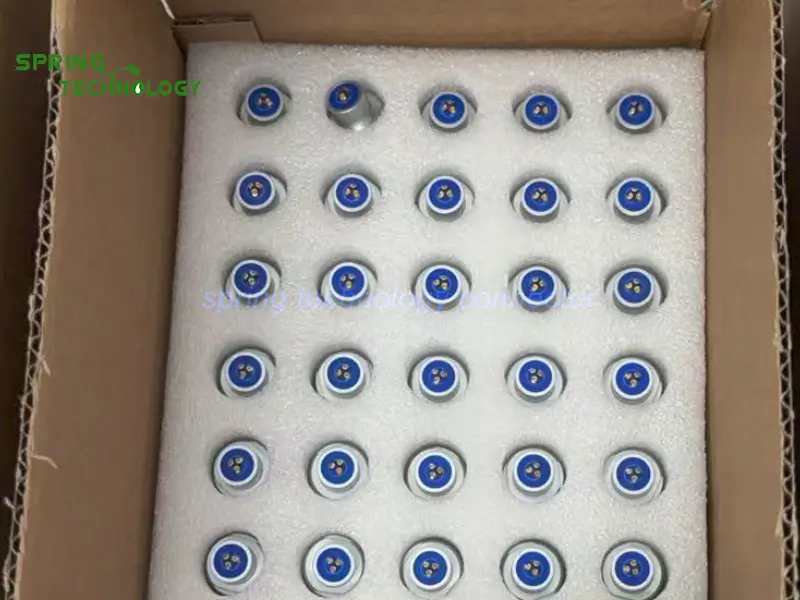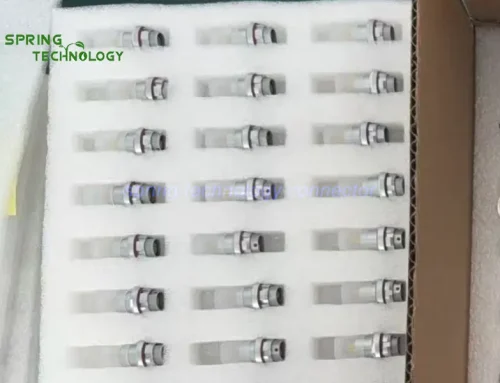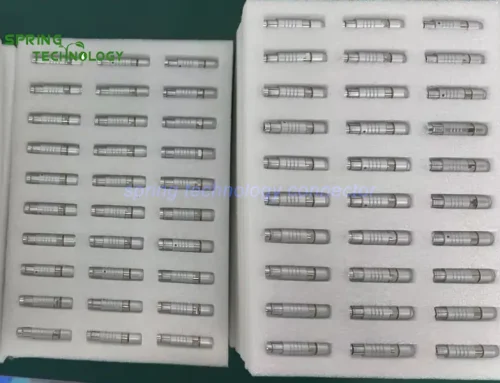


CBZL3FN-SFSM03-S000 Push-Pull Connector for Portable Photoelectric Tachometers 2026: 103F 3-Contact Panel Receptacle
The CBZL3FN-SFSM03-S000 push-pull connector is a three-contact 103F hermetic panel socket for the external optical sensor interface of a portable photoelectric tachometer — female solder contacts, a chrome-plated brass housing, PPS insulation, push-pull self-latching coupling, IP68 when mated, -55 °C to +145 °C operation and more than 3,000 mating cycles, with a 303 insert of 1.3 mm contacts rated 1000 V and 10 A. Three contacts are the natural fit for a simple optical sensor: supply, pulse output and signal ground.
An optical tachometer measures rotation without touching the machine: a reflective mark on the shaft or roller, a sensor that counts the reflected pulses, and a handheld unit that turns the pulse frequency into an RPM reading. The instrument itself is easy — the awkward part of the job is the sensor cable, which is clamped to a bracket, routed past moving parts, and replaced when the sensor is knocked or the wrong one was brought to site.
Core answer: CBZL3FN-SFSM03-S000 gives that sensor cable a defined panel interface: a rear-mounted hermetic socket that seals the enclosure at the panel, three low-voltage contacts on a 1.3 mm contact size, 1000 V working voltage, 10 A per contact and a maximum contact resistance of 5.0 mΩ. The sensor cable plugs in from outside; the internal harness stays inside and is soldered once. Replacing a damaged sensor becomes a cable change rather than a rework of the instrument.
1. Technical Parameters & Engineering Standards
Every value below for the CBZL3FN-SFSM03-S000 push-pull connector comes from the published 103F platform documentation and from the 303 three-contact insert row of the product page P/N table. Items that depend on the exact order configuration are marked as such.
- Latching Mechanism: push-pull self-latching coupling — the mating plug seats with an axial push and releases by pulling the outer sleeve, with a keyed shell (key N, with A and B variants) so a neighbouring 103F interface cannot be cross-mated.
- Recommended Hardware: the ZLN.103F hermetic socket on the instrument panel and a 103F cable plug on the sensor cable, both from the Spring Technology 103F range.
- Key Metric: 3 contacts on a 1.3 mm insert, 1000 V working voltage, 10 A per contact, ≤5.0 mΩ contact resistance, IP68 when mated and more than 3,000 mating cycles.
1.1 Configuration Summary
| Parameter | Value / Status |
|---|---|
| Model | CBZL3FN-SFSM03-S000 |
| Body | 103F hermetic panel socket, female solder contacts, chrome-plated brass housing, rear-mounted configuration |
| Contacts | 3 (303 insert) |
| Contact size | 1.3 mm |
| Conductor size | AWG 20 |
| Working voltage | 1000 V |
| Rated current | 10 A per contact (connector rating) |
| Contact resistance | ≤5.0 mΩ |
| Termination | Solder (the SFSM contact code designates female solder contacts) |
| Keying | Key N, with A and B variants in the 103F range |
| Insert material | PPS (polyphenylene sulfite) |
| Protection index | IP68 when mated |
Note: the panel cutout, mounting depth and the exact order suffix should be confirmed against the product drawing before the enclosure is machined. The IP68 rating applies when mated, under the platform test conditions; the protection of a complete instrument also depends on the panel gasket and the sensor cable’s clamp.
1.2 Shared 103F Platform Specifications
| Parameter | Value |
|---|---|
| Shell size | 103F (3F) — layouts from 2 to 16 contacts |
| Operating temperature | -55 °C ~ +145 °C |
| Humidity | Up to 95% at 40 °C |
| Vibration resistance | 10–2000 Hz, 147 m/s², ≤1 µm instantaneous break |
| Impact resistance | 490 m/s² instantaneous break |
| Mating cycles | >3,000 |
| Protection index | IP68 when mated |
| Termination | Solder |
| Fastening type | Push-pull |
| Keying | N, with A and B variants |
| Shell material and finish | Brass, chrome plated (silver or black) |
| Contact material and finish | Brass, gold plated |
| Insert material | PPS (polyphenylene sulfite) |
Note: these are platform-level values published for the 103F shell. The 103F belongs to the watertight family, so its temperature range, sealing and mating life differ from the 0B and 1B platforms and must not be carried across from another shell size.
2. Key Advantages of the CBZL3FN-SFSM03-S000 Push-Pull Connector
A sensor socket on a handheld tachometer is judged by three things: whether it keeps the enclosure sealed, whether it survives a cable being pulled at the wrong angle, and whether a sensor can be changed without opening the instrument. The characteristics below explain why this CBZL3FN-SFSM03-S000 push-pull connector suits that role:
2.1 Compact Three-Contact Configuration
The CBZL3FN-SFSM03-S000 push-pull connector carries three low-voltage contacts on a 1.3 mm contact size. A reflective optical sensor needs exactly three conductors — supply, pulse output and ground — so a three-contact interface is the smallest arrangement that does the job, and it keeps the panel footprint of a handheld instrument small.
The 1.3 mm contacts are the larger option in the 103F range: they are rated 10 A per contact, which leaves generous headroom for a sensor that draws far less than that but may see inrush or a long cable.
2.2 Rear-Mounted Panel Integration
The CBZL3FN-SFSM03-S000 push-pull connector is a rear-mounted panel socket: the body is installed from inside the enclosure while the mating interface stays accessible to the technician from outside. That keeps the front of a handheld unit free for the display and keypad, and it keeps the sensor cable away from the operator’s hands.
Internally, mounting from the rear shortens the run to the circuit board and lets the panel hole be positioned from the board side, where the mechanical clearance is actually known.
2.3 Brass Housing for Mechanical Stability
The housing of the CBZL3FN-SFSM03-S000 push-pull connector is chrome-plated brass. On a portable instrument the sensor connector is the part that gets pulled at the wrong angle when the cable is caught, and a metal shell keeps the interface geometry intact through that handling.
The metal body also gives the screen a solid bond to the panel when a shielded sensor cable is used — the arrangement that keeps switching noise from a nearby motor drive out of a low-level pulse signal.
2.4 PPS Insulation
The insert of the CBZL3FN-SFSM03-S000 push-pull connector is moulded in PPS (polyphenylene sulfite), the material specified across the 103F platform. It separates the three contacts at a fixed spacing and holds that spacing across the -55 °C to +145 °C range the series is rated for.
Stable geometry matters for a pulse signal: a contact that shifts under cable load changes the impedance and the contact resistance, and an intermittent pulse is read by the instrument as a genuine speed fluctuation.
2.5 Convenient Sensor Replacement
Because the sensor plugs into the CBZL3FN-SFSM03-S000 push-pull connector rather than into the board directly, a damaged sensor cable is replaced from outside the instrument. That is the difference between a technician swapping a cable at the machine and the instrument going back to a bench for rework.
It also lets one instrument carry several sensor types — reflective, slotted, or a different cable length — as long as the sensor’s three-wire circuit and the keying match.
2.6 A Sealed Interface for Field Use
The 103F platform is rated IP68 when mated, with a -55 °C to +145 °C range and 147 m/s² vibration resistance. Measurement in a plant room, on a rooftop fan or beside a conveyor happens in dust, humidity and temperature swings, and a sealed panel interface is what keeps the instrument usable there.
The rating applies to the mated pair under the platform’s test conditions; the panel gasket and the cable clamp complete the installation, so the assembly should be specified as a whole.
3. Why Choose the CBZL3FN-SFSM03-S000 for Measurement Equipment?
Portable optical tachometers need a dependable electrical connection between the measuring unit and an external sensing component. The CBZL3FN-SFSM03-S000 push-pull connector offers the characteristics below:
- Three low-voltage contacts for a supply, pulse and ground sensor circuit.
- Rear-mounted hermetic panel socket for a compact instrument layout.
- IP68 when mated, with the panel gasket and cable clamp completing the assembly.
- Chrome-plated brass housing and PPS insulation.
- 1000 V working voltage and 10 A per contact on the 303 insert.
- More than 3,000 mating cycles.
Three boundaries are worth stating plainly. First, this is a three-wire interface: a sensor that also needs a calibration line, an enable input or a second channel requires more conductors and a different insert. Second, the connector is not a wetted or optical part — it belongs in a protected position on the enclosure and has no optical function. Third, the ratings describe the 303 insert and the 103F platform, not the measurement: the sensor’s optics, its alignment to the reflective mark and the instrument’s pulse processing decide the reading.
Before integration, engineers should verify the exact terminal variant and suffix, the mating plug, the pin assignment, the electrical ratings and the sealing requirements of the complete instrument assembly.
4. 103F Connector Family Overview
The 103F shell is the mid-size watertight member of the 103F series: layouts from 2 to 16 contacts, IP68 when mated, a -55 °C to +145 °C operating range, 147 m/s² vibration resistance and more than 3,000 mating cycles. Instruments that need a sealed interface with more contacts than the 102F shell usually land on this size.
4.1 Available Configurations
The 303 three-contact insert is the power-and-signal end of the range with 1.3 mm contacts rated 10 A each; the 305 and 306 inserts step down to 0.9 mm and 0.7 mm for denser signal bundles, and the 310 to 316 inserts use 0.5 mm contacts for up to sixteen circuits. Plugs, hermetic sockets and free sockets share the same contact system.
For the CBZL3FN-SFSM03-S000 push-pull connector, the socket is the fixed half on the instrument panel and the plug is the half that travels with the sensor cable — the arrangement that keeps the enclosure sealed while a sensor is exchanged.
4.2 Customization Services
Beyond the catalogue configurations, Spring Technology builds custom cable assemblies around the 103F platform for the CBZL3FN-SFSM03-S000 push-pull connector: conductor mapping to the sensor design, shielded or low-noise cable construction, overmoulding or bend relief, labelling and 100% continuity testing before shipment.
5. Frequently Asked Questions (FAQ)
Conclusion & Call to Action
The CBZL3FN-SFSM03-S000 push-pull connector gives a portable photoelectric tachometer a sealed three-contact sensor interface: a rear-mounted hermetic socket with solder contacts, a chrome-plated brass housing, PPS insulation, IP68 when mated and more than 3,000 mating cycles.
For more information about our 103F series connectors or to discuss your requirements, contact us at [email protected] or [email protected], or visit our website.
Building a portable speed or motion measurement instrument? Send us your sensor wiring, panel constraints and sealing requirements — our engineering team will respond with a tailored connector proposal within 24 hours.
Further Reading
- CBTG3FN-SMSM03-D720 Push-Pull Connector for Portable Hot-Wire Anemometers 2026: 103F 3-Contact Straight Plug
- CBZY3FN Push-Pull Connector for Compressed Air Purity Analyzers 2026: 103F 4-Contact Panel Socket
- CBTG3FN Push-Pull Connector for J2534 Diagnostic Devices 2026: 103F 4-Contact USB Plug
- CBTG2FN-SMSM07-D520 Push-Pull Connector for Portable Milk Analyzers 2026: 102F 7-Contact Straight Plug
- CBTH0BG Connectors for Airborne Particle Counters 2026: 0B 6-Contact Elbow Plug and Panel Receptacle
- 103F Series Push-Pull Waterproof Connectors — Configurations, Specifications and Downloads
- ZLN.103F Hermetic Socket — 103F Panel Receptacle Product Page
- Custom Cable Assembly Services — Sensor Cable Harnesses