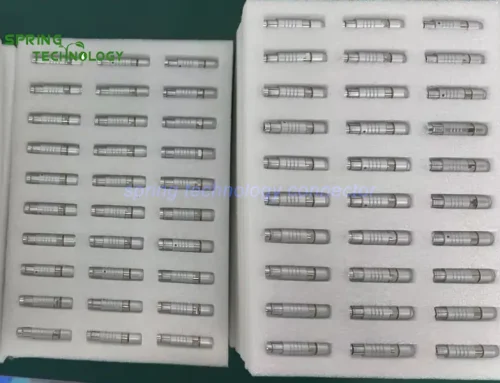


CBTF1SA-TMS275-D27B Push-Pull Connector for Portable SDI Waveform Monitors 2026: 75-Ohm 1S Coaxial Cable Plug
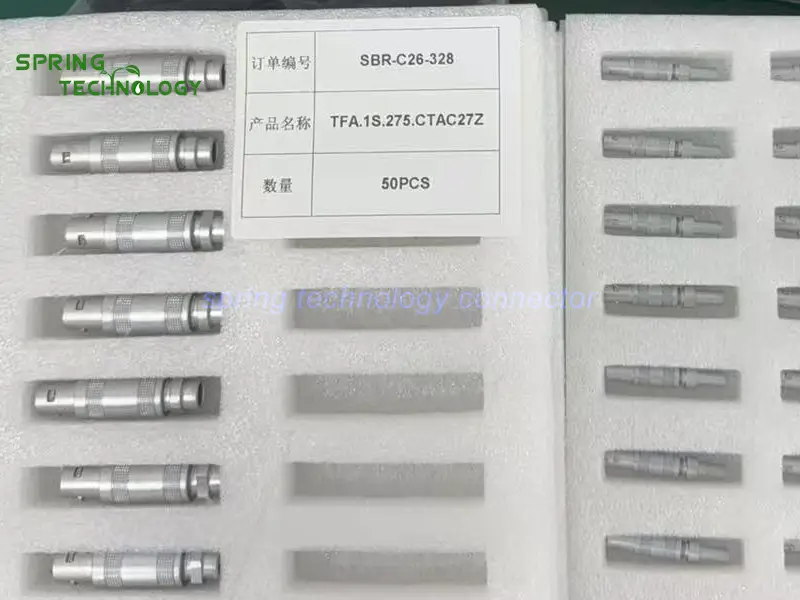
The CBTF1SA-TMS275-D27B push-pull connector is a single-contact 75-ohm coaxial cable plug from the 1S series: one TMS275 coaxial contact with solder termination, PTFE insulation, a chrome-plated brass shell, push-pull self-latching coupling, key A, IP50 protection and 5,000 mating cycles — sized for the detachable video input of a portable SDI waveform monitor.
A portable waveform monitor is a diagnostic instrument: it is carried to a rack, a camera position or an outside-broadcast vehicle, plugged into a suspect signal path, read, and unplugged again. The panel connector therefore sees far more insertions than the equipment it tests, and every one of them happens with a cable in the operator’s hand rather than with the enclosure on a bench.
Core answer: CBTF1SA-TMS275-D27B turns that video input into a defined panel interface — a 75-ohm coaxial contact that keeps the transmission line continuous through the connector, a push-pull latch that seats with a push and releases with a pull, and a bend-relief option that takes the load off the solder joint when the cable is pulled out of the case. The monitor’s internal 75-ohm video path is terminated once at the panel; the external cable is the field-replaceable part.
1. Technical Parameters & Engineering Standards
Every electrical value below for the CBTF1SA-TMS275-D27B push-pull connector is taken from the 275 coaxial contact row of the published 1S series P/N table, plus the 1S platform documentation. Items that depend on the exact order configuration are marked as such.
- Latching Mechanism: push-pull self-latching — the plug seats with an axial push and releases by pulling the outer sleeve, with a keyed shell (key A) so a neighbouring coaxial interface on the same panel cannot be cross-mated.
- Matching Hardware: the ZRA.1S fixed unipole coaxial socket on the instrument panel and a 1S coaxial cable plug on the video lead, both from the Spring Technology 1S range.
- Key Metric: one 75-ohm coaxial contact, 1.3 mm contact size, AWG 20 conductor capacity, 2,400 V test voltage, 10 A rated current, ≤5.0 mΩ contact resistance, IP50 and 5,000 mating cycles.
1.1 Configuration Summary
| Parameter | Value / Status |
|---|---|
| Part number | CBTF1SA-TMS275-D27B |
| Manufacturer | Spring Technology |
| Series | 1S (unipole coaxial) |
| Connector type | Straight cable plug (TF body style) |
| Coaxial contacts | 1 |
| Impedance | 75 Ω nominal |
| Contact size | 1.3 mm |
| Contact termination | Solder |
| Conductor size | AWG 20 |
| Insulator | PTFE |
| Rated current | 10 A |
| Test voltage | 2,400 V |
| Contact resistance | ≤5.0 mΩ |
| Locking system | Push-pull self-latching, key A |
| Housing material | Chrome-plated brass |
| Ingress protection | IP50 |
| Mating cycles | 5,000 |
| Mating receptacle | ZRA.1S.275.CTL (listed on the 1S socket page as ERA.1S.275.CTL) |
Note: the collet code in the part number sets the accepted cable outer diameter, and the trailing B denotes the reference supplied with a nut for fitting a bend-relief accessory. Confirm both against the drawing before the cable assembly is built; the solder cup, the cable clamp and the bend relief are dimensioned as one stack.
1.2 Shared 1S Coaxial Platform Specifications
| Parameter | 1S platform value |
|---|---|
| Insulation resistance / dielectric | PTFE (polytetrafluoroethylene) — low loss, stable dielectric constant |
| Mating cycles | >5,000 |
| Humidity | up to 95% at 60 °C |
| Temperature range | -45 °C ~ +125 °C |
| Vibration | 10–2,000 Hz, 15 g |
| Shock | 100 g, 6 ms |
| Salt spray | >48 h |
| Protection index (mated) | IP50 (standard 1S column) |
| Screening | 360° shell screening |
Note: the platform values above describe the 1S shell family. The connector is a passive 75-ohm interface — the usable bandwidth of an installation is set by the cable, the termination and the panel launch together, not by the connector alone.
2. Why the CBTF1SA-TMS275-D27B Push-Pull Connector Suits a Waveform Monitor
Professional SDI systems are specified around 75-ohm coaxial transmission. The instrument end of that system is where the connector lives, and it is the point that gets cycled most often.
2.1 The Signal Path Through the Connector
A typical portable waveform-monitor input runs: SDI source (camera, router output or signal generator) → 75-ohm coaxial cable → CBTF1SA-TMS275-D27B cable plug → ZRA.1S.275.CTL panel socket → the monitor’s internal 75-ohm video front end. The center conductor carries the signal; the shell and the coaxial contact body provide the return path and the shielding.
Every element in that chain is 75 ohm, and the connector is the one element that can be changed in the field. That is why it is worth treating as a component in its own right rather than as a cable accessory.
2.2 Impedance Continuity and Reflections
In the CBTF1SA-TMS275-D27B push-pull connector, the 75-ohm contact is what keeps the mating plane from becoming a discontinuity: a connector that presents a different impedance there creates a reflection. In a monitoring instrument the consequence is visible: level readings drift, eye patterns close, and the operator has trouble telling a genuine cable fault from an artefact of the test setup.
The 275 coaxial contact is the 75-ohm member of the 1S contact family, dimensioned so the transition through the connector stays close to the line impedance. It does not make the system 75 ohm on its own — the cable and the panel launch must match — but it keeps the connector from being the weakest link.
2.3 Shielding Integrity
The CBTF1SA-TMS275-D27B push-pull connector screens the video path 360° around the shell, and that matters because a waveform monitor is measuring a few hundred millivolts of signal in an environment full of video routers, wireless transmitters and switching supplies. The published shielding performance of the connector is at least 75 dB at 10 MHz and 40 dB at 1 GHz, with a 360° shell-to-shell contact.
The chassis side matters as much as the connector: a coaxial socket only screens as well as its panel bond. If the socket is mounted without a clean metal-to-metal contact to the chassis, the shielding figure in the catalogue is not what the installation delivers.
2.4 Push-Pull Latching for Field Work
The CBTF1SA-TMS275-D27B push-pull connector uses a push-pull latch rather than a threaded coupling. Threaded couplings are slow with gloves on and awkward when the monitor is wedged between racks. A push-pull latch seats with a straight push and releases with a pull on the outer sleeve — no rotation, no torque transmitted into the panel, and no risk of a partially engaged coupling reading as a connection.
The audible and tactile click is also a diagnostic aid: the operator knows the connector is home without looking at it.
2.5 PTFE Insulation
The CBTF1SA-TMS275-D27B push-pull connector uses a PTFE-insulated 1S coaxial contact. Compared with common thermoplastics it has a lower and more stable dielectric constant, low loss, and it does not soften at the temperatures a soldering iron or a hot rack produces. For a passive video interface the practical benefit is a transmission line that behaves predictably and does not drift as the instrument warms up.
2.6 Cable Protection and Bend Relief
On the CBTF1SA-TMS275-D27B push-pull connector, the trailing B denotes the reference supplied with a nut for fitting a bend-relief accessory. On a portable instrument this is the difference between a cable that fails at the solder joint and one that survives: the bend relief takes the bending load and keeps the minimum bend radius away from the termination.
The collet in the part number sets the accepted cable outer diameter, and the relief, the collet and the solder cup are dimensioned as one stack — order them together rather than mixing collet codes across batches.
2.7 Designed for Repeated Connection Cycles
The CBTF1SA-TMS275-D27B push-pull connector inherits the 1S platform rating of 5,000 mating cycles. On a handheld instrument that figure is consumed faster than it looks: an outside-broadcast day can involve dozens of insertions per monitor, and a rental fleet multiplies that across units. A connector with a defined cycle life is what makes a service interval predictable.
3. Matching the CBTF1SA-TMS275-D27B Push-Pull Connector to the Panel
The mating part named in the documentation is the ZRA.1S.275.CTL fixed unipole coaxial socket — the 275 contact, 75-ohm member of the same 1S family. Using a 50-ohm socket on the same panel is the most common way to lose the impedance discipline: the two are mechanically similar and electrically not interchangeable.
- Panel preparation: a metal-to-metal seat for the socket body, with the panel finish removed where the screen contact lands.
- Cable assembly: a 75-ohm cable of the same nominal impedance, terminated with the correct solder procedure and a consistent shield bond.
- Strain relief: a bend relief fitted so that the cable leaves the plug along its axis, never at the case edge.
- Verification: a return-loss or time-domain check on the assembled lead is worth more than any single component specification.
4. Where the CBTF1SA-TMS275-D27B Push-Pull Connector Fits
The CBTF1SA-TMS275-D27B push-pull connector is aimed at the detachable video input of portable test and measurement hardware: waveform monitors, rasterizers, portable scopes with SDI input options, and the monitor inputs built into outside-broadcast and studio maintenance carts. The same interface appears wherever a 75-ohm signal has to cross an enclosure wall and be unplugged again in the field.
Because the contact is a soldered coaxial termination rather than a press-fit, the assembly is done once, correctly, by someone with the right tools — which is the correct division of labour for an instrument that will then be cycled thousands of times.
5. Frequently Asked Questions (FAQ)
Conclusion & Call to Action
The CBTF1SA-TMS275-D27B push-pull connector gives a portable SDI waveform monitor a detachable 75-ohm video input that can be cycled thousands of times: one TMS275 coaxial contact, PTFE insulation, solder termination, push-pull latching, key A, IP50 and 5,000 mating cycles, with a bend-relief option to protect the termination.
For more information about our 1S coaxial connectors or to discuss your requirements, contact us at [email protected] or [email protected], or visit our website.
Building a broadcast test instrument with a coaxial video input? Send us your impedance, cable type, panel constraints and expected mating cycles — our engineering team will respond with a tailored 1S connector and cable assembly proposal within 24 hours.
Further Reading
- CBTF1SA-TMS405-D320 and CBZR1SA-TFS405-0000 High-Voltage Connectors for Dielectric Withstand Test 2026: 1S Coaxial Interface
- CBZR00SA-TFS250-0000 00S Series Coaxial Receptacle for Nuclear Medicine Imaging 2026
- HDMI Cable Custom Assembly for Broadcast Video Interfaces 2026: X Series High-Speed Contacts
- DisplayPort Cable Custom Assembly for Video Monitoring Systems 2026: 4XN High-Speed Connectors
- High-Speed Connectors for Offshore Drilling Rig Video Monitoring 2026: HBTX4XN-KMSH38-M100
- TFA.1S Straight Unipole Coaxial Plug — 1S Series Product Page
- ZRA.1S Fixed Unipole Coaxial Socket — Matching 1S Panel Receptacle
- Custom Push-Pull Connector Engineering — Spring Technology