

Automotive Connectors Complete Guide 2026: Types, Applications, Design Standards & Industry Trends
Meta Description: Comprehensive guide to automotive connectors in 2026. Learn about connector types, design standards, temperature resistance requirements, applications in EVs and autonomous vehicles, and industry trends shaping the future of car connectivity.
Keywords: automotive connectors, car connectors, vehicle electrical connectors, EV connectors, automotive wiring harness, connector design standards, temperature resistant connectors, automotive electronics
Introduction: The Critical Role of Automotive Connectors in Modern Vehicles
What is a car connector? Far beyond racing associations, automotive connectors represent the backbone of electronic engineering technology in the automotive field. These essential components achieve connectivity between different circuits or isolated circuits – a fundamental requirement for modern vehicle operation.
With the global automotive connector market projected to reach $22.8 billion by 2027, growing at a CAGR of 7.2%, these components have become increasingly critical as vehicles evolve toward electrification and autonomy. From powertrain systems to infotainment, automotive connectors ensure reliable electrical connections in some of the harshest operating environments imaginable.

Core Components of Automotive Connectors
Four Essential Parts
Although vehicle designs vary significantly, automotive connector functions and main accessories remain fundamentally consistent. The core structure includes:
- Contact Connector (Housing): The protective shell that houses and secures all internal components, typically made from high-temperature resistant plastics or metals
- Positive and Negative Contactors: The core conductive elements that generate and transmit electrical signals, usually copper alloy with precious metal plating
- Insulators: Critical safety components that prevent short circuits and maintain proper contact spacing, made from dielectric materials
- Accessories and Fixing Elements: Mounting brackets, locks, seals, and other hardware that ensure secure installation and environmental protection
Material Selection Criteria
Material selection for automotive connectors must satisfy two critical conditions:
- Withstand high temperatures during assembly (reflow soldering) without blistering or deformation
- Maintain performance under real-world operating temperatures ranging from -40°C to +200°C
Design Standards and Safety Requirements
Electrical Performance Standards
Automotive connector design must prioritize vehicle safety through rigorous electrical standards:
- Voltage Rating: Typically 12V, 24V, or 48V for conventional vehicles; up to 800V for EV high-voltage systems
- Current Capacity: From signal-level mA to power distribution at 300A+
- Contact Resistance: Must remain below 10mΩ to minimize voltage drop and heat generation
- Dielectric Strength: Withstand 1000V AC for 1 minute without breakdown
Environmental Durability Requirements
Connectors must adapt to extreme automotive conditions:
- Vibration Resistance: Meet ISO 16750-3 for random vibration (10-2000 Hz, 3 axes)
- Temperature Cycling: -40°C to +125°C (engine bay: up to +200°C)
- IP Rating: IP67/IP68/IP6K9K for water and dust protection
- Chemical Resistance: Withstand exposure to oils, fuels, brake fluids, and road salts
Mechanical Stability
Secure fixation is critical for reliable operation:
- Positive locking mechanisms prevent accidental disconnection
- CPA (Connector Position Assurance) and TPA (Terminal Position Assurance) features
- Proper strain relief for cable entries
- Mounting support to handle automotive vibration and shock loads
Temperature Resistance: A Critical Challenge
Why Standard Materials Fail
Automotive connectors cannot use basic raw materials due to extreme thermal demands. When exposed to high temperatures (such as reflow ovens during assembly), moisture within components rapidly converts to steam, causing blistering that compromises mechanical properties and assembly integrity.
Industry Standards: JEDEC MSL 1
The automotive industry demands connectors meet JEDEC Moisture Sensitivity Level 1 (MSL 1) – the highest rating for moisture resistance. While some thermoplastics meet MSL 1 requirements, material brittleness, weak weld lines, or low heat resistance often force design compromises.
High-Temperature Performance
Real-world automotive applications can reach 200°C in engine compartments. Traditional materials using iodide salts as thermal stabilizers may cause metal contact corrosion. Alternative stabilizer-free formulations sacrifice thermal stability.
Spring Technology Solution
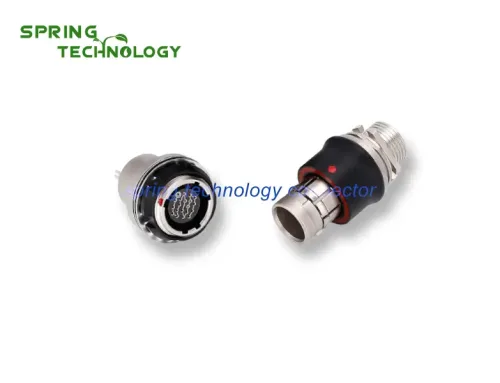
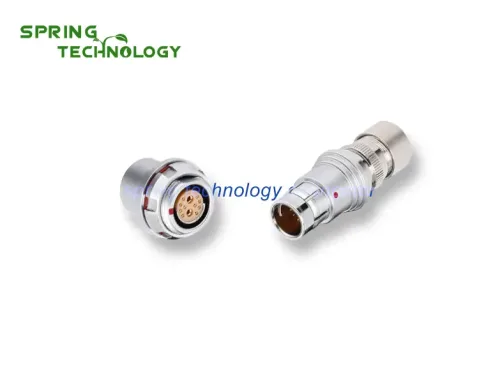
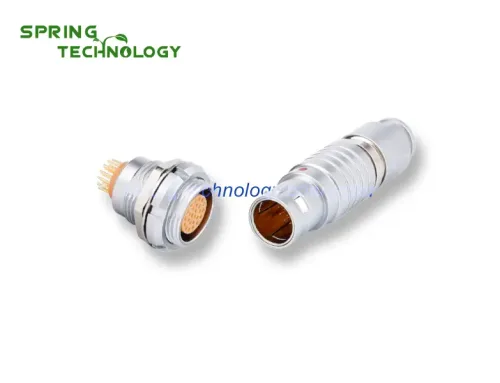
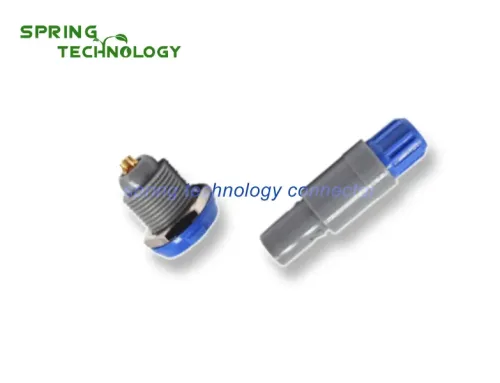
SPRING TECHNOLOGY metal circular push-pull self-locking connectors feature:
- Chrome-plated or nickel-plated metal shells
- Copper-alloy contacts with appropriate plating
- Temperature range: -40°C to +200°C
- Minimal signal transmission loss – ideal for automotive testing equipment and harsh environments
Applications Across Vehicle Systems
Powertrain and Engine Management
- Engine control units (ECU)
- Fuel injection systems
- Ignition systems
- Sensors (oxygen, temperature, pressure, position)
- Alternator and starter motor connections
Electric and Hybrid Vehicles (EV/HEV)
- High-voltage battery connections (400V-800V systems)
- Inverter and motor controller interfaces
- On-board charger (OBC) connections
- DC-DC converter links
- Charging port interfaces (CCS, CHAdeMO, GB/T)
Chassis and Safety Systems
- ABS and ESC modules
- Airbag systems (requiring ultra-reliable connections)
- Electric power steering
- Brake-by-wire systems
Body Electronics and Infotainment
- Lighting systems (LED, matrix headlights)
- Window and door controls
- HVAC systems
- Infotainment displays and audio
- Advanced driver assistance systems (ADAS)
- Autonomous driving sensors (LiDAR, radar, cameras)
Industry Trends 2026 and Beyond
Electrification Driving Innovation
The shift to electric vehicles demands high-voltage connectors capable of handling 800V architectures and 350kW+ fast charging. Orange-colored HV connectors with enhanced safety features are becoming standard.
Miniaturization and High Density
As vehicles pack more electronics into limited space, connectors trend toward:
- Smaller pitch sizes (down to 0.5mm)
- Higher contact density (100+ positions)
- Modular designs for flexible configuration
Autonomous Vehicle Requirements
Self-driving technology requires ultra-reliable connectors for:
- High-speed data transmission (10+ Gbps for camera/sensor data)
- EMI/RFI shielding for sensitive electronics
- Redundant connections for safety-critical systems
Sustainability and Circular Economy
Environmental regulations drive:
- Halogen-free, flame-retardant materials
- Recyclable connector designs
- Reduced use of precious metals
- Longer service life to minimize waste
Smart Connectivity
IoT integration enables:
- Connectors with built-in sensors for temperature/current monitoring
- Predictive maintenance capabilities
- Vehicle-to-everything (V2X) communication interfaces
Common Failure Modes and Prevention
Poor Contact
Causes: Unreasonable contact design, wrong material selection, substandard dimensions, improper plating
Prevention: Use gold or silver plating for critical signals, ensure proper contact force, implement regular inspection protocols
Poor Fixation
Causes: Improper installation, excessive plug/unplug cycles, material fatigue, design flaws
Prevention: Use CPA/TPA features, follow torque specifications, implement proper strain relief, choose appropriate locking mechanisms
Poor Insulation
Causes: Metal excess on insulator surface, contamination (dust, flux, moisture), material aging, mold growth
Prevention: Maintain clean assembly environment, use conformal coatings, select appropriate insulating materials, implement regular dielectric testing
Environmental Degradation
Causes: Corrosion from salt/chemicals, UV degradation, thermal cycling fatigue
Prevention: Specify appropriate IP ratings, use corrosion-resistant materials, implement protective boots and seals
Conclusion: Ensuring Reliable Automotive Connectivity
Automotive connectors are far more than simple electrical interfaces – they are mission-critical components that ensure vehicle safety, performance, and reliability. As the automotive industry accelerates toward electrification, autonomy, and connectivity, connector technology continues to evolve to meet increasingly demanding requirements.
From temperature resistance and vibration tolerance to high-speed data transmission and high-voltage safety, modern automotive connectors must excel across multiple performance dimensions. Understanding these requirements is essential for engineers, procurement specialists, and anyone involved in automotive electronics.
Whether you’re designing the next generation of electric vehicles or maintaining existing fleets, choosing the right automotive connectors – and understanding their limitations – is fundamental to success in today’s automotive landscape.
FAQ: Frequently Asked Questions
Q1: What is the typical lifespan of an automotive connector?
Quality automotive connectors are designed for 15+ years of service life, matching vehicle lifespan. This includes 50-100 mating cycles for service connectors and 500+ cycles for test/access connectors.
Q2: Why are automotive connectors more expensive than consumer connectors?
Automotive connectors must meet stringent standards (USCAR, LV214, ISO) for vibration, temperature, and corrosion resistance. Additional costs come from precious metal plating, complex locking mechanisms, and extensive validation testing.
Q3: What’s the difference between 12V and high-voltage automotive connectors?
HV connectors (for EVs) require enhanced safety features: orange color coding, finger-safe designs, higher creepage/clearance distances, interlock circuits (HVIL), and superior insulation for 400V-800V systems.
Q4: Can automotive connectors be repaired or must they be replaced?
Most automotive connectors are designed as sealed units and should be replaced if damaged. However, some commercial/industrial connectors allow individual contact replacement. Always follow OEM guidelines.
Q5: What certifications should I look for in automotive connectors?
Key certifications include: IATF 16949 (automotive quality management), USCAR-2 (performance specification), LV214 (European OEM standard), ISO 26262 (functional safety for ASIL-rated applications), and UL recognition for specific applications.
Xi’an Spring Technology Co., Ltd. is a professional push-pull connector manufacturer integrating connector R&D, production, and sales. We specialize in high-reliability connectors for automotive, medical, industrial, and broadcast applications.
Contact us for more information and best pricing:
Email: [email protected] | [email protected]
Website: https://www.spring-connectors.com/