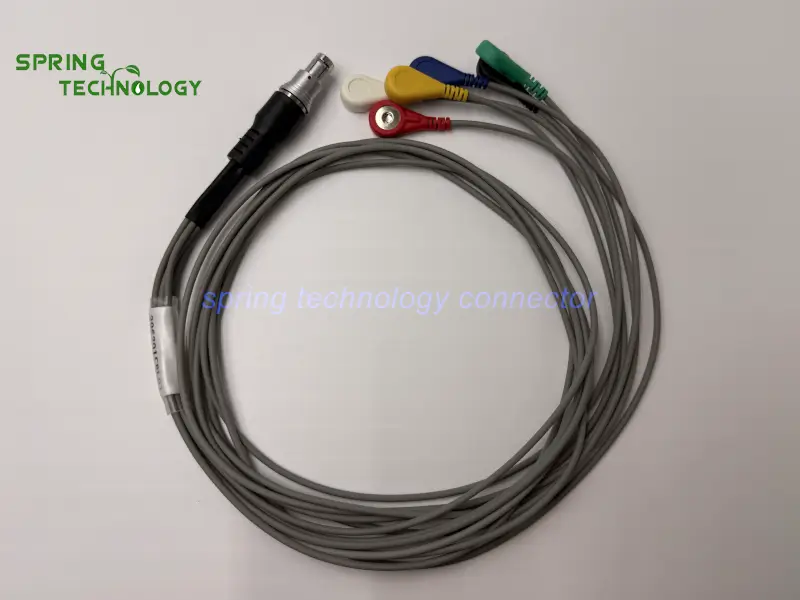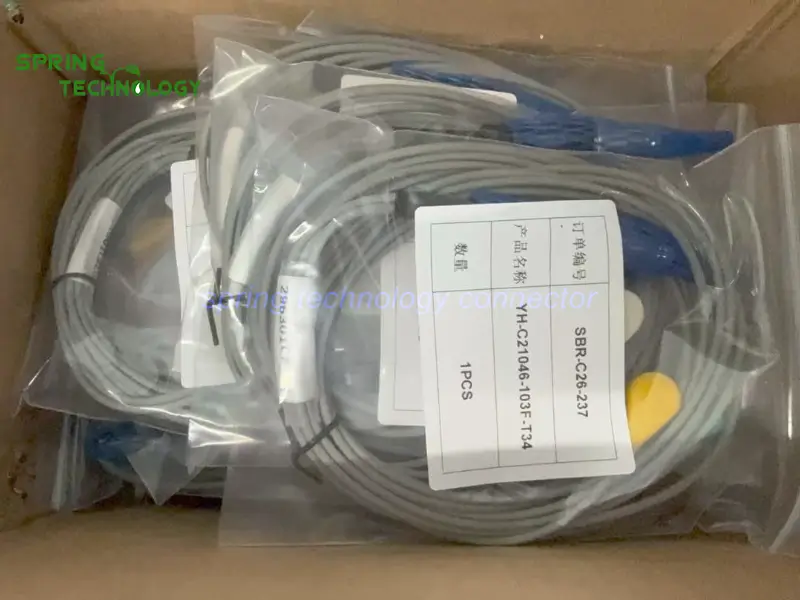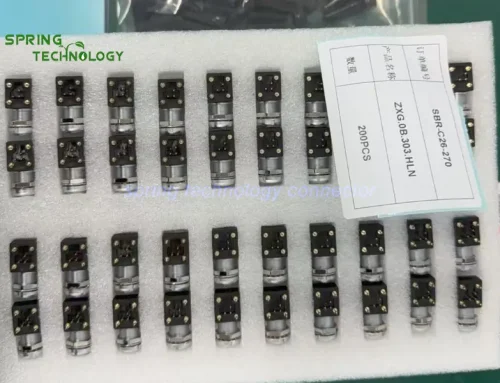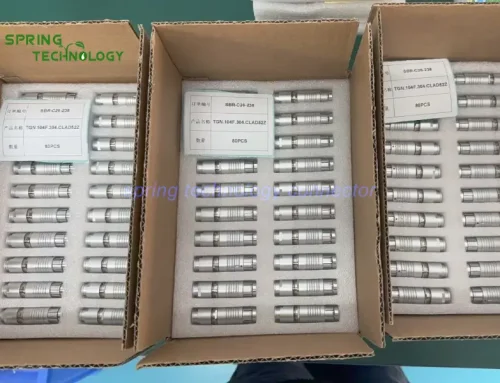


Custom Multi-Lead Physiological Signal Cable with CBTL3FN-SMSM10-D720 10-Pin Connector and Six Electrode Connectors for Multi-Lead ECG Signal Acquisition Systems
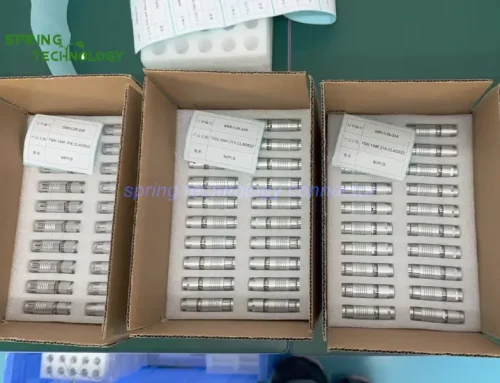
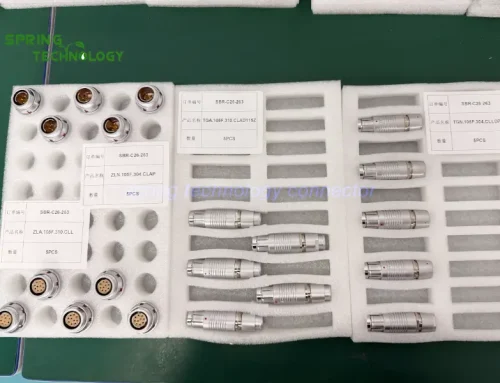
Spring Technology builds a custom multi-lead physiological signal cable that runs from a CBTL3FN-SMSM10-D720 10-pin connector at one end to six electrode connectors at the other — a 103F platform plug with ten contacts, gold-plated brass contacts, push-pull locking, solder termination, IP68 protection (mated), operation from -55 °C to +145 °C, more than 3,000 mating cycles and a cable opening range of 2.2–7.5 mm. Every specification in this guide is backed by the custom cable assembly engineering of Spring Technology for multi-lead ECG signal acquisition systems that record cardiac electrical activity through several electrodes.
Pain point: Getting six electrode leads from the patient to the acquisition unit — where multiple body-surface electrodes record cardiac electrical activity, six electrode connectors branch from a single 10-contact cable interface, reference, ground and shield circuits also draw on the same contact budget, cables are detached and cleaned between sessions, and low-amplitude cardiac signals demand a documented, validated wiring scheme?
Core answer: Spring Technology supplies a CBTL3FN custom cable for ECG signal acquisition systems: a custom multi-lead physiological signal cable featuring the CBTL3FN-SMSM10-D720 10-pin connector at one end and six electrode connectors at the other, offering consolidated signal connections, convenient disconnection and flexible cable assembly design. ECG signal acquisition systems record the electrical activity of the heart from multiple electrodes placed on the body surface, and are used in clinical assessment, cardiac monitoring, exercise and rhythm studies, and laboratory investigations of cardiac electrical activity. A multi-lead physiological signal cable connects an electrode assembly or compatible sensor interface to the signal acquisition equipment: the connector provides the physical interface, while the custom cable carries the assigned electrical signals between compatible components — with the exact wiring arrangement depending on the ECG system architecture, electrode placement, and acquisition equipment requirements.
1. Technical Parameters & Engineering Standards
This ECG cable connector is built on the TLN 103F platform, a mid-size push-pull circular connector family for professional signal equipment.
- Latching Mechanism: Push-pull locking (quick mating and unmating without a threaded coupling operation)
- Recommended Hardware: Spring Technology Circular Connector and custom cable assembly service
- Key Metric: 10 contacts; gold-plated contacts; IP68 (mated); -55 °C ~ +145 °C; >3,000 mating cycles
| Parameter | Value |
|---|---|
| Plug (this assembly) | CBTL3FN-SMSM10-D720 — TLN 103F straight plug, 10 contacts |
| Contacts | 10 contacts, 2–16 pin range across the 103F shell |
| Patient-end termination | 6 electrode connectors |
| Contact material / finish | Brass with gold-plated mating surface |
| Termination | Solder |
| Fastening type | Push-pull |
| Protection | IP68 (mated) |
| Operating temperature | -55 °C ~ +145 °C (103F platform) |
| Vibration resistance | 10–20000 Hz, 147 m/s², ≤1 µm instantaneous break |
| Mating cycles | >3,000 cycles |
| Cable opening | 2.2–7.5 mm (103F platform) |
| Orientation / keying | Position N (with A, B variants) |
| Housing | Chrome-plated shell, silver or black, with PPS insulator |
Note: ten contacts do not automatically equal ten independent ECG leads, because reference, ground, shielding and other circuit requirements may also use contacts. The exact full part number matters because different variants may have different specifications, and the 103F and 1031F size families have different published contact-count ranges.
2. Custom Physiological Signal Cable Design Highlights
Cardiac recording cables are handled often and serviced between sessions. The design advantages below explain why this CBTL3FN custom cable for ECG signal acquisition systems suits multi-electrode cardiac interfaces:
2.1 Multiple Connections Through One Connector Interface
- Multi-electrode cardiac signal systems may require several electrode-related signal paths and auxiliary connections. A 10-contact configuration brings multiple assigned circuits together through a single detachable interface, while the patient end terminates in six electrode connectors. Compared with running six separate cables into the acquisition unit, a suitably designed multi-contact cable assembly simplifies equipment connections and reduces interface complexity. The actual number of usable signal leads depends on the system’s wiring scheme and on how reference, ground and shielding circuits are allocated.
2.2 Push-Pull Locking for Convenient Connection and Disconnection
- These connectors are available with push-pull locking designed to support quick mating and unmating. When the selected variant uses this mechanism and is paired with a compatible receptacle, users can connect or disconnect the cable without a threaded coupling operation — helpful during equipment setup, electrode cable replacement and routine maintenance. A secure, correctly mated connector also helps reduce accidental disconnection during normal handling.
2.3 Custom Cable Lengths for Different Equipment Layouts
- Cardiac signal acquisition equipment may be configured for bedside monitoring, exercise testing, ambulatory recording or laboratory experiments, and the required distance between the six electrode connectors and the acquisition unit can vary. A custom cable assembly allows the cable length, conductor arrangement, outer jacket, connector orientation and strain relief to be specified for the intended setup. Selecting an appropriate length reduces excess cable around the patient and keeps connections organised — while cable routing should still be designed to minimise pulling forces, tangling and movement artifacts.
2.4 Organized Wiring for Easier Assembly and Maintenance
- A professionally assembled multi-lead cable can use a documented pin assignment and clearly defined conductor mapping between its two ends, making manufacturing inspection, continuity testing, troubleshooting and replacement more straightforward. If the cable needs servicing, a defined wiring specification also helps ensure the replacement assembly matches the intended system configuration. For cardiac signal equipment, every conductor should be verified against the approved wiring diagram before the cable is used.
2.5 Connector Options for Different Integration Requirements
- The connector family offers a range of contact configurations, termination methods and locking options, providing flexibility when selecting a connector for a custom cable assembly. The selected connector should be checked for the required contact count, contact polarity, termination method, cable diameter and mating receptacle — verification that is particularly important for a 10-contact assembly, since the 103F and 1031F size families have different published contact-count ranges.
2.6 Potential Benefits for Repeated Equipment Setup
- ECG and physiological signal acquisition systems may be assembled, disconnected, cleaned, transported or reconfigured regularly, and a compatible push-pull connector makes repeated connection tasks more convenient. The family includes variants designed for repeated mating cycles, but the applicable endurance rating must be confirmed for the exact selected model. Proper handling, cable strain relief and connector inspection remain important for maintaining dependable electrical connections over time.
2.7 Customization Around the Signal Acquisition Requirements
- The connector is only one part of the complete cable assembly. Other design factors include conductor shielding, cable flexibility, insulation, connector backshell, strain relief and the electrical characteristics of the signals being carried — all of which a custom cable manufacturer can specify according to the target ECG acquisition system. For low-amplitude cardiac signals, the cable design should be validated for noise, shielding, grounding, movement artifacts and signal integrity. The use of a connector alone does not guarantee measurement accuracy or medical-device compliance.
3. Why Choose a Custom Cable Assembly with the CBTL3FN Connector?
A custom multi-lead physiological signal cable helps equipment manufacturers match the physical and electrical interface to their specific acquisition system — exactly the goal of this CBTL3FN custom cable for ECG signal acquisition systems. Using a compatible CBTL3FN-SMSM10-D720 connector at one end may offer:
- Six electrode connectors at the patient end, matched to your electrode type
- A detachable interface for multiple assigned circuits
- Convenient connection and disconnection with the appropriate locking variant
- Flexible cable length and assembly configuration
- Documented conductor mapping for inspection and servicing
- Gold-plated contacts for stable low-level signal transmission
- IP68 protection (mated) with a -55 °C ~ +145 °C operating range
- A connector choice that can be matched to the system’s mechanical and electrical requirements
Before production, confirm the exact connector part number, the mating receptacle, contact assignments, cable specifications and required electrical tests. If the cable is intended for a medical device, the complete assembly must also be assessed against the applicable safety, biocompatibility, cleaning and regulatory requirements.
4. 103F Series Connector Family Overview
The 103F shell belongs to Spring Technology’s push-pull connector family for professional signal equipment, and the same platform serves this CBTL3FN custom cable for ECG signal acquisition systems while scaling across pin counts and body styles.
4.1 Available Configurations
- Plugs: TLN 103F straight plugs including the 10-contact layout used in this assembly.
- Receptacles: cable-mount and panel receptacles, plus hermetic socket versions.
- Pin counts: 2–16 contacts across the 103F shell.
- Keying: orientation positions N (A, B) to prevent mismating across instrument variants.
4.2 Customization Services
- Custom contact allocations and part numbers (such as the CBTL3FN-SMSM10-D720) matched to each system’s wiring diagram.
- Custom cable lengths, jackets, shielding and strain relief built to the acquisition system’s layout.
- Low-noise assembly design with documented conductor mapping and continuity testing.
- Mating receptacle selection support, including keying and contact-layout confirmation.
5. Applications: Cardiac Electrical Activity Signal Acquisition
These are potential applications for this CBTL3FN custom cable for ECG signal acquisition systems, based on the cable’s intended function — not verified installations in specific manufacturers’ products:
5.1 Multi-Lead ECG Acquisition Systems
Multi-lead ECG signal acquisition systems and detachable cables with six electrode connectors that record cardiac electrical activity from several body-surface electrodes.
5.2 Clinical Monitoring and Rhythm Studies
Clinical cardiac monitoring instrumentation, exercise and rhythm study recording equipment.
5.3 Laboratory Cardiac Signal Systems
Physiological signal acquisition laboratory systems and compatible cardiac monitoring equipment interfaces.
6. Frequently Asked Questions (FAQ)
Conclusion & Call to Action
This custom cable assembly shows how Spring Technology serves cardiac and physiological signal equipment — from the ten gold-plated contacts and push-pull locking of the CBTL3FN-SMSM10-D720 to the documented conductor mapping and flexible length options around it, every detail was aligned with the customer’s multi-lead ECG acquisition requirements. Spring Technology also provides professional customization services for both push-pull connectors and cable assemblies, offering tailored solutions to meet your specific technical requirements.
For more information about our 103F series connectors or to discuss your requirements, contact us at [email protected] or [email protected], or visit our website.
Building a multi-lead physiological signal cable or multi-electrode cardiac interface? Send us your wiring scheme, electrode-connector type and layout requirements — our engineering team will respond with a proposal for a tailored CBTL3FN custom cable with six electrode connectors for your ECG signal acquisition systems within 24 hours.
Further Reading
- CBZL3FN Push-Pull Connector for Industrial Control Modules 2026: ZL 3F and 5F Receptacles for Compact and High-Power Automation Modules for Russian Clients
- CBTG3FN Push-Pull Connector for Medical Endoscopes 2026: CBTG3FN-SMSM12-D720 and CBZL3FN-SFPM12-S000 for 4K/8K Endoscope Cable Assemblies for Russian Client
- BPPA1PG Push-Pull Connector for Patient Monitors 2026: P Series Plastic Connector for Medical Electronics and Clinical Surgical Instruments for US Client
- CBTG31FN Push-Pull Connector for Minimally Invasive Surgery 2026: 31F Series Receptacle for Surgical Handpieces, Consoles and Foot Pedals for Austrian Client
- CBTY31FN Push-Pull Connector for Surgical Robots 2026: Custom Cable YH-C21046-1031F-35 with CBTY31FN-KMSM12-D72B and CBUP2UR-KMSM09-D72B for USA Client
- TLN.103F Straight Plug — Product Page
- Custom Cable Assembly — Service Page
- 103F Series Connector