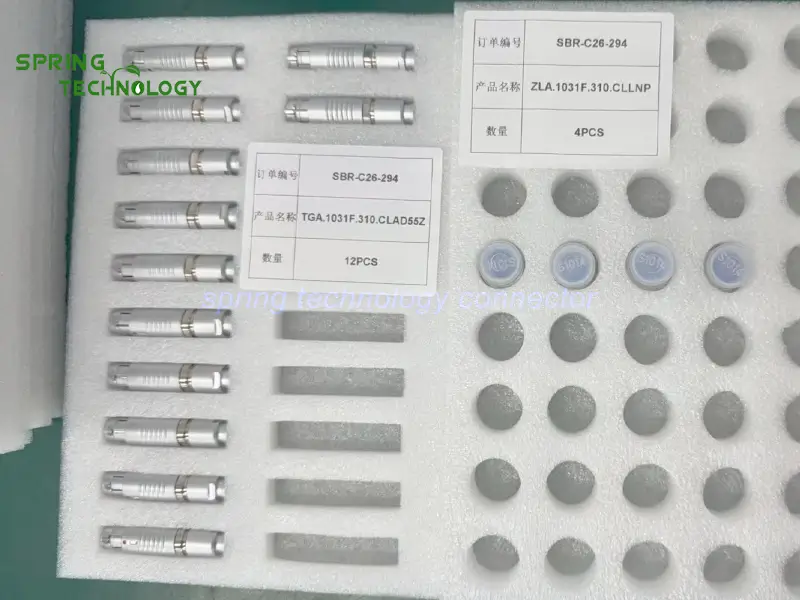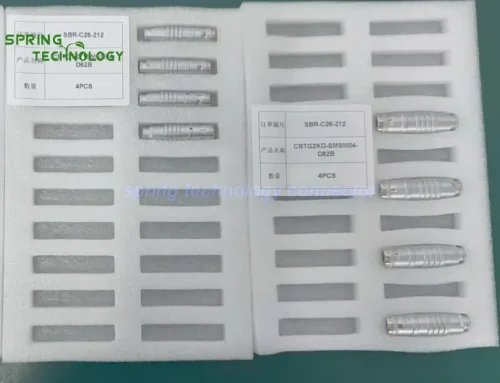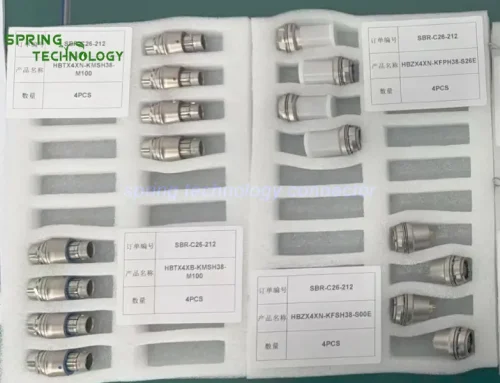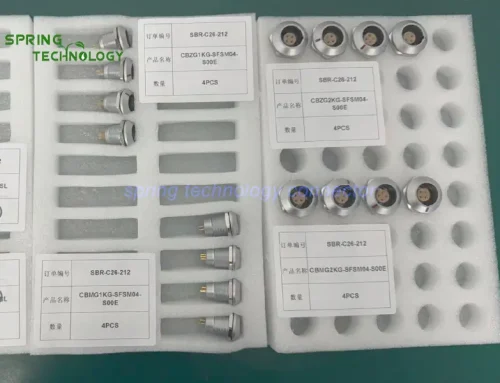


Connectors for Eddy Current Conductivity Meters 2026: CBTG31FA-SMSM10-D52B Plug and CBZL31FA-SFSM10-S000 Receptacle
Spring Technology supplies connectors for eddy current conductivity meters — the CBTG31FA-SMSM10-D52B cable-mounted plug with ten contacts and the CBZL31FA-SFSM10-S000 panel-mounted hermetic receptacle — both on the 1031F platform with IP68 protection when mated, solder termination, push-pull fastening, operation from -55 °C to +145 °C, vibration resistance of 10–20,000 Hz at 147 m/s² with ≤1 µm instantaneous break, more than 3,000 mating cycles, key N keying and a 4.5–8.8 mm cable opening range on the plug. Every specification in this guide is backed by the non-destructive testing equipment interconnect engineering of Spring Technology.
Pain point: Keeping a probe signal chain stable in a handheld conductivity meter — where the probe is swapped between alloy sorting jobs, the contact budget has to cover measurement signals plus identification and auxiliary lines, and no sealing rating can be assumed without checking the exact part?
Core answer: Spring Technology offers these connectors for applications requiring a compact, multi-contact connection between a detachable cable and an instrument enclosure, supporting reliable probe connections in portable eddy current conductivity meters for metal alloy testing, material sorting and heat-treatment quality control. Portable eddy current conductivity meters are widely used in metalworking, aerospace material inspection, aluminum alloy sorting and heat-treatment quality control, measuring the electrical conductivity of conductive materials to help operators identify material variations, evaluate processing consistency and support non-destructive inspection workflows. Reliable electrical connections between the instrument, measurement probe and external cable assembly are essential for stable measurement operations — and this plug-and-receptacle pairing combines a cable-mounted plug with a panel-mounted receptacle to serve that role, subject to confirmation of the complete part numbers and mating compatibility.
1. Technical Parameters & Engineering Standards
Both parts are built on the 1031F platform, a sealed multi-contact circular connector family for inspection instruments.
- Latching Mechanism: Push-pull fastening (a compatible plug connects and releases without a threaded-coupling operation)
- Recommended Hardware: Spring Technology Circular Connector and custom cable assembly service
- Key Metric: 10 contacts in this configuration; IP68 (mated); -55 °C ~ +145 °C; >3,000 mating cycles
1.1 Plug and Receptacle in this Pairing
| Feature | CBTG31FA-SMSM10-D52B | CBZL31FA-SFSM10-S000 |
|---|---|---|
| Format | Cable-mounted plug | Panel-mounted hermetic receptacle |
| Contacts | 10 contacts | 10 contacts |
| Termination | Solder | Solder |
| Cable interface | Cable opening 4.5–8.8 mm (1031F plug) | Back-panel mounting with arc-shape metal guides |
| Protection (mated) | IP68 | IP68 |
| Mating cycles | >3,000 cycles | >3,000 cycles |
| Keying | Key N standard | Key N standard |
1.2 Shared 1031F Platform Specifications
| Parameter | Value |
|---|---|
| Series | 1031F platform — sealed circular connector |
| Protection | IP68 (mated) |
| Operating temperature | -55 °C ~ +145 °C |
| Vibration resistance | 10–20,000 Hz, acceleration 147 m/s², ≤1 µm instantaneous break |
| Mating cycles | >3,000 cycles |
| Termination | Solder |
| Fastening | Push-pull |
| Keying | Key N standard; alternative keys available to determine keying |
| Receptacle body | Hermetic watertight socket, back-panel mounting, arc-shape metal guides |
Note: the 1031F platform documentation lists a 12–19 pin range for these bodies, so the exact ten-contact configuration of the two part numbers above should be confirmed against the corresponding part datasheet before ordering.
2. Why Use These Connectors?
Probe cables come and go; the instrument stays in service. The design advantages below explain why these connectors for eddy current conductivity meters suit portable probe interfaces:
2.1 Multi-Contact Connectivity for Probe Interfaces
- A portable conductivity meter may need to connect measurement signals, probe identification circuits, auxiliary control lines or other low-voltage functions, depending on its internal design. A 10-pin connector configuration provides multiple contacts within one connector interface, helping equipment designers organise several electrical circuits into a single cable connection instead of using multiple individual connectors. The actual contact assignment must be designed around the instrument’s electrical architecture.
2.2 Convenient Connection Between the Probe Cable and Instrument
- The CBTG31FA-SMSM10-D52B is a cable-mounted plug style while the CBZL31FA-SFSM10-S000 is a panel-mounted receptacle style. This combination provides a practical interface between a detachable probe cable and the conductivity meter’s housing — and for inspection technicians who frequently connect and disconnect probes during material testing, a dedicated connector interface simplifies cable replacement, equipment servicing and instrument maintenance.
2.3 Support for Portable Inspection Workflows
- Portable conductivity meters are often used on production floors, in material inspection laboratories and at field inspection locations. A properly selected multi-pin connector keeps the cable interface organised and reduces the need for separate electrical connections. Connector retention, cable strain relief and suitable enclosure mounting should be considered during equipment design to help maintain connection reliability during routine handling.
2.4 Potential for More Organized Instrument Integration
- A 10-pin interface helps consolidate the electrical connection between the probe assembly and the instrument — particularly useful when the equipment includes several signal paths or auxiliary functions. The connector’s contact layout, termination method, cable diameter compatibility and electrical ratings should be checked against the requirements of the specific conductivity meter before integration.
2.5 A Configurable Connection Solution
- The 1031F series includes multiple contact configurations and connector styles, giving equipment manufacturers options when designing cable-mounted and panel-mounted interfaces for different instrument layouts. For a portable eddy current conductivity meter, this plug and receptacle may be evaluated as part of a custom cable assembly, subject to confirmation of the complete part numbers and mating compatibility.
3. Applications in Metal Inspection Equipment
The proposed connector combination may be considered for portable conductivity meters used in:
- Aluminum alloy identification: comparing conductivity readings to help distinguish material conditions or support alloy sorting procedures.
- Heat-treatment quality control: checking conductivity variations that may be associated with differences in material processing.
- Aerospace material inspection: supporting conductivity measurement workflows for conductive metal components, subject to the instrument’s approved inspection procedure.
- Metal production and incoming inspection: connecting detachable probes to portable instruments used for routine quality checks.
These are potential equipment-design applications for these connectors for eddy current conductivity meters — not a claim that this exact connector combination has been verified in a particular manufacturer’s conductivity meter.
4. 1031F Series Connector Family Overview
The 1031F platform belongs to Spring Technology’s sealed push-pull connector family for inspection and measurement equipment. The same platform serves these connectors for eddy current conductivity meters and scales across plugs, hermetic sockets and contact variants.
4.1 Available Configurations
- Plugs: TGN.1031F straight plugs, including bend-relief versions.
- Receptacles: ZLN.1031F hermetic sockets, including elbow PCB-contact variants.
- Contact counts: multiple configurations across the 1031F platform, with the exact range confirmed per body.
- Keying: key N standard, with alternative keys available to determine keying.
4.2 Customization Services
- Custom contact allocations and part numbers (such as the CBTG31FA-SMSM10-D52B and CBZL31FA-SFSM10-S000) matched to each instrument’s wiring plan.
- Cable assembly builds with defined cable opening ranges and strain relief for handheld instruments.
- Shielding and grounding support for low-level measurement signal circuits.
- Mating receptacle selection support, including keying and contact-layout confirmation.
5. Frequently Asked Questions (FAQ)
Conclusion & Call to Action
This connector pairing shows how Spring Technology serves non-destructive testing instruments — from the cable-mounted ten-contact plug to the hermetic back-panel receptacle with IP68 mated protection and 3,000+ mating cycles, every detail was aligned with the customer’s portable eddy current conductivity meter requirements. Spring Technology also provides professional customization services for both push-pull connectors and cable assemblies, offering tailored solutions to meet your specific technical requirements.
Before selecting the connectors, manufacturers should confirm the exact 10-pin part numbers, mating compatibility, contact configuration, electrical ratings, environmental protection requirements and cable specifications.
For more information about our 1031F series connectors or to discuss your requirements, contact us at [email protected] or [email protected], or visit our website. Our engineering team will respond to your connectors for eddy current conductivity meters enquiry within 24 hours.
Further Reading
- CBTG1BG Push-Pull Connector for Ultrasonic Flaw Detectors 2026: 1B Series 7-Contact 7 A Plug for Portable NDT Instrument Interfaces
- CBZE0BG Push-Pull Connector for Handheld XRF Analyzers 2026: 0B Series 4-Contact 7 A Receptacle for Compact Analytical Instruments
- BBZX0BG Push-Pull Connector for Vibration Calibrators 2026: 0B Series 3-Contact Elbow PCB Socket for Portable Calibration Instruments
- CBTG2FN Push-Pull Connector for Precision Machine Tools 2026: CBTG2FN-SMSM09-D520 and CBZL2FN-SFPM09-S000 for Multi-Channel Miniature Sensor Aggregation for Russian Client
- CBZG00BG Push-Pull Connector for Insulation Resistance Testers 2026: 00B Series 4-Contact M7 Panel Socket for Portable Test Instruments for US Client
- TGN.1031F Straight Plug — Product Page
- ZLN.1031F Hermetic Socket — Product Page
- 1031F Series Connector