

CBZE0BG Push-Pull Connector for Handheld XRF Analyzers 2026: 0B Series 4-Contact 7 A Receptacle for Compact Analytical Instruments
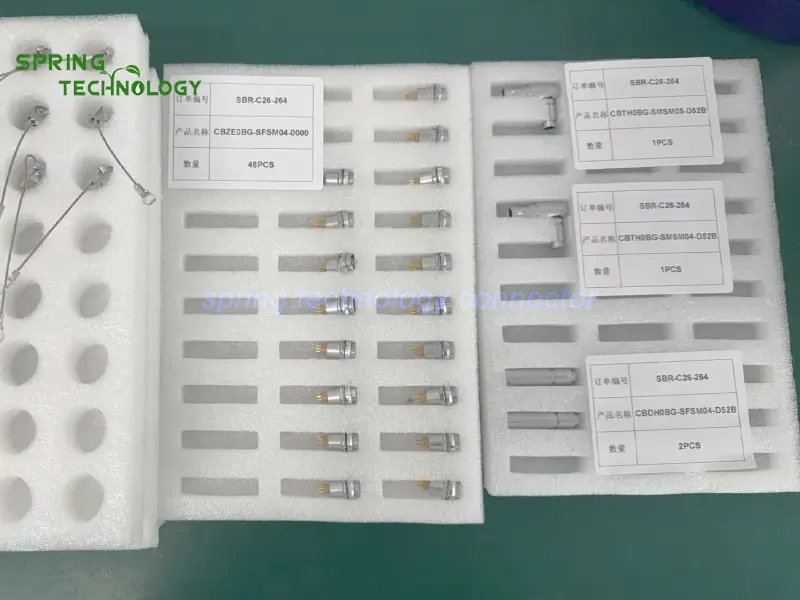
The CBZE0BG-SFSM04-0000 is a CBZE0BG push-pull connector for handheld XRF analyzers — a 4-contact low-voltage fixed receptacle in the 0B series with a rated current of up to 7 A, AWG 30–22 wiring, solder termination, a push-pull locking system, one differential pair for high-speed signals and an M9 panel drill hole. Every specification in this guide is backed by the compact analytical instrument interconnect engineering of Spring Technology.
Pain point: Fitting reliable internal module connections into an instrument that an operator holds and points all day — where internal space is measured in millimetres, and detector signals, module power and control wiring must all survive repeated handling and servicing?
Core answer: Spring Technology supplies the CBZE0BG-SFSM04-0000, a 4-contact low-voltage fixed receptacle in the 0B series, serving as a CBZE0BG push-pull connector for handheld XRF analyzers. Handheld X-ray fluorescence analyzers are compact analytical instruments used for rapid material identification and elemental analysis, integrating an X-ray source, detector, signal-processing electronics, control circuits, display, battery system and measurement module into a compact housing. Because the equipment is designed to be held and positioned by an operator, its internal connection system must remain stable despite repeated handling, movement and maintenance — so compact size, secure push-pull locking, power capacity and signal integrity all matter.
1. Technical Parameters & Engineering Standards
This analyzer connector is built on the ZEG.0B fixed socket platform, a compact circular connector family for professional instrumentation equipment.
- Latching Mechanism: Push-pull self-latching system (mating connector inserts and releases quickly without rotating a threaded coupling)
- Recommended Hardware: Spring Technology Circular Connector
- Key Metric: 4 low-voltage contacts; up to 7 A rated current; one differential pair; M9 panel mounting
| Parameter | Value |
|---|---|
| Socket (this order) | CBZE0BG-SFSM04-0000 — ZE fixed socket, 0B shell, 4 contacts |
| Contacts | 4 low-voltage contacts |
| Rated current | Up to 7 A |
| Conductor size | AWG 30–22, up to 0.34 mm² |
| Differential pair | One differential pair for high-speed signals |
| Termination | Solder termination |
| Mounting | Fixed rear-panel mounting, M9 panel drill hole |
| Cable compatibility | Jacket diameters approx. 1.00–8.30 mm |
| Shielding | Min. 75 dB at 10 MHz, 40 dB at 1 GHz |
| Mating cycles | Up to 5,000 mating cycles |
| Shock resistance | 100 g · 6 ms |
| Vibration resistance | 10~20000 Hz, 15 g |
| Protection | IP50 (0B platform, mated) |
| Operating temperature | -45 °C ~ +125 °C (0B platform) |
| Housing | Chrome-plated brass shell with PPS insulator |
2. Handheld XRF Analyzer Connector Design Highlights
Elemental analysis happens in the operator’s hand. The design advantages below explain why this CBZE0BG push-pull connector for handheld XRF analyzers suits compact analytical equipment:
2.1 Compact 4-Contact Interface for Internal Analyzer Modules
- Four low-voltage contacts sit inside a compact 0B body with a fixed rear-panel mounting configuration using an M9 panel drill hole. In a handheld XRF analyzer this interface suits connections between detector modules and processing electronics, measurement modules and control boards, auxiliary power modules, and sensor or control assemblies — helping designers make better use of limited internal space.
2.2 Up to 7 A Rated Current for Module Power
- A published 7 A rated current with support for conductors up to 0.34 mm² / AWG 22 provides useful capacity where a small connector must carry both electrical power and control circuits. The connector can be evaluated for power delivery to selected internal modules or auxiliary electronics, offering an alternative to a separate large power connector when the architecture calls for a compact multi-contact interface.
2.3 One Differential Pair for Signal Transmission
- One differential pair for high-speed signals adds flexibility for analytical equipment needing both power/control connections and a differential signal interface — for example an internal interface carrying detector-related signals, measurement synchronisation, control signals, differential communication and auxiliary power. The exact pin assignment and signal protocol should always be determined by the equipment’s electrical design.
2.4 Push-Pull Locking for Fast Service
- The push-pull self-latching system lets the mating connector be inserted and released quickly without repeatedly rotating a threaded coupling mechanism, which suits detector replacement, internal module maintenance, cable assembly replacement, factory testing and calibration service — while maintaining a secure mechanical connection during normal equipment use.
2.5 Reliable Connection During Repeated Equipment Handling
- Handheld analyzers are frequently moved between measurement locations, so internal cable assemblies experience mechanical movement and vibration. Specified for up to 5,000 mating cycles with shock resistance up to 100 g (6 ms) and vibration resistance up to 15 g over 10~20000 Hz, the connector supports a durable connection architecture for instruments repeatedly transported, serviced and repositioned.
2.6 Shielding for Sensitive Measurement Electronics
- Minimum shielding performance of 75 dB at 10 MHz and 40 dB at 1 GHz supports reliable electrical performance around sensitive detector and signal-processing circuits. The actual EMC performance of the finished analyzer depends on the complete system design, including cable construction, grounding, PCB layout, shielding and enclosure.
2.7 Suitable for Compact Panel Integration
- As a fixed rear-mounted receptacle with an M9 panel mounting interface and published cable compatibility from approximately 1.00 mm to 8.30 mm jacket diameter, the connector provides a defined panel-mounted interface between an internal cable assembly and a replaceable module — simplifying the mechanical organisation of internal wiring.
3. Why Choose CBZE0BG-SFSM04-0000 for Handheld XRF Analyzers?
The connector offers several characteristics that benefit compact analytical equipment:
- Compact 0B Size: the 0B format integrates multiple electrical functions into a relatively small interface, helping designers manage limited internal space.
- 4 Electrical Contacts: four low-voltage contacts give flexibility for combining power, ground, control and signal functions according to the equipment architecture.
- 7 A Rated Current: useful capacity for compact power interfaces, subject to the actual thermal and electrical conditions of the application.
- Differential Signal Capability: one differential pair for high-speed signals adds flexibility for measurement electronics.
- Push-Pull Self-Latching: quick connection and disconnection during assembly, testing, maintenance and module replacement.
- Mechanical Durability: up to 5,000 mating cycles with resistance to shock and vibration, for equipment requiring repeated service and handling.
4. 0B Series Connector Family Overview
The 0B shell is part of Spring Technology’s push-pull connector family, used in instrumentation, portable measurement and compact analytical equipment. The same platform serves this analyzer socket and scales across pin counts and mounting variants.
4.1 Available Configurations
- Sockets: ZEG.0B fixed socket variants, including rear-panel versions with small panel drill holes.
- Pin counts: 2 to 9 contacts across the 0B shell, including the 4-contact layout in this order.
- Termination: solder termination with cable collet options.
- Materials: chrome-plated brass shells with PPS insulators.
4.2 Customization Services
- Custom contact allocations and part numbers (such as the CBZE0BG-SFSM04-0000) matched to each instrument’s module plan.
- Internal module and panel cable assemblies sized to the enclosure.
- Shielding and EMC verification for detector and signal-processing circuits.
- Pre-wired module interfaces for detector, power and control assemblies.
5. Applications: Handheld XRF Analyzers and Compact Analytical Instruments
Field elemental analysis depends on an interface that disappears inside the housing. This CBZE0BG push-pull connector for handheld XRF analyzers serves the instrument’s internal connections.
5.1 Detector Assemblies and Measurement Electronics
Detector interface modules and measurement electronics connect through the 4-contact layout with differential signal capability.
5.2 Auxiliary Power and Control Electronics
Auxiliary power circuits and control electronics share the compact interface with a 7 A current rating.
5.3 Portable Analytical and Spectroscopy Instruments
Portable elemental analyzers, compact material analysis instruments, portable spectroscopy equipment and industrial material identification systems use the same 0B format where a defined panel-mounted interface is required.
6. Frequently Asked Questions (FAQ)
Conclusion & Call to Action
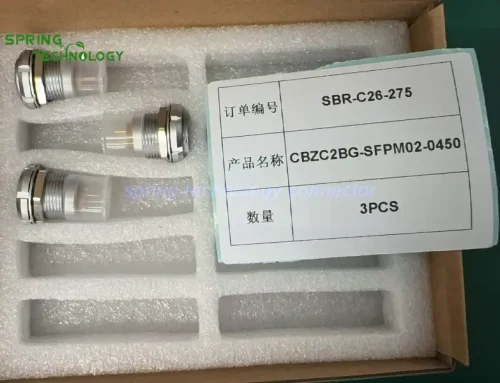
This 0B connector delivery shows how Spring Technology serves compact analytical instruments — from the 7 A contacts and differential pair of the CBZE0BG-SFSM04-0000 to its M9 panel mounting and shielding, every detail was aligned with the customer’s handheld XRF analyzer requirements. Spring Technology also provides professional customization services for both push-pull connectors and cable assemblies, offering tailored solutions to meet your specific technical requirements.
For more information about our 0B series connectors or to discuss your requirements, contact us at [email protected] or [email protected], or visit our website.
Building a handheld XRF analyzer or portable analytical instrument? Send us your module and panel requirements — our engineering team will respond with a tailored CBZE0BG push-pull connector proposal for your handheld XRF analyzers within 24 hours.
Further Reading
- CBZC2BG Push-Pull Connector for Portable Spectrum Analyzers 2026: 2B Series 4-Contact 90° PCB Socket for RF Test Instrument Interfaces for Canadian Client
- CBZG00BG Push-Pull Connector for Insulation Resistance Testers 2026: 00B Series 4-Contact M7 Panel Socket for Portable Test Instruments for US Client
- CBTG1BG Push-Pull Connector for Ultrasonic Flaw Detectors 2026: 1B Series 7-Contact 7 A Plug for Portable NDT Instrument Interfaces
- CBZE1KG Push-Pull Connector for GNSS Surveying Receivers 2026: 1K Series 10-Contact IP68 PCB Socket for Outdoor Positioning Terminals for US Customers
- Push-Pull Connector for Data Acquisition 2026: CBZG0BG-SFSM06, CBZG1BG-SFSM06 and CBZG0BB-SFSM06 for Test, Measurement and Industrial Data Acquisition for Russian Customers
- ZEG.0B Fixed Socket — Product Page
- 0B Series Connector