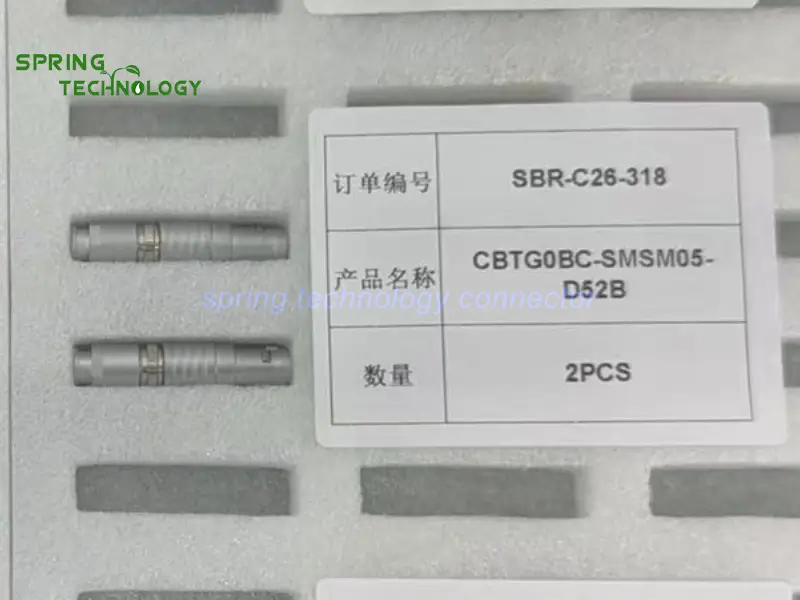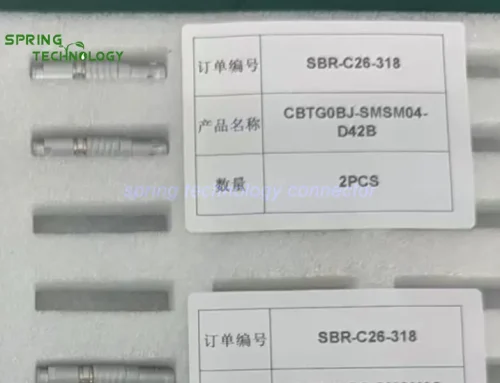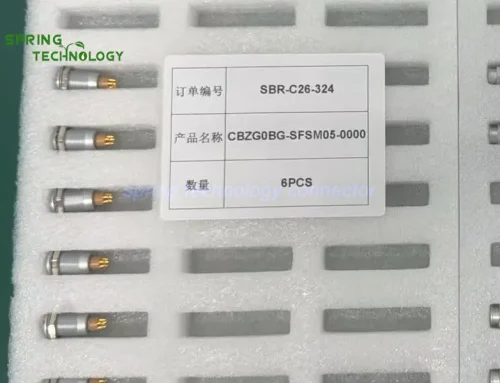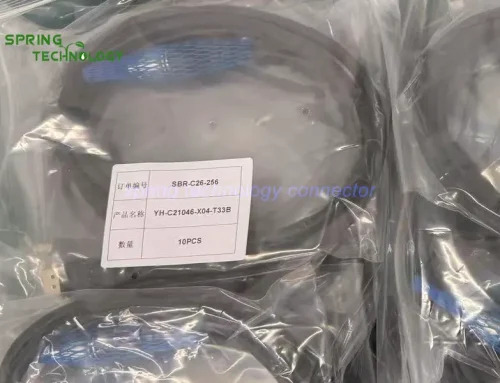


CBTG0BG-SMSM05-D52B Push-Pull Connector for Portable Chlorophyll Fluorometers 2026: 0B 5-Contact Straight Plug
The CBTG0BG-SMSM05-D52B push-pull connector is a five-contact 0B straight cable plug built for the detachable electrical link between a leaf-measurement probe assembly and a portable chlorophyll fluorometer — push-pull self-latching coupling, solder termination, a 4.30–5.20 mm cable opening for this variant, IP50 when mated, more than 5,000 mating cycles, and a 305 insert rated 750 V with 6.5 A per contact. It carries electrical signals only: light in and out of the leaf stays in a dedicated optical path, not in this connector.
Chlorophyll fluorometry is done where the plants are — greenhouses, field plots, growth chambers, research stations — and the instrument is usually a handheld or shoulder-carried unit with a leaf clip on a cable. That cable is connected and disconnected every time the operator moves from one leaf to the next plot: a detachable interface is not an accessory in this workflow, it is the working end of the instrument.
Core answer: CBTG0BG-SMSM05-D52B gives that probe-to-main-unit link a locking, serviceable interface: five low-voltage contacts on a 0.7 mm contact size that can carry temperature sensor signals, a PAR sensor channel, auxiliary control lines or other low-voltage circuits depending on the instrument’s electrical architecture, with solder termination so the cable follows the instrument’s own design. Its compact straight body fits handheld enclosures, and the published cable range of 4.30–5.20 mm covers the multi-conductor, shielded constructions a field probe cable normally uses.
1. Technical Parameters & Engineering Standards
Every value below for the CBTG0BG-SMSM05-D52B push-pull connector comes from the published 0B platform documentation and from the 305 five-contact insert row of the product page P/N table. Items that depend on the cable variant or the instrument design are marked as such.
- Latching Mechanism: push-pull self-latching system — the plug seats with an axial push and releases by pulling the outer sleeve, with a keyed shell (key G, with A…M and R variants) so a neighbouring interface cannot be cross-mated.
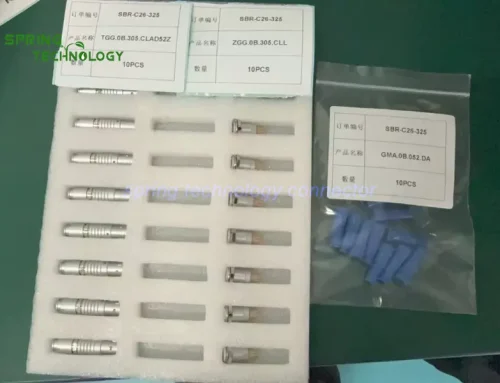
- Recommended Hardware: the TGG.0B straight plug on the probe cable and a 0B panel socket on the main unit, both from the Spring Technology 0B range.
- Key Metric: 5 contacts on a 0.7 mm insert, 750 V working voltage, 6.5 A per contact, ≤12.5 mΩ contact resistance, IP50 when mated and more than 5,000 mating cycles.
1.1 Configuration Summary
| Parameter | Value / Status |
|---|---|
| Model | CBTG0BG-SMSM05-D52B |
| Body | 0B straight cable plug, male solder contacts |
| Contacts | 5 (305 insert) |
| Contact size | 0.7 mm |
| Conductor size | AWG 22–26 |
| Working voltage | 750 V |
| Rated current | 6.5 A per contact (connector rating) |
| Contact resistance | ≤12.5 mΩ |
| Termination | Solder |
| Cable opening | 4.30–5.20 mm for this cable variant (0B platform opening 1.5–5.5 mm) |
| Keying | Key G, with A…M and R variants available in the 0B range |
| Insert material | PPS (polyphenylene sulfite) |
| Protection index | IP50 when mated |
Note: the contact assignment, cable construction and shield termination belong on the assembly drawing. The protection rating applies to the mated pair, not to the plug alone.
1.2 Shared 0B Platform Specifications
| Parameter | Value |
|---|---|
| Shell size | 0B — layouts from 2 to 9 contacts |
| Operating temperature | -45 °C ~ +125 °C |
| Humidity | Up to 95% at 60 °C |
| Vibration resistance | 10–20,000 Hz, 15 g |
| Mechanical shock | 100 g · 6 ms |
| Salt spray corrosion test | >48 h |
| Mating cycles | >5,000 |
| Protection index | IP50 when mated |
| Termination | Solder |
| Fastening type | Push-pull |
| Shell material and finish | Brass, chrome plated |
| Contact material and finish | Brass, gold plated |
| Insert material | PPS (polyphenylene sulfite) |
| Cable opening | 1.5–5.5 mm across the 0B platform |
Note: these are platform-level values published for the 0B shell, so they describe the connector family rather than a single supplied assembly.
2. Key Advantages of the CBTG0BG-SMSM05-D52B Push-Pull Connector
A probe connector on a field instrument has one job: let the operator move to the next leaf without thinking about it. The characteristics below explain why this CBTG0BG-SMSM05-D52B push-pull connector suits portable plant measurement equipment:
2.1 Push-Pull Locking for Convenient Field Operation
Fluorometers are used in greenhouses, field plots and research stations, and the leaf clip or probe assembly is connected and disconnected repeatedly through a measurement session. The CBTG0BG-SMSM05-D52B push-pull connector uses a push-pull self-latching mechanism: it seats with an axial push and releases by pulling the outer sleeve, with no threaded collar to work loose in the field.
That matters when the operator is holding a leaf clip in one hand and the instrument in the other. The latch also resists the accidental pull that comes from a cable caught on a bench, a rail or a plant support.
2.2 Five Contacts for Auxiliary Sensor Integration
The plug carries five low-voltage contacts on a 0.7 mm contact size. In a fluorometer those contacts can be assigned to a temperature sensor, a photosynthetically active radiation (PAR) sensor channel, auxiliary control lines or other low-voltage circuits, depending on the instrument’s electrical architecture.
Putting those circuits in one keyed shell simplifies the detachable probe interface: the operator connects one cable instead of three, and the instrument’s internal harness terminates at one connector rather than at several small ones.
2.3 Compact Straight-Plug Design
The CBTG0BG-SMSM05-D52B push-pull connector is a straight cable-mounted plug in the compact 0B shell. On a handheld instrument the shell diameter sets how much of the enclosure is dedicated to the connector, and a straight body keeps the cable leaving the instrument in a predictable direction instead of turning through a bend radius the housing was not designed for.
Its published cable range of 4.30–5.20 mm covers the shielded multi-conductor constructions a probe cable normally uses, so the connector does not force a change of cable construction.
2.4 Electrical Contact Behaviour That Suits Sensor Signals
The 305 insert is published with a maximum contact resistance of 12.5 mΩ and gold-plated brass contacts. For auxiliary sensor channels — a thermistor pair, a PAR sensor line, a reference — that is a bounded contribution to the circuit rather than a source of drift.
On the CBTG0BG-SMSM05-D52B push-pull connector, intermittent contact is the failure mode that hurts most in this application, because a momentary open on a sensor channel can look like a physiological response in the recorded data. The push-pull latch and a properly strain-relieved harness are what keep that from happening.
2.5 Designed for Repeated Connection Cycles
The CBTG0BG-SMSM05-D52B push-pull connector is specified for more than 5,000 mating cycles on the 0B platform. Interchangeable probes, leaf clips and accessories mean the interface is worked far more than the instrument’s other connectors, and the connector becomes a wear item before the electronics do.
Because the plug is the sacrificial half, a worn interface is resolved by replacing a cable rather than by returning the instrument.
2.6 An Electrical Interface — Not an Optical Path
Chlorophyll fluorometry depends on delivering excitation light to the leaf and collecting the emitted fluorescence. Where an instrument uses a fibre-optic probe for that, the optical path is a dedicated fibre connection with its own tolerance for bend radius, termination and cleanliness.
The CBTG0BG-SMSM05-D52B push-pull connector is an electrical connector: it carries sensor signals, control lines and supply to the probe assembly, and it must not be treated as part of the optical design. Keeping the two paths separate in the mechanical layout is a design decision worth making early, because a connector that is used as a fibre feed-through will disappoint in both directions.
3. Why Choose the CBTG0BG-SMSM05-D52B for Plant Measurement Equipment?
Portable chlorophyll fluorometers need a practical electrical interface between the main unit and a detachable leaf-measurement accessory. A suitable connector should be easy to operate in the field, keep contact behaviour stable, and fit the cable and enclosure the instrument already needs. The CBTG0BG-SMSM05-D52B push-pull connector offers the characteristics below:
- Push-pull locking for repeated field connection and release.
- Five low-voltage contacts for auxiliary sensor and control circuits.
- Compact straight plug for handheld enclosures.
- Solder termination and a 4.30–5.20 mm cable range for this variant.
- PPS insulation and gold-plated contacts on a 0.7 mm insert.
- More than 5,000 mating cycles.
For the CBTG0BG-SMSM05-D52B push-pull connector, the field routine is a sequence of short, repeated measurements rather than one long one: the clip goes on a leaf, the reading is taken, the clip moves, and the same leaf may be measured several times to build a light-response curve. Across a plot that is hundreds of connect and release events in a morning, and the probe cable is the part being handled each time. A connector that seats in one push and releases with a sleeve pull keeps that rhythm; one that needs a coupling ring does not.
Three boundaries are worth stating plainly. First, this is an electrical connector, not an optical one: excitation and fluorescence collection must stay in a dedicated optical path. Second, the protection rating is IP50 when mated, which suits indoor, protected or fair-weather use — a greenhouse or a field plot in the rain is not the same environment, and the interface should be protected accordingly. Third, the 6.5 A figure is a per-contact connector rating; the current an auxiliary circuit actually carries depends on conductor size, the number of energised contacts and the ambient conditions.
Before integration, engineers should verify the contact assignment, the cable construction, the current requirement of each circuit and the environmental conditions the finished instrument will meet.
4. 0B Series Connector Family Overview
The 0B shell is the compact member of the 0B series: layouts from 2 to 9 contacts, solder termination, push-pull self-latching coupling, IP50 when mated and a -45 °C to +125 °C operating range. Handheld instruments that need a smaller interface than the 1B shell but more contacts than the 00B family usually settle on this size.
4.1 Available Configurations
Five contacts covers the usual auxiliary set on a probe: a sensor pair, a supply and control line, and a spare. Two and three contacts serve simpler power and status circuits; six to nine contacts serve denser signal bundles. Plugs, panel sockets and free sockets share the same contact system.
For the CBTG0BG-SMSM05-D52B push-pull connector, the plug travels with the probe cable while a 0B panel socket stays on the main unit — the arrangement that keeps the instrument sealed and the probe replaceable.
4.2 Customization Services
Beyond the catalogue configurations, Spring Technology builds custom cable assemblies around the 0B platform for the CBTG0BG-SMSM05-D52B push-pull connector: conductor mapping to the instrument’s probe design, shielded or low-noise cable construction, overmoulding or bend relief at the probe end, labelling and 100% continuity testing before shipment.
5. Frequently Asked Questions (FAQ)
Conclusion & Call to Action
The CBTG0BG-SMSM05-D52B push-pull connector gives a portable chlorophyll fluorometer a probe interface that locks by push-pull, releases without tools and survives more than 5,000 cycles: five low-voltage contacts for temperature, PAR and control circuits, a compact straight body for handheld enclosures, PPS insulation and a 4.30–5.20 mm cable range for the shielded probe cable.
For more information about our 0B series connectors or to discuss your requirements, contact us at [email protected] or [email protected], or visit our website.
Developing a plant measurement instrument with a detachable probe? Send us your sensor channel count, cable requirements and enclosure constraints — our engineering team will respond with a tailored connector and cable proposal within 24 hours.
Further Reading
- CBTG0BG-SMSM05 Push-Pull Connectors for Transformer Oil Breakdown Voltage Testers 2026: CBTG0BG-SMSM05-D52B Plug and CBZG0BG-SFSM05-0000 Panel Socket
- 0B Precision Sensor Connector 2026: CBTG0BG-SMSM05-D52B Plug and CBZG0BG-SFSM05-0000 Socket for Load Cells and Accelerometers
- CBZG0BG-SFSM05-0000 Push-Pull Connector for Portable Battery Impedance Testers 2026: 0B 5-Contact M9 Panel Socket
- CBTG0BG Push-Pull Connector for Grain Moisture Analyzers 2026: 0B 5-Contact Probe Plug for Portable Field Meters
- CBTN1BG Push-Pull Connectors for Coating Thickness Gauges 2026: TN Body Style 1B Series 2-Pin Connectors
- 0B Series Push-Pull Circular Connectors — Configurations, Specifications and Downloads
- TGG.0B Straight Plug — 0B Cable Plug Product Page
- Custom Cable Assembly Services — Probe and Sensor Cable Harnesses