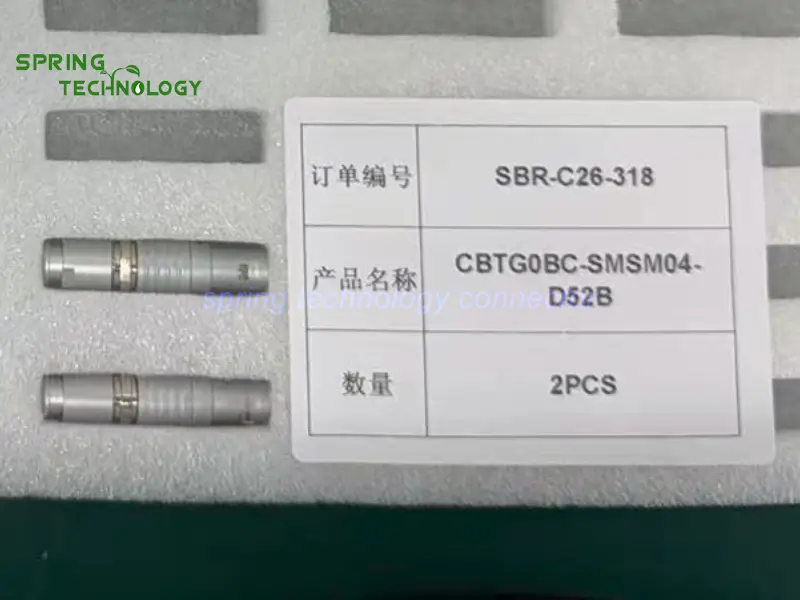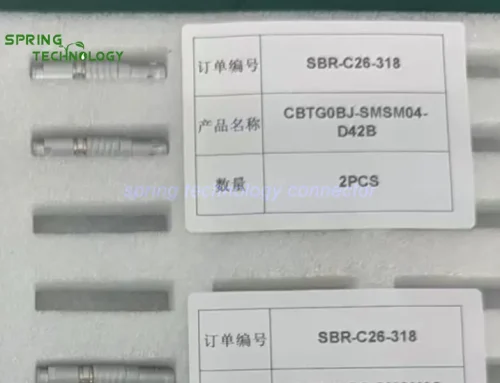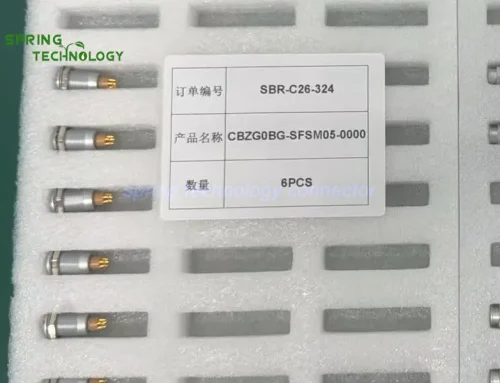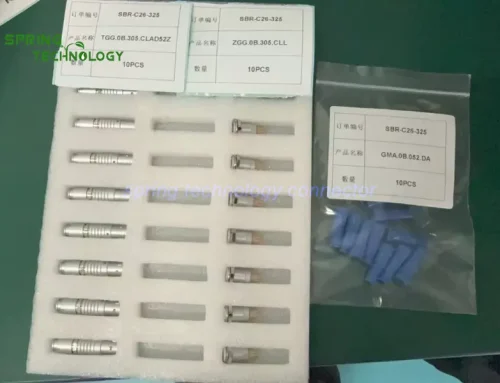


CBTG0BC-SMSM04-D52B Push-Pull Connector for Benchtop Soil Nutrient Analyzers 2026: 0B 4-Contact USB Straight Plug
The CBTG0BC-SMSM04-D52B push-pull connector is a four-contact 0B straight cable plug built for the detachable USB data link between a benchtop soil nutrient analyzer and its PC software — push-pull self-latching coupling, solder termination, a 4.30–5.20 mm cable opening for this variant, IP50 when mated, more than 5,000 mating cycles, and a 304 insert rated 750 V with 7 A per contact. It is the data path of a laboratory workflow, not a measurement electrode: the soil sample and its chemistry stay inside the analyzer.
Soil testing laboratories live on records. A bench analyzer that reads nitrogen, phosphorus, potassium, pH, conductivity, organic matter or moisture is only half the instrument; the other half is the sample ID, the batch, the operator and the report that has to survive an audit months later. That record moves over a USB cable, from a bench instrument to a PC, several times a day, on a cable that is plugged in at the start of a batch and pulled out when the bench is cleared.
Core answer: CBTG0BC-SMSM04-D52B gives that data port a locking, replaceable interface instead of a consumer USB socket soldered to a main board: four low-voltage contacts on a 0.7 mm contact size — enough for a USB 2.0 link’s VBUS, D−, D+ and ground — rated 750 V and 7 A per contact with a maximum contact resistance of 12.5 mΩ, in a compact straight body that mounts on the instrument’s rear panel cable. The published specification covers USB 2.0 data transmission up to 480 Mbit/s, and the assembly still has to be built as a USB interface: correct pinout, correct cable construction and a properly bonded shield.
1. Technical Parameters & Engineering Standards
The CBTG0BC-SMSM04-D52B push-pull connector is specified below against the published 0B platform documentation and the 304 four-contact insert row of the product page P/N tables. The 0BC keyed variant itself is not listed as a separate row there, so the electrical figures are taken from the shared 304 insert, while the keyway and ordering code should be confirmed on the drawing.
- Latching Mechanism: push-pull self-latching system — the plug seats with an axial push and releases by pulling the outer sleeve. The 0BC variant is a keyed shell, so a neighbouring 0B interface cannot be mated to the wrong cable.
- Recommended Hardware: the TGG.0B straight plug on the data cable and a 0B panel socket with the matching keyway on the instrument, both from the Spring Technology 0B range.
- Key Metric: 4 contacts on a 0.7 mm insert, 750 V working voltage, 7 A per contact, ≤12.5 mΩ contact resistance, USB 2.0 data up to 480 Mbit/s, IP50 when mated and more than 5,000 mating cycles.
1.1 Configuration Summary
| Parameter | Value / Status |
|---|---|
| Model | CBTG0BC-SMSM04-D52B |
| Body | 0B straight cable plug, male solder contacts, keyed shell (0BC) |
| Contacts | 4 (304 insert) |
| Contact size | 0.7 mm |
| Conductor size | AWG 22–26 |
| Working voltage | 750 V |
| Rated current | 7 A per contact (connector rating, not the USB bus current) |
| Contact resistance | ≤12.5 mΩ |
| Data interface | USB 2.0, up to 480 Mbit/s under the published specification — with the correct pinout, cable construction and shield termination |
| Termination | Solder |
| Cable opening | 4.30–5.20 mm for this cable variant (0B platform opening 1.5–5.5 mm) |
| Insert material | PPS (polyphenylene sulfite) |
| Protection index | IP50 when mated |
Note: the USB pin assignment, cable impedance and shield termination belong on the assembly drawing, and the mating socket must be specified with the matching keyway. The protection rating applies to the mated pair.
1.2 Shared 0B Platform Specifications
| Parameter | Value |
|---|---|
| Shell size | 0B — layouts from 2 to 9 contacts |
| Operating temperature | -45 °C ~ +125 °C |
| Humidity | Up to 95% at 60 °C |
| Vibration resistance | 10–20,000 Hz, 15 g |
| Mechanical shock | 100 g · 6 ms |
| Salt spray corrosion test | >48 h |
| Mating cycles | >5,000 |
| Protection index | IP50 when mated |
| Termination | Solder |
| Fastening type | Push-pull |
| Shell material and finish | Brass, chrome plated |
| Contact material and finish | Brass, gold plated |
| Insert material | PPS (polyphenylene sulfite) |
| Cable opening | 1.5–5.5 mm across the 0B platform |
Note: these are platform-level values published for the 0B shell, so they describe the connector family rather than a single supplied assembly.
2. Key Advantages of the CBTG0BC-SMSM04-D52B Push-Pull Connector
A data port on a laboratory instrument is judged by whether the record actually reaches the PC on a busy day, and whether the port survives being used as a port. The characteristics below explain why this CBTG0BC-SMSM04-D52B push-pull connector suits benchtop analyzers:
2.1 USB 2.0 Data Transmission
The plug of the CBTG0BC-SMSM04-D52B push-pull connector carries four low-voltage contacts and is published for USB 2.0 data transmission at up to 480 Mbit/s. In a USB 2.0 design those four contacts take VBUS, D−, D+ and ground, which is exactly the conductor count a bench instrument needs to hand results to a PC.
For a soil nutrient analyzer, that link carries batch files, sample records and QC results into a database or a spreadsheet — small payloads compared with video, but payloads that have to arrive intact and be attributable to the right sample.
2.2 Push-Pull Locking for Secure Connections
Laboratory instruments are connected to computers, data stations and peripherals many times a week, and a friction-fit connector in that routine slowly loses its grip. The CBTG0BC-SMSM04-D52B push-pull connector locks by push-pull: an axial push to seat, a pull on the outer sleeve to release, so the cable cannot be worked loose by a bench being wiped down or a chair rolling into the cable.
There is also no threaded collar to cross-thread, which matters when several people share the same bench instrument and each has their own way of plugging things in.
2.3 Four Contacts and One Differential Pair
Four contacts is the minimum sensible layout for a USB 2.0 link: one differential pair for the data, plus power and ground. In the CBTG0BC-SMSM04-D52B push-pull connector that pair sits on the same 0.7 mm contact system as the supply conductors, so the cable designer has a defined geometry to work with.
The differential pair is where the signal integrity of the link lives. Keeping the pair together through the connector, the cable and the transition to the panel socket is what preserves the impedance the USB 2.0 link expects.
2.4 Contact Behaviour That Supports Laboratory Record Transfer
On the CBTG0BC-SMSM04-D52B push-pull connector, the 304 insert is published with a maximum contact resistance of 12.5 mΩ on gold-plated brass contacts. For a data port, what matters is that the resistance stays stable through repeated mate and unmate cycles rather than drifting into intermittent contact — an intermittent USB connection during a batch export is how records get half-transferred.
The insert is moulded in PPS (polyphenylene sulfite), the material used across the 0B platform, which holds the four contacts at a fixed spacing and keeps that behaviour predictable.
2.5 Compact Straight Plug for Instrument Panel Integration
The CBTG0BC-SMSM04-D52B push-pull connector is a straight cable-mounted plug in the compact 0B shell, and this cable variant accepts an outside diameter of 4.30–5.20 mm. On a benchtop instrument the data cable leaves the rear panel and runs to a PC under the bench, so a straight body with a defined cable range is usually easier to dress than an angled one.
The compact shell also leaves more of the rear panel for the mains inlet, fuses and other interfaces that a laboratory instrument needs.
2.6 Suitable for Repeated Laboratory Use
The CBTG0BC-SMSM04-D52B push-pull connector is specified for more than 5,000 mating cycles on the 0B platform. A shared bench instrument may be re-cabled several times a day, and the connector becomes the wear item long before the analyzer’s electronics do.
Because the plug is on the cable, wear is resolved by replacing a data cable rather than by returning an instrument — the difference between a five-minute fix and a service call.
3. Why Choose the CBTG0BC-SMSM04-D52B for Soil Testing Equipment?
Benchtop soil nutrient analyzers need a data connection that supports a laboratory workflow: results out to a PC, records that can be traced to a sample, and a port that survives daily use. The CBTG0BC-SMSM04-D52B push-pull connector offers the characteristics below:
- Four low-voltage contacts for a USB 2.0 interface design.
- Published USB 2.0 data transmission up to 480 Mbit/s.
- Push-pull locking for repeated connection and release.
- Compact straight plug for rear-panel integration.
- Solder termination and a 4.30–5.20 mm cable range.
- PPS insulation and gold-plated contacts on a 0.7 mm insert.
- More than 5,000 mating cycles.
Three boundaries are worth stating plainly. First, the connector does not by itself set the data rate: 480 Mbit/s is a property of the complete USB 2.0 link — pinout, cable impedance, shield termination, host and device. Second, the protection rating is IP50 when mated, which is appropriate for a laboratory bench but not for a wet or washdown environment. Third, this is a data interface, not the measurement path: the soil sample, the reagents and the optical or electrochemical measurement cell sit entirely outside this connector.
Before integration, engineers should verify the USB wiring, the mating socket and its keyway, the cable construction and the rear-panel cutout, so that the finished instrument, its software and its records all line up.
4. 0B Series Connector Family Overview
The 0B shell is the compact member of the 0B series: layouts from 2 to 9 contacts, solder termination, push-pull self-latching coupling, IP50 when mated and a -45 °C to +125 °C operating range. Benchtop and handheld instruments that need a smaller interface than the 1B shell usually settle on this size.
4.1 Available Configurations
Four contacts is the smallest layout that still covers a USB 2.0 link with a pair plus power and ground, which is why the 304 insert is common on data interfaces. Two and three contacts serve power and status circuits; five to nine contacts serve denser signal bundles. Plugs, panel sockets and free sockets share the same contact system, and the keyed variants keep adjacent interfaces from being cross-mated.
For the CBTG0BC-SMSM04-D52B push-pull connector, the plug travels with the data cable while a 0B panel socket stays on the instrument — the arrangement that keeps the enclosure closed and the cable replaceable.
4.2 Customization Services
Beyond the catalogue configurations, Spring Technology builds custom cable assemblies around the 0B platform for the CBTG0BC-SMSM04-D52B push-pull connector: conductor mapping to the instrument’s USB design, shielded pair construction, overmoulding or bend relief, labelling and 100% continuity testing before shipment.
5. Frequently Asked Questions (FAQ)
Conclusion & Call to Action
The CBTG0BC-SMSM04-D52B push-pull connector gives a benchtop soil nutrient analyzer a data port that locks, releases without tools and survives more than 5,000 mating cycles: four contacts on a 0.7 mm insert for a USB 2.0 link, a published path up to 480 Mbit/s, a compact straight body for rear-panel routing and a 4.30–5.20 mm cable range for a shielded data cable.
For more information about our 0B series connectors or to discuss your requirements, contact us at [email protected] or [email protected], or visit our website.
Building a laboratory analyzer with a detachable data port? Send us your USB pinout, cable requirements and panel cutout — our engineering team will respond with a tailored connector and cable proposal within 24 hours.
Further Reading
- CBTG0BC Push-Pull Connector for CNC Commissioning Terminals 2026: 0B 4-Contact USB 2.0 Plug
- CBTG0BG-SMSM04-D42B Push-Pull Connector for Handheld Digital Force Gauges 2026: 0B 4-Contact USB Straight Plug
- Connectors for USB Industrial Data Loggers 2026: CBTN1BA-SMSM04-D52B Four-Contact Lanyard-Release Plug
- CBTG0BG-SMSM05-D52B Push-Pull Connector for Portable Chlorophyll Fluorometers 2026: 0B 5-Contact Straight Plug
- 0B Precision Sensor Connector 2026: CBTG0BG-SMSM05-D52B Plug and CBZG0BG-SFSM05-0000 Socket for Load Cells and Accelerometers
- 0B Series Push-Pull Circular Connectors — Configurations, Specifications and Downloads
- TGG.0B Straight Plug — 0B Cable Plug Product Page
- Custom Cable Assembly Services — USB Data Cable Harnesses