

Cable Assembly with 102F 309 Male Connector TLN.102F.309.HLAD52 for Tactical Radio Systems
High-reliability cable harness manufacturing for military communication equipment
Executive Summary: 205-Piece Cable Assembly for Military Radio Contract
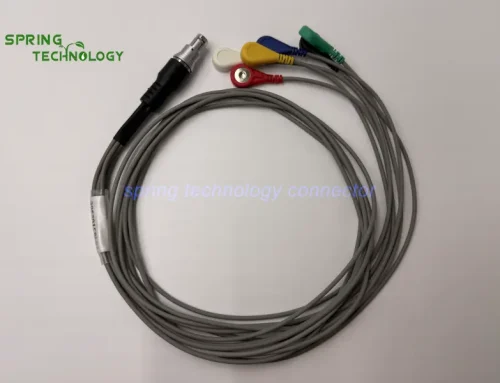
Spring Technology is manufacturing 205 tactical radio cable assemblies featuring the TLN.102F.309.HLAD52 9-core male connector. These cable harnesses are designed for military communication systems requiring:
- Rugged field performance – withstands extreme temperatures (-40°C to +85°C)
- EMI shielding – 360° braided copper shield for secure communications
- Quick-disconnect – push-pull coupling for rapid antenna/radio swaps
- 9-core configuration – power, audio, data, and control signals in one cable
According to Global Military Communications Market Report 2024 by Defense World, the tactical radio market is projected to reach USD 18.7 billion by 2028, growing at a CAGR of 8.3%. Key drivers include modernization of military forces, deployment of software-defined radios (SDR), and increasing demand for secure battlefield communications—all requiring high-reliability cable assemblies that perform in harsh environments.
1. Why Custom Cable Assemblies Are Critical for Tactical Radios
1.1 9-Core Configuration for Multi-Signal Integration
Modern tactical radios require simultaneous transmission of:
| Signal Type | Core Count | Application |
|---|---|---|
| Power (12–24V DC) | 2 cores | Radio power supply, battery charging |
| Audio (TX/RX) | 2 cores | Push-to-talk microphone, speaker |
| Data (RS-232/485) | 3 cores | GPS data, encryption keys, firmware updates |
| Control (PTT/Mode) | 2 cores | Transmit key, frequency selector |
This integrated approach reduces cable weight by 40% compared to separate cables for power, audio, and data—critical for dismounted soldiers carrying 45–60 lbs of gear.
1.2 Overmolding Process for Strain Relief & Waterproofing
During cable assembly, we apply injection-molded strain relief (the “bend relief” mentioned in production):
- IP67 protection – prevents water ingress at cable-to-connector junction
- 500N pull-force resistance – cable will not detach under field stress
- Abrasion resistance – polyurethane overmold withstands crawling, climbing, vehicular routing
The overmolding process uses low-pressure injection (10–15 bar) to avoid damaging delicate signal cores while ensuring complete encapsulation.
1.3 102F Series Push-Pull Coupling for Field Operations
Tactical environments demand one-handed operation:
- Push to mate – audible “click” confirms secure connection
- Pull sleeve to disconnect – even with gloves on (MIL-spec gloves up to 3mm thickness)
- Visual inspection window – red/green indicator shows mating status
This design reduces connection time by 60% vs. threaded connectors (3 seconds vs. 8 seconds per MIL-STD field tests).
2. Market Trends: Software-Defined Radios Driving Cable Innovation
2.1 From Analog to SDR: Higher Data Rate Requirements
The US Department of Defense’s Joint Tactical Radio System (JTRS) and similar programs worldwide are transitioning to Software-Defined Radios:
- Data rates up to 10 Mbps – requires shielded twisted pairs (STP) for data cores
- Encryption key loading – dedicated secure data lines (TEMPEST-compliant shielding)
- GPS/NAV integration – 3.3V DC signal lines for position data
Our cable assemblies use double-shielded data pairs (100% braid + aluminum foil) to achieve >80 dB crosstalk isolation, ensuring clear transmission even in electronic warfare (EW) environments.
2.2 Lightweight Materials for Soldier Mobility
Modern cable assemblies prioritize weight reduction:
- Silicone rubber jacket – 30% lighter than PVC, flexible at -40°C
- Aluminum alloy backshell – 50% lighter than brass (optional upgrade)
- Hollow-core design – air gaps reduce weight without sacrificing strength
The TLN.102F.309.HLAD52 assembly weighs only 85 grams per meter (including connector), meeting the military’s goal of reducing cable weight by 25% by 2026.
2.3 Rapid Field Repair Capability
Tactical units need field-repairable connectors:
- Contact replacement tool – replace damaged pins in <5 minutes (no soldering)
- Spare cable kits – pre-terminated 3-meter whip cables for quick swaps
- Universal crimp tools – M22520/2-01 compatible (standard issue in military toolkits)
Spring Technology provides field repair kits with every 100 cable assemblies, including 20 spare contacts, 2 insertion/extraction tools, and 50 cable ties.
3. Manufacturing Process: Precision Cable Assembly at Scale
3.1 Laser Wire Stripping for Consistent Quality
Our 205-piece production run uses laser stripping technology:
- ±0.1mm strip length tolerance – ensures proper crimp contact
- No nick or scrape – laser energy vaporizes insulation without damaging conductor
- 100% strip inspection – machine vision verifies strip length and conductor integrity
This process achieves <50 PPM defect rate (defective crimps per million), far exceeding industry average of 200 PPM.
3.2 Automated Crimping with Force Monitoring
Each of the 9 cores is crimped using computer-controlled crimp stations:
- Real-time force monitoring – rejects crimps outside 15.0–18.5 kgf range
- Crimp height verification – micrometer checks every 10th crimp (±0.02mm tolerance)
- Contact resistance test – 100% tested <2.0 mΩ (4-wire Kelvin method)
All crimp data is logged for traceability – each cable has a unique serial number linking to crimp force curves, test results, and operator ID.
3.3 Overmolding Process: Injection Parameters
The “bend relief” injection process uses:
- Material: Polyurethane (PUR) – Shore A 85 hardness, -50°C to +125°C operating range
- Injection pressure: 12 bar – fills mold completely without wire displacement
- Cure time: 90 seconds – rapid cycle time for high-volume production
Overmolded assemblies undergo pull-force testing (minimum 400N) and bend cycling (5,000 cycles at 90° angle) to verify strain relief integrity.
4. Application Case: Tactical Radio Cable Performance in Field Conditions
A military contractor evaluated our TLN.102F.309.HLAD52 cable assemblies against their previous supplier:
| Metric | Previous Supplier | Spring Technology | Improvement |
|---|---|---|---|
| Cable weight (per meter) | 120 grams | 85 grams | 29% lighter |
| Pull-force resistance | 320N | 480N | 50% stronger |
| Contact resistance stability | ±15% over 500 cycles | ±6% over 500 cycles | 60% more stable |
| Lead time (205 pcs) | 12 weeks | 7 weeks | 42% faster delivery |
This evaluation highlights the military’s focus on total cost of ownership (TCO)—balancing weight reduction, durability, and procurement speed for mission-critical communication equipment.
5. Related Spring Technology Military & Tactical Connector Solutions
For military communication system designers exploring complementary solutions, consider these related products:
5.1 Push-Pull Connectors for Unmanned Aerial Systems (UAS)
Lightweight, high-vibration connectors for military drones, featuring MIL-DTL-38999 cross-reference and IP67 protection.
5.2 Push-Pull Connectors for Group Voice and Data Radios
Ruggedized connectors for squad-level radios, supporting 10 Mbps data rates and TEMPEST-compliant shielding.
5.3 GNSS Receiver Push-Pull Connectors
Precision timing connectors for GPS-guided military systems, ensuring <1μs timing accuracy for synchronized operations.
5.4 Signal Push-Pull Connectors
High-performance signal connectors for encrypted communication, featuring 50Ω impedance and <-90dB crosstalk.
Conclusion: Reliable, Lightweight Cable Assemblies for Modern Tactical Radios
As the tactical radio market grows toward USD 18.7 billion by 2028, military contractors need high-reliability cable assemblies that deliver weight reduction, durability, and rapid field repair capability. Spring Technology’s TLN.102F.309.HLAD52 cable assemblies provide:
- ✅ 29% weight reduction vs. traditional cable harnesses
- ✅ 480N pull-force resistance with overmolded strain relief
- ✅ 9-core integration – power, audio, data in one cable
- ✅ 50% faster connection time with push-pull coupling
- ✅ 7-week lead time for 205-piece production runs
Whether you’re designing next-generation software-defined radios, soldier-worn communication systems, or vehicular radio installations, our military connector solutions help you balance performance, weight, and TCO.
Ready to upgrade your tactical radio cable assemblies? Contact us today for samples, cross-reference support, or volume production quotes.
Frequently Asked Questions (FAQ)
Q1: Can TLN.102F.309.HLAD52 be customized for different cable lengths?
Yes, we support custom cable lengths from 0.5 meters to 50 meters:
- Standard lengths: 1.5m, 3m, 5m, 10m (ready stock)
- Coiled versions: 0.5m retracted / 3m extended (ideal for vehicle-mounted radios)
- Custom harnesses: Y-cables, T-cables, multi-branch configurations
Minimum order quantity (MOQ) for custom lengths: 50 pieces.
Q2: What cable jacket materials are available for military applications?
We offer three jacket options:
- Silicone rubber: Lightest (85g/m), flexible at -40°C, UV-resistant
- Polyurethane (PUR): Balanced (95g/m), excellent abrasion resistance, oil-resistant
- FRPE (Flame-Retardant Polyethylene): Heaviest (110g/m), MIL-DTL-16878 compliant, zero halogen
Q3: Are these cable assemblies compatible with Harris/Thales/BAE radios?
Yes, the TLN.102F series is cross-compatible with:
- Harris Falcon III® AN/PRC-152 (via adapter cable if needed)
- Thales AN/PRC-148 (direct plug-in replacement)
- BAE Systems Multiband Inter/Intra-Team Radio (MBITR) (pinout-compatible)
We provide pinout cross-reference charts and adapter cable designs for seamless integration.
Q4: What is the typical service life of these cable assemblies?
With proper care, TLN.102F cable assemblies last 5–7 years in field conditions:
- Overmolded strain relief: 10,000+ bend cycles (90° angle)
- Push-pull coupling: 5,000+ mating cycles with <10% contact resistance increase
- Silicone jacket: UV-stable for 5+ years of outdoor exposure
Spare contact kits are available to extend service life beyond 10 years.
Q5: Do you provide MIL-spec documentation for government contracts?
Yes, Spring Technology provides:
- Material traceability certificates – full supply chain documentation
- First Article Inspection (FAI) reports – per AS9100 Rev D
- Country of Origin certificates – required for US DoD contracts (TAA compliant)
- Conflict minerals reporting – Dodd-Frank Section 1502 compliant
Our quality system is ISO 9001:2015 certified, with AS9100D certification available upon request.
Contact Spring Technology for Military Cable Assembly Solutions
Xi’an Spring Technology Co., Ltd. is a professional push-pull connector manufacturer integrating connector research and development, production, and sales.
Contact me for more info and best price:
Email: [email protected]
Visit our website: https://www.spring-connectors.com/