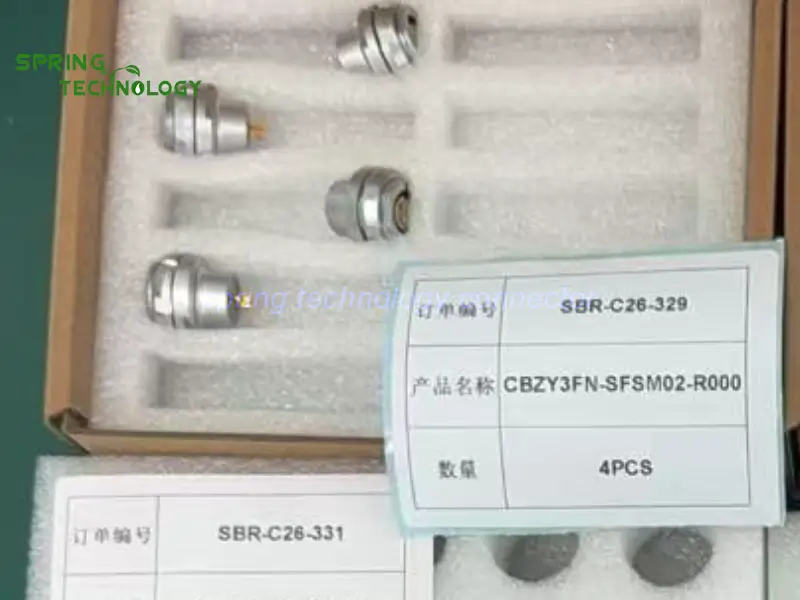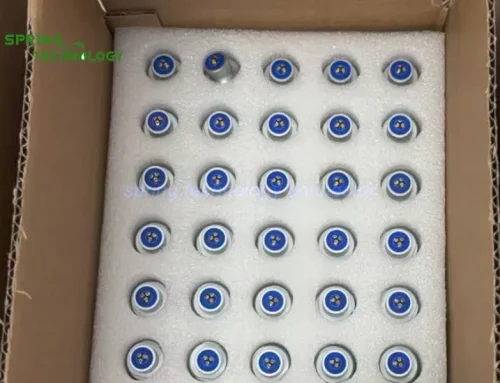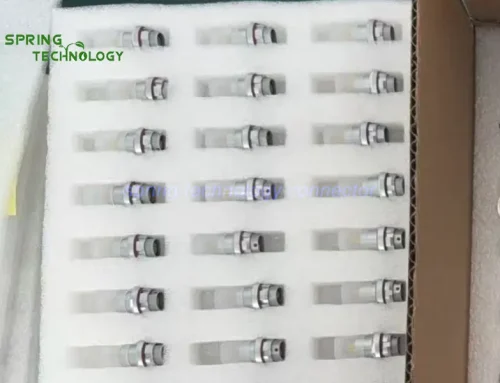


CBZY3FN-SFSM02-R000 Push-Pull Connector for Portable 4-20mA Loop Calibrators 2026: 103F 2-Contact Panel Receptacle
The CBZY3FN-SFSM02-R000 push-pull connector is a two-contact 103F rear-mounted panel receptacle for the external test lead of a portable 4-20 mA loop calibrator — female solder contacts on a 1.3 mm contact size, a chrome-plated brass housing, PPS insulation, push-pull self-latching coupling, IP68 when mated, -55 °C to +145 °C operation and more than 3,000 mating cycles, with a 302 insert rated 1000 V and 10 A.
A loop calibrator is the instrument an engineer carries when a process reading looks wrong. It measures the milliamp signal a transmitter is sending, sources a known current into the loop to check the receiving card, or simulates a transmitter so the rest of the chain can be proven. All three modes share one thing: a two-wire connection brought out to the front or side of a handheld case, plugged and unplugged thousands of times over the instrument’s life.
Core answer: CBZY3FN-SFSM02-R000 gives that test lead a defined panel interface — a rear-mounted socket that seals the enclosure at the panel, two contacts on a 1.3 mm contact size rated 1000 V and 10 A, and a maximum contact resistance of 5.0 mΩ. The external lead plugs in from outside; the internal wiring is soldered once and stays inside. Replacing a worn test lead becomes a cable change rather than an instrument repair.
1. Technical Parameters & Engineering Standards
Every value below for the CBZY3FN-SFSM02-R000 push-pull connector comes from the 302 two-contact insert row of the published 103F P/N table and from the 103F platform documentation. Items that depend on the exact order configuration are marked as such.
- Latching Mechanism: push-pull self-latching coupling — the mating plug seats with an axial push and releases by pulling the outer sleeve, with a keyed shell (key N, with A and B variants) so a neighbouring 103F interface cannot be cross-mated.
- Mating Hardware: a 103F cable plug on the test lead, from the Spring Technology 103F range; the receptacle is the ZYN.103F hermetic short socket.
- Key Metric: 2 contacts on a 1.3 mm insert, 1000 V working voltage, 10 A per contact, ≤5.0 mΩ contact resistance, IP68 when mated and more than 3,000 mating cycles.
1.1 Configuration Summary
| Parameter | Value / Status |
|---|---|
| Model | CBZY3FN-SFSM02-R000 |
| Series | 103F (3F shell) |
| Body | Rear-mounted panel receptacle (ZY body style), female solder contacts, chrome-plated brass housing |
| Contacts | 2 (302 insert) |
| Contact size | 1.3 mm |
| Conductor size | AWG 20 |
| Working voltage | 1000 V |
| Rated current | 10 A per contact (connector rating) |
| Contact resistance | ≤5.0 mΩ |
| Termination | Solder (the SFSM contact code designates female solder contacts) |
| Insert material | PPS (polyphenylene sulfite) |
| Housing | Chrome-plated brass |
| Keying | Key N, with A and B variants in the 103F range |
| Potting | R = resin potting (per the R000 suffix); confirm the exact sealing arrangement on the drawing |
| Protection index | IP68 when mated |
| Mating cycles | >3,000 |
Note: the panel cutout, mounting depth and the exact order suffix should be confirmed against the product drawing before the enclosure is machined. The IP68 rating applies when mated, under the platform test conditions; the protection of a complete instrument also depends on the panel gasket and the test lead’s clamp.
1.2 Shared 103F Platform Specifications
| Parameter | 103F platform value |
|---|---|
| Mating cycles | >3,000 |
| Humidity | up to 95% at 40 °C |
| Temperature range | -55 °C ~ +145 °C |
| Vibration | 10–2,000 Hz, 147 m/s², ≤1 µm instantaneous break |
| Impact | 490 m/s², ≤1 µm instantaneous break |
| Protection index (mated) | IP68 |
| Insert material | PPS |
| Shell material | Brass, chrome plated, silver or black finish |
Note: these are shell-level values for the 103F family. The electrical ratings in section 1.1 belong to the 302 two-contact insert specifically; other inserts in the same shell carry different current and voltage figures.
2. Why the CBZY3FN-SFSM02-R000 Push-Pull Connector Suits a Loop Calibrator
The 4-20 mA loop is the oldest and still the most common analog process signal. Two wires carry the current; the current itself carries the measurement. That simplicity is why a calibrator can be a small handheld instrument — and why the interface to the process is only ever two conductors.
2.1 What the Two Contacts Carry
In a two-wire loop the transmitter modulates the current drawn from a series supply between 4 mA and 20 mA; the receiving card converts that current back into a process value. A calibrator works on the same pair: it can measure the current the loop is carrying, source a known current into it, or simulate a transmitter by controlling the current itself.
CBZY3FN-SFSM02-R000 presents those two conductors on a panel receptacle. Contact assignments are the instrument designer’s decision — positive and return is the natural mapping, and the design should keep the polarity consistent with the socket so that a reversed lead is obvious rather than destructive.
2.2 Rear Mounting and Internal Wiring
On the CBZY3FN-SFSM02-R000 push-pull connector, a rear-mounted socket is installed from inside the enclosure. That matters on a handheld instrument: the panel gasket is not disturbed during assembly, the external interface stays flush with the case, and the internal run to the measurement board is short — which on a screened analog input is worth having.
The 103F ZY body is a hermetic short socket; the solder cups sit behind the panel, so the test lead is the only part an operator can touch.
2.3 Contact Rating Headroom
The 302 insert is rated 10 A per contact and 1000 V. A 4-20 mA loop needs a few tens of milliamps, so the connector is not the limiting component — which is the point. The headroom covers the 24 V loop supply present on many calibrators, accidental connection to a higher voltage, and the inrush of a transmitter’s start-up.
Headroom is not protection. The instrument still needs its own current limiting, fusing and isolation on the test terminals; the connector’s rating defines what the contact can survive, not what the instrument should allow through.
2.4 PPS Insulation
The CBZY3FN-SFSM02-R000 push-pull connector uses a PPS insert. The practical reason is dimensional and thermal stability: PPS holds its shape and its dielectric properties across the -55 to +145 °C range and through repeated soldering, so the contact spacing in the insert does not drift over the instrument’s life. On a two-contact interface carrying a low-level analog signal, stable spacing means stable leakage and stable capacitance.
2.5 Test Lead Replacement
With the CBZY3FN-SFSM02-R000 push-pull connector, test leads stay the consumable in calibration work: they get caught, coiled tightly, and dragged across plant floors. A detachable assembly turns a damaged lead into a cable change; the instrument is not opened and the internal wiring is not desoldered. That is the same argument that made the 103F series popular on other portable instruments.
2.6 The Boundary: Connector, Loop and Safety
CBZY3FN-SFSM02-R000 is a passive interface component. It does not isolate, does not limit current and does not define the safety category of the instrument. The loop supply, the isolation barrier, the input protection and the safety rating of the complete calibrator remain the designer’s responsibility — and in process plants those are the requirements that matter most.
3. Design Notes for the CBZY3FN-SFSM02-R000 Push-Pull Connector
Four things decide whether the CBZY3FN-SFSM02-R000 push-pull connector works out in a handheld calibrator:
- Pin assignment and polarity: fix the mapping between the socket contacts and the instrument’s positive and return terminals, and keep it consistent across the product family so a lead from one unit fits another.
- Mating plug: a 103F cable plug carrying the 302 insert and a matching keyway. Confirm the plug ordering code and the keying variant against the drawing.
- Potting suffix: the R000 designation calls for resin potting. Confirm on the drawing how the potted rear face interacts with the panel gasket and the solder cups.
- Panel preparation: cutout, thread and seating torque per the drawing; the sealing claim depends on that interface as much as on the connector.
4. Where the CBZY3FN-SFSM02-R000 Push-Pull Connector Fits
The CBZY3FN-SFSM02-R000 push-pull connector is aimed at the external test connection of portable process instruments: 4-20 mA loop calibrators, HART communicators with loop test leads, signal simulators, and the test inputs of handheld process multimeters. The same two-contact 103F interface appears wherever a low-level analog signal has to cross an enclosure wall and be unplugged again in the field.
Adjacent industries use the same shell for different physics: pressure calibrators, vibration calibrators and gas analysers all bought variants of this family, which is why the platform documentation matters more than any single application note.
5. Frequently Asked Questions (FAQ)
Conclusion & Call to Action
The CBZY3FN-SFSM02-R000 push-pull connector gives a portable 4-20 mA loop calibrator a sealed two-contact test interface: a rear-mounted 103F receptacle with female solder contacts, a chrome-plated brass housing, PPS insulation, IP68 when mated and more than 3,000 mating cycles.
For more information about our 103F series connectors or to discuss your requirements, contact us at [email protected] or [email protected], or visit our website.
Building a portable process instrument with an external test lead? Send us your wiring, panel constraints and sealing requirements — our engineering team will respond with a tailored connector proposal within 24 hours.
Further Reading
- CBZY3FN Push-Pull Connector for Compressed Air Purity Analyzers 2026: 103F 4-Contact Panel Socket
- Receptacles for Pressure Calibrators 2026: CBME1KG-SFSM07-R00E Hermetic Panel Socket
- BBZX0BG Push-Pull Connector for Vibration Calibrators 2026: 0B Series 3-Contact Elbow PCB Socket
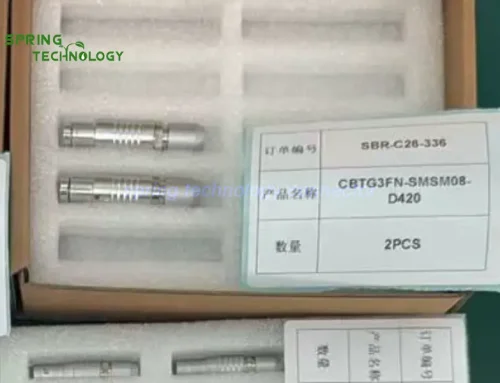
- CBTG3FN Push-Pull Connector for J2534 Diagnostic Devices 2026: 103F 4-Contact USB Plug
- CBTG3FN-SMSM03-D720 Push-Pull Connector for Portable Hot-Wire Anemometers 2026
- ZYN.103F Hermetic Short Socket — 103F Rear-Mounted Panel Receptacle
- 103F Series Push-Pull Waterproof Connectors — Configurations and Downloads
- Custom Push-Pull Connector Engineering — Spring Technology