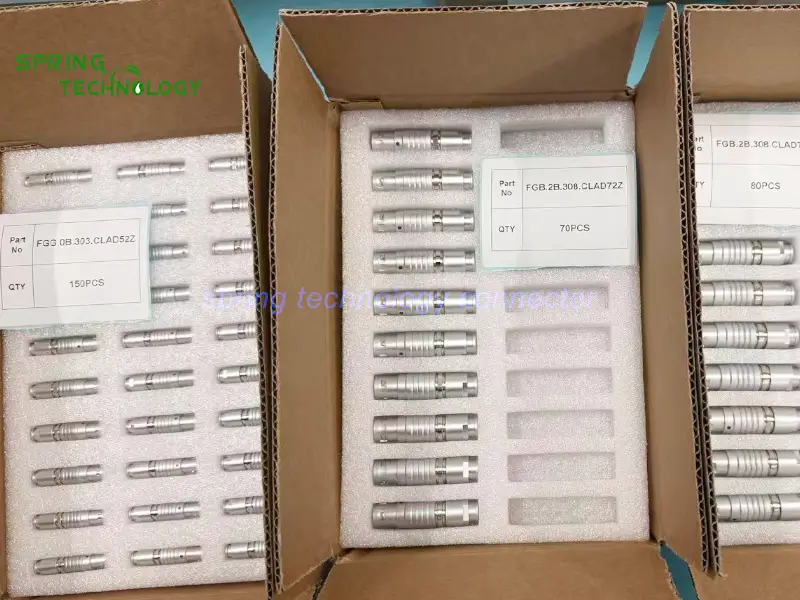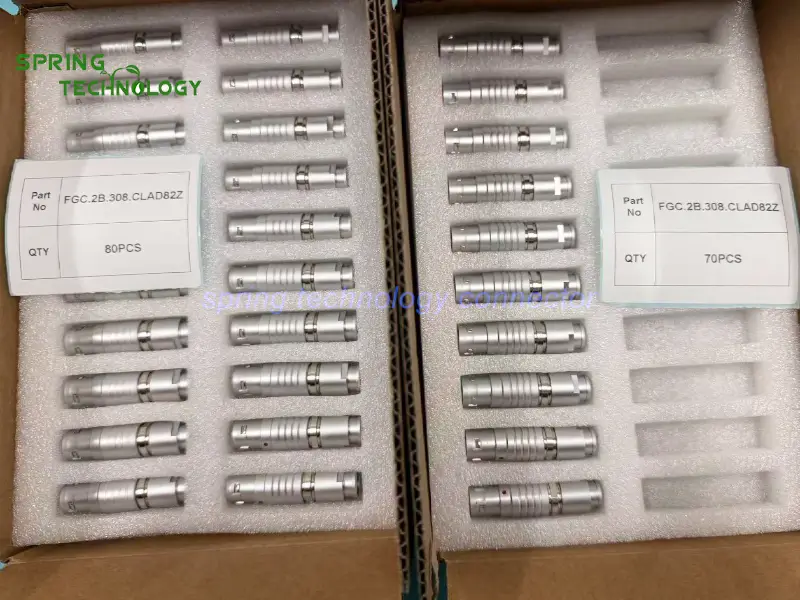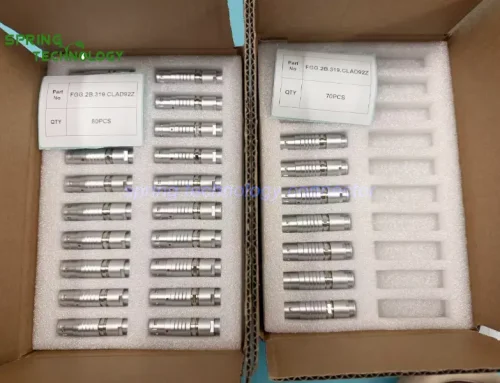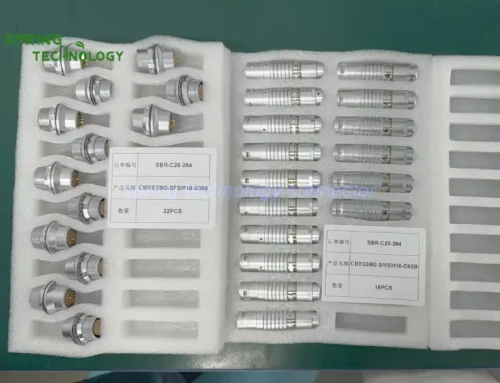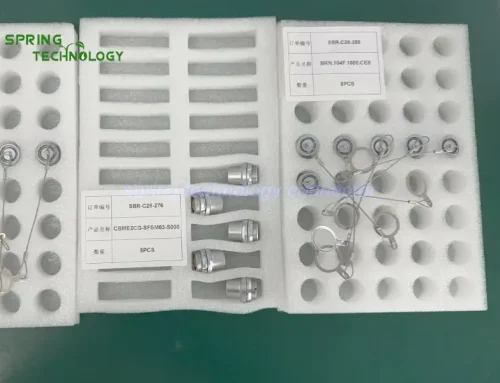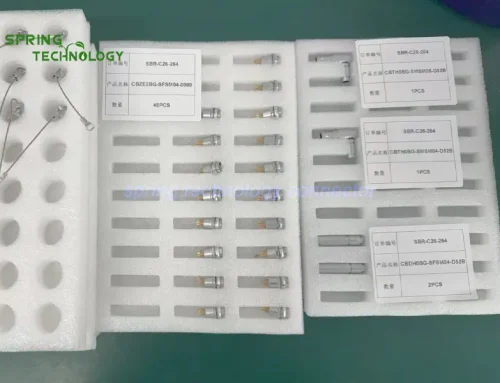


CBTG2BG Push-Pull Connector for Battery Module Charge-Discharge Testers 2026: 2B Series 8-Contact 10 A Plug for Battery Test Interfaces
The CBTG2BG-SMSM08-D82B is a CBTG2BG push-pull connector for battery module charge-discharge testers — a 2B series eight-contact low-voltage plug with a rated current of up to 10 A, solder termination, cable jacket compatibility of approximately 6.3–7.2 mm, IP50 protection, up to 5,000 mating cycles and shielding of at least 75 dB at 10 MHz. Every specification in this guide is backed by the battery test equipment interconnect engineering of Spring Technology.
Pain point: Keeping auxiliary control, monitoring and status circuits dependable across long charge and discharge cycles — where test channels are reconfigured regularly, fixtures change between programs, and the signal wiring sits next to switching power electronics?
Core answer: Spring Technology supplies the CBTG2BG-SMSM08-D82B, an eight-contact low-voltage plug in the 2B series that serves as a CBTG2BG push-pull connector for battery module charge-discharge testers. Industrial battery module testers evaluate battery performance, charging and discharging characteristics, cycle life and electrical stability, typically integrating programmable power electronics, voltage and current measurement circuits, temperature monitoring, control boards and data acquisition software. Their electrical interfaces must support reliable signal connections during repeated test cycles and routine maintenance, so this connector can be evaluated for auxiliary control, monitoring and low-voltage signal connections where its ratings and contact configuration meet the system requirements.
1. Technical Parameters & Engineering Standards
This battery tester connector is built on the 2B series push-pull platform, a mid-size circular connector family for professional test equipment.
- Latching Mechanism: Push-pull self-latching mechanism (mated and released without repeatedly turning a threaded coupling)
- Recommended Hardware: Spring Technology Circular Connector
- Key Metric: 8 contacts; up to 10 A; IP50; up to 5,000 mating cycles
| Parameter | Value |
|---|---|
| Plug (this order) | CBTG2BG-SMSM08-D82B — TG plug, 2B shell, key G, 8 contacts |
| Contacts | 8 low-voltage contacts |
| Rated current | Up to 10 A |
| Conductor size | Up to 0.34 mm² (AWG 22) |
| Termination | Solder termination |
| Cable diameter | Jacket approx. 6.3–7.2 mm (platform opening 1.5–9.7 mm) |
| Protection | IP50 |
| Shielding | Min. 75 dB at 10 MHz, 40 dB at 1 GHz |
| Mating cycles | Up to 5,000 mating cycles |
| Shock resistance | 100 g · 6 ms |
| Vibration resistance | 10~20000 Hz, 15 g |
| Operating temperature | -45 °C ~ +125 °C (2B platform) |
| Housing | Chrome-plated brass shell with PPS insulator |
Note: the 10 A rating covers suitable auxiliary and control circuits. The connector should not be assumed suitable for carrying high-current battery charge-discharge power without a separate engineering assessment.
2. Battery Tester Connector Design Highlights
Battery test benches run for hours and reconfigure often. The design advantages below explain why this CBTG2BG push-pull connector for battery module charge-discharge testers suits auxiliary test interfaces:
2.1 Eight Contacts for Multi-Channel Signal Connections
- Eight low-voltage contacts in one connector let multiple compatible circuits share a compact interface — covering battery test channel control signals, temperature monitoring module interfaces, test fixture status feedback, auxiliary sensor connections, measurement system control signals and equipment status or interlock interfaces. Consolidating compatible circuits simplifies cable routing and reduces the number of separate connection points; the actual pin assignment must be determined by the tester’s electrical design.
2.2 Push-Pull Locking for Convenient Maintenance
- The push-pull self-latching mechanism mates and releases the connector without repeatedly turning a threaded coupling. Battery testers may operate across multiple test channels and require regular fixture changes, inspection and maintenance, so a quick-connect interface makes it easier for technicians to disconnect and reconnect compatible control cables during servicing. The self-latching design also helps establish a secure connection during normal operation when plug and receptacle are correctly matched and installed.
2.3 Mechanical Durability for Repeated Test Cycles
- Battery test systems can run long charging and discharging cycles, sometimes over extended periods. Specified for up to 5,000 mating cycles with shock resistance up to 100 g and vibration resistance up to 15 g over 10~20000 Hz, the connector suits test equipment undergoing repeated cable replacement, fixture reconfiguration or routine service. Correct cable routing and strain relief remain important where test fixtures are moved frequently.
2.4 Rated Current of up to 10 A for Suitable Auxiliary Circuits
- A published 10 A rated current with conductor support up to 0.34 mm² (AWG 22) suits appropriately designed auxiliary power or control circuits, subject to operating temperature, contact loading, cable specifications and system-level derating requirements. For a battery module tester the connector may be evaluated for selected low-voltage auxiliary modules — it should not be assumed suitable for carrying high-current charge-discharge power without a separate engineering assessment.
2.5 Shielding to Support Signal Integrity
- Battery test systems often contain switching power electronics, current-control circuits and other sources of electromagnetic interference, so signal wiring should be designed with appropriate shielding and grounding. Minimum shielding performance of 75 dB at 10 MHz and 40 dB at 1 GHz supports reliable signal connections when the connector is incorporated into a properly designed cable assembly; actual system performance also depends on cable shielding, grounding, PCB layout and enclosure design.
2.6 Defined Cable Compatibility for Organized Wiring
- Accommodating cable jacket diameters of approximately 6.3–7.2 mm with solder termination provides a defined mechanical interface for cable assemblies between a tester’s control cabinet, monitoring modules and auxiliary equipment. Selecting the correct cable diameter and strain-relief components improves cable organisation and reduces mechanical stress on soldered connections.
3. Why Choose CBTG2BG-SMSM08-D82B for Battery Testing Equipment?
The connector offers several characteristics worth evaluating for industrial battery test systems:
- Eight contacts: supports multiple compatible low-voltage signal and control circuits.
- Push-Pull locking: simplifies routine connection and disconnection.
- 10 A rated current: capacity for suitable auxiliary circuits when used within specified limits.
- Shielding: supports EMC-conscious cable assembly design.
- Mechanical durability: specified for repeated mating, shock and vibration.
- Defined cable range: supports consistent cable assembly and strain-relief design.
Together these features help designers build organised, serviceable auxiliary interfaces for battery testing systems.
4. 2B Series Connector Family Overview
The 2B shell belongs to Spring Technology’s push-pull connector family for professional test and measurement equipment. The same platform serves this battery tester plug and scales across pin counts and cable variants.
4.1 Available Configurations
- Connectors: 2B plugs (including this order), fixed sockets and receptacle variants.
- Pin counts: 2–26 contacts across the 2B shell, including the 8-contact layout.
- Termination: solder termination with cable collet and bend relief options.
- Cable range: cable openings from 1.5 to 9.7 mm across the 2B platform.
4.2 Customization Services
- Custom contact allocations and part numbers (such as the CBTG2BG-SMSM08-D82B) matched to each tester’s channel plan.
- Test fixture and monitoring module cable assemblies sized to the cabinet.
- Shielding and EMC verification for measurement and control wiring.
- Pre-wired channel control and temperature monitoring harnesses.
5. Applications: Industrial Battery Testing Equipment
Battery validation depends on connections that survive thousands of cycles. This CBTG2BG push-pull connector for battery module charge-discharge testers serves the auxiliary side of the bench.
5.1 Charge-Discharge and Cycle-Life Testers
Industrial battery module charge-discharge testers and battery cycle-life testing equipment use the 8-contact interface for channel control and monitoring signals.
5.2 BMS Test Benches and Temperature Monitoring
Battery management system test benches and battery temperature monitoring systems connect their auxiliary modules through the compact interface.
5.3 Automated Fixtures and Production-Line Test Stations
Automated battery test fixtures, battery laboratory control equipment, energy storage module diagnostic systems and battery production-line test stations benefit from the defined cable range and push-pull servicing.
6. Frequently Asked Questions (FAQ)
Conclusion & Call to Action
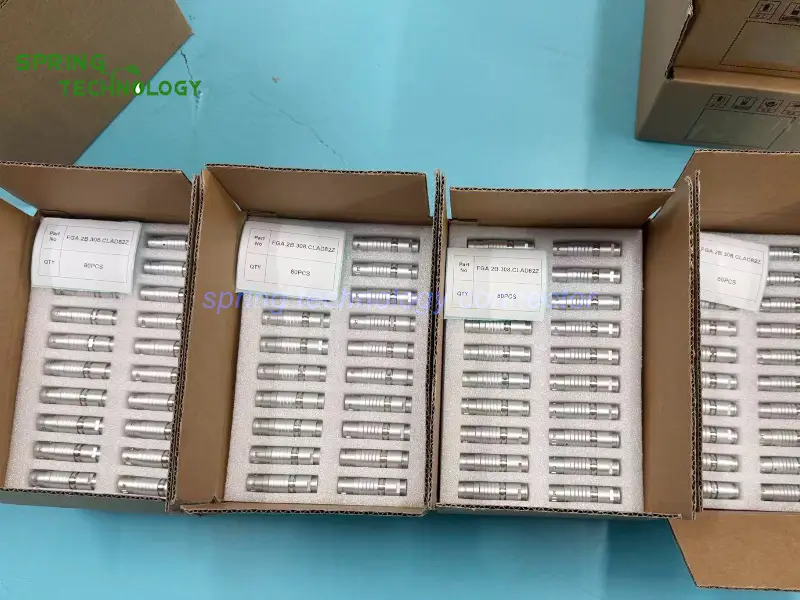
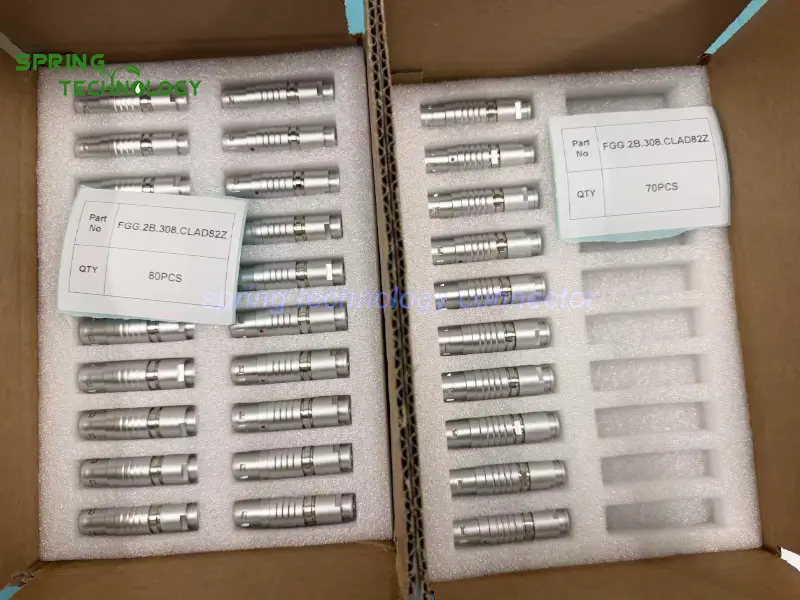
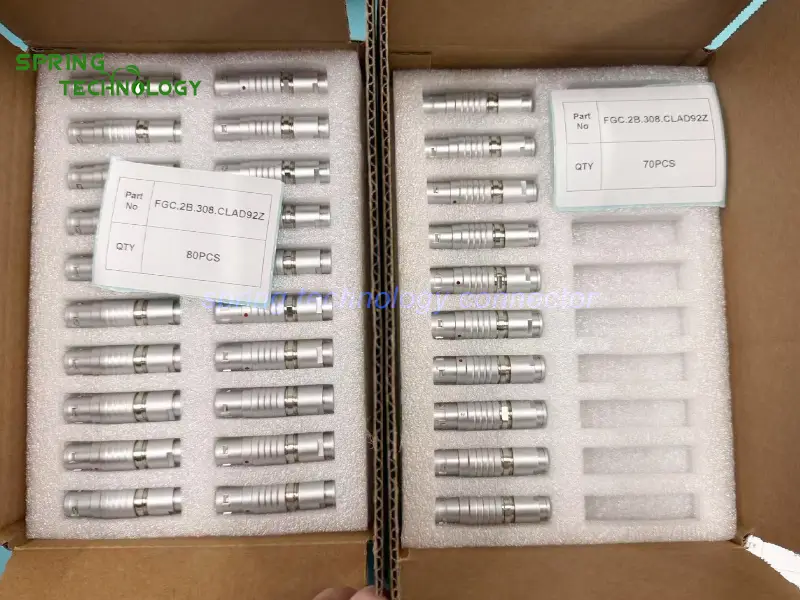
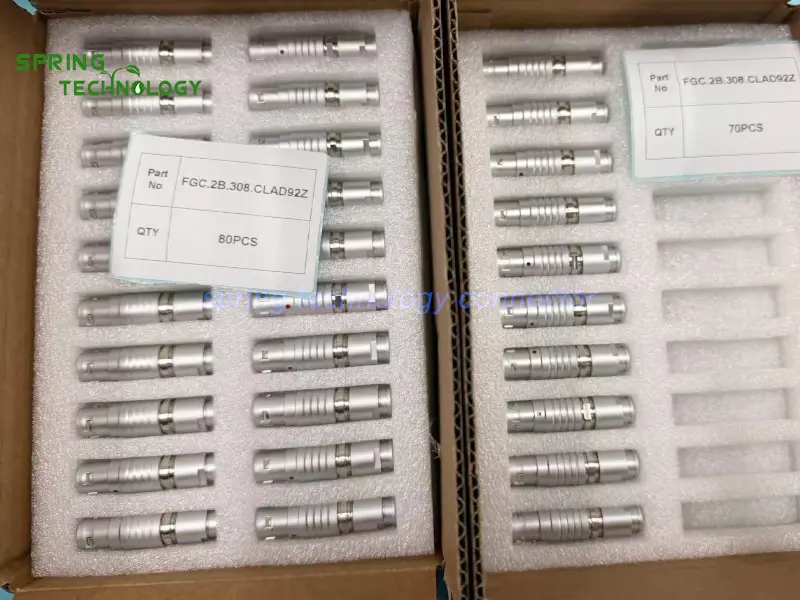
This 2B connector delivery shows how Spring Technology serves battery test equipment — from the eight contacts and 10 A rating of the CBTG2BG-SMSM08-D82B to its shielding and defined cable compatibility, every detail was aligned with the customer’s battery module tester requirements. Spring Technology also provides professional customization services for both push-pull connectors and cable assemblies, offering tailored solutions to meet your specific technical requirements.
For more information about our 2B series connectors or to discuss your requirements, contact us at [email protected] or [email protected], or visit our website.
Building a battery test bench or production-line test station? Send us your channel and cable requirements — our engineering team will respond with a tailored CBTG2BG push-pull connector proposal for your battery module charge-discharge testers within 24 hours.
Further Reading
- CBZC2BG Push-Pull Connector for Programmable DC Electronic Loads 2026: 2B Series 2-Contact 25 A Power Socket for High-Current DC Test Interfaces
- CBZE2BG Push-Pull Connector for Programmable DC Power Supplies 2026: 2B Series 2-Contact 20.5 A Output Socket for High-Power Power Equipment
- Push-Pull Connector for Automated Test Equipment 2026: CBZC1BG-SFSM07-0000 and CBTA1BG-SMSM07-0000 for High-Precision Test, Measurement and Industrial Robotics for US Customers
- Push-Pull Connector for Data Acquisition 2026: CBZG0BG-SFSM06, CBZG1BG-SFSM06 and CBZG0BB-SFSM06 for Test, Measurement and Industrial Data Acquisition for Russian Customers
- CBZG00BG Push-Pull Connector for Insulation Resistance Testers 2026: 00B Series 4-Contact M7 Panel Socket for Portable Test Instruments for US Client
- TGG.2B Connector — Product Page
- 2B Series Connector