

CBME1BJ Push-Pull Connector for Ground Penetrating Radar Systems 2026: 1B 8-Contact Hermetic Socket
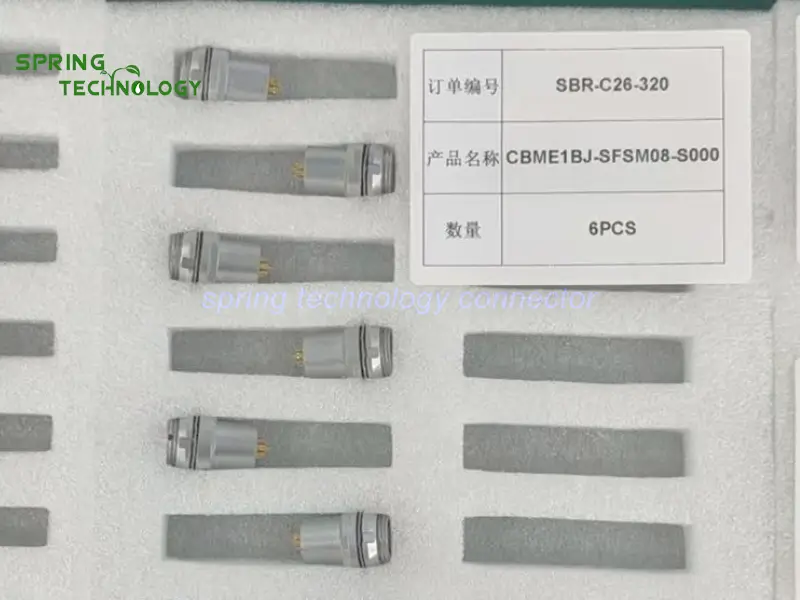
The CBME1BJ-SFSM08-S000 is a CBME1BJ push-pull connector for ground penetrating radar systems — a 1B rear-panel-mounted hermetic receptacle using the 1B.308 contact configuration with eight low-voltage contacts, a published maximum contact resistance of 6.1 mΩ, a PPS insulator, a push-pull self-locking mechanism, nut fixing with rear-panel mounting, solder termination, watertight or vacuumtight construction, IP68 protection on the 1B hermetic platform, operation from -45 °C to +125 °C, vibration resistance of 10~20,000 Hz at 15 g, salt spray resistance beyond 48 h and more than 5,000 mating cycles. Every specification in this guide is backed by the geophysical survey equipment interconnect engineering of Spring Technology.
Pain point: Getting encoder feedback, trigger and sensor lines off a GPR antenna platform into the control enclosure — where the hardware is carried between roads, buildings and utility trenches, the rear panel is the only clean entry point, and the radio-frequency paths must stay strictly separate from these auxiliary circuits?
Core answer: The CBME1BJ-SFSM08-S000 can be considered as a panel-mounted interface for auxiliary low-voltage connections in ground penetrating radar data acquisition and antenna control systems. GPR is a non-destructive testing technology that uses electromagnetic waves to investigate underground structures and materials — the antenna transmits pulses into the ground, and when these signals encounter boundaries between materials or buried objects part of the energy is reflected back to the receiving antenna, with the control unit recording the reflected signals and processing the data into subsurface images. Typical uses include underground water pipe and utility detection, buried electrical cable location, road pavement and structural layer inspection, concrete structure investigation, and underground void and buried object detection. A system may include a transmitting and receiving antenna, a radar control and data acquisition unit, an antenna positioning or distance encoder, a trigger and synchronisation circuit, auxiliary sensors and monitoring electronics, and a display and data storage system.
1. Technical Parameters & Engineering Standards
The CBME1BJ-SFSM08-S000 is a rear-panel hermetic receptacle on the 1B platform, using the 1B.308 contact configuration.
- Latching Mechanism: Push-pull self-locking mechanism (simple push-pull operation, no threaded coupling rotation)
- Recommended Hardware: Spring Technology Circular Connector and custom cable assembly service
- Key Metric: 8 low-voltage contacts (1B.308); 6.1 mΩ; rear-panel mounting; IP68 on the hermetic platform; >5,000 cycles
1.1 Configuration Summary
| Parameter | Value |
|---|---|
| Model | CBME1BJ-SFSM08-S000 |
| Body | 1B fixed rear-panel hermetic receptacle (MEG), female contacts |
| Contact configuration | 1B.308 — 8 low-voltage contacts |
| Maximum contact resistance | 6.1 mΩ |
| Insulator | PPS (polyphenylene sulfide) |
| Mounting | Rear-panel mounting, nut fixing |
| Sealing | Watertight / vacuumtight construction; IP68 on the 1B hermetic platform |
| Termination | Solder |
| Mating cycles | >5,000 cycles |
1.2 Shared 1B Hermetic Platform Specifications
| Parameter | Value |
|---|---|
| Series | 1B shell — MEG hermetic fixed socket |
| Pin counts available | 2–16 pins across the 1B shell; this model uses the eight-contact 1B.308 layout |
| Fastening / mounting | Push-pull fastening; nut fixing with rear-panel mounting; watertight or vacuumtight |
| Protection level | IP68 |
| Operating temperature | -45 °C ~ +125 °C |
| Humidity | Up to 95% maximum at 60 °C |
| Vibration resistance | 10~20000 Hz, 15 g |
| Shock resistance | 100 g · 6 ms |
| Salt spray resistance | >48 h |
| Materials | Chrome-plated brass shell, gold-plated brass contacts, PPS insert |
| Keying | Key G or keys A…M and R to prevent mismating |
Note: the connector should not automatically be treated as the RF antenna interface — GPR transmit and receive paths require suitable RF transmission components designed for the antenna’s operating frequency and signal characteristics. Environmental protection must be verified against the complete ordered part number: a separately specified sealed variant may document unmated sealing performance that should not be automatically transferred to other versions.
2. Key Advantages of the CBME1BJ-SFSM08-S000
Radar hardware travels, and every site is a new panel. The design advantages below explain why this CBME1BJ push-pull connector for ground penetrating radar systems suits portable GPR control enclosures:
2.1 Eight Contacts for Multiple Auxiliary Signals
- The connector uses an 8-contact configuration in the 1B series. A GPR system may require several auxiliary connections between antenna platform and control electronics, including positioning encoder feedback, external triggering, sensor signals and status monitoring — and the 8-contact arrangement gives designers flexibility to organise multiple low-voltage circuits through one interface, reducing separate panel connections and simplifying cable management.
2.2 Rear-Panel Mounting for Enclosure Integration
- The hermetic connector design uses a fixed rear-panel mounting structure, suitable for integration into the rear panel of a GPR control unit, electronic enclosure or auxiliary signal compartment. It lets the receptacle be secured to the equipment panel while its solder contacts connect to the internal wiring harness — helping organise internal connections and providing an accessible external interface for detachable cable assemblies.
2.3 Push-Pull Locking for Convenient Field Maintenance
- GPR equipment is frequently transported between construction sites, roads, buildings and underground utility survey locations, and during setup and maintenance technicians may need to connect or disconnect antenna accessories and auxiliary cables. The push-pull self-locking mechanism allows a compatible plug to be connected or released through a simple push-pull operation — simplifying field installation, inspection and cable replacement without repeatedly rotating a threaded coupling.
2.4 Low Contact Resistance for Stable Electrical Connections
- The 1B.308 contact configuration has a maximum contact resistance of 6.1 mΩ according to the published technical information, helping maintain stable electrical connections in low-voltage control and sensor circuits — beneficial for encoder feedback, trigger signals and auxiliary sensor connections, though overall signal quality also depends on cable shielding, grounding, signal conditioning and the electrical design of the complete system.
2.5 PPS Insulator for Electrical Insulation
- The connector uses a PPS (polyphenylene sulfide) insulator, supporting the electrical insulation requirements of compact multi-contact instrumentation interfaces — a material suitable for equipment where stable insulation performance and dimensional stability are important, and therefore relevant to auxiliary signal connections within industrial measurement and data acquisition equipment.
2.6 Designed for Repeated Mating Operations
- The published specification lists a mechanical endurance of 5,000 mating cycles for the corresponding 1B.308 configuration. GPR equipment may undergo frequent setup, transport, antenna replacement and cable maintenance, so a reusable push-pull interface simplifies repeated connection operations and reduces routine maintenance work.
3. Why Choose the CBME1BJ-SFSM08-S000?
Ground penetrating radar systems require organised electrical interfaces between their control units, antenna platforms and auxiliary sensors. This CBME1BJ push-pull connector for ground penetrating radar systems offers an 8-contact configuration, a rear-panel mounting structure and a push-pull locking mechanism — characteristics that make it a potential connection solution for auxiliary low-voltage circuits in GPR data acquisition and antenna control systems, where the rear-panel arrangement supports integration into compact enclosures and the push-pull mechanism makes external cable handling more convenient for field technicians.
4. 1B Series Connector Family Overview
The 1B shell belongs to Spring Technology’s push-pull connector family for survey and measurement equipment. The same platform serves this CBME1BJ push-pull connector for ground penetrating radar systems and scales across hermetic sockets, standard panel sockets, plugs and PCB sockets.
4.1 Available Configurations
- Hermetic sockets: MEG 1B fixed sockets (as used here), watertight or vacuumtight with rear-panel mounting.
- Standard panel sockets: ZGG.1B, ZEG.1B and ZCG.1B fixed panel sockets for front-panel mounting.
- PCB-contact sockets: straight and elbow PCB termination panel sockets.
- Plugs: TG 1B straight plugs and TN body style 1B plugs for detachable cable assemblies.
- Pin counts: 2–16 contacts across the 1B shell, with key G or keys A…M and R.
4.2 Customization Services
- Custom contact allocations and part numbers (such as the CBME1BJ-SFSM08-S000) matched to each GPR enclosure layout.
- Encoder, trigger and auxiliary sensor cable assemblies with defined screening and bend relief.
- Rear-panel cutout and sealed-mounting consultation for field equipment.
- Mating plug selection support, including keying and contact-layout confirmation.
5. Frequently Asked Questions (FAQ)
Conclusion & Call to Action
The CBME1BJ-SFSM08-S000 is a potential connector solution for ground penetrating radar data acquisition and antenna control systems — its 8-contact configuration supports multiple auxiliary low-voltage connections, while the rear-panel mounting structure allows convenient integration into GPR control enclosures. Combined with push-pull locking, PPS insulation and the mechanical endurance specified for the 1B.308 configuration, the connector offers a practical option for detachable sensor and control cable assemblies. This connector shows how Spring Technology serves geophysical survey equipment, aligning a sealed 1B socket with the customer’s GPR enclosure requirements, and the company also provides professional customization services for both push-pull connectors and cable assemblies, offering tailored solutions to meet your specific technical requirements.
For more information about our 1B series connectors or to discuss your requirements, contact us at [email protected] or [email protected], or visit our website. Our engineering team will respond to your CBME1BJ push-pull connector for ground penetrating radar systems enquiry within 24 hours.
Further Reading
- Push-Pull Connector for Geophysical Exploration 2026: CBTG3FN-SMSM03-D720 and CBTG4FN-SMSM02-D720 Plugs for Field Survey and Industrial Power for Russian Customers
- CBZE1KG Push-Pull Connector for GNSS Surveying Receivers 2026: 1K Series 10-Contact IP68 PCB Socket for Outdoor Positioning Terminals for US Customers
- B Series Push-Pull Connectors for SLAM Mobile Mapping 2026: Compact Interconnects for LiDAR, IMU and GNSS Payloads on Survey Backpacks and Drone Pods for US Client
- CBTG2BG Push-Pull Connector for Railway Track Geometry Trolleys 2026: 2B 10-Contact Plug
- CBTG2FN Push-Pull Connector for Precision Machine Tools 2026: CBTG2FN-SMSM09-D520 and CBZL2FN-SFPM09-S000 for Multi-Channel Miniature Sensor Aggregation for Russian Client
- MEG.1B Fixed Socket — Product Page
- 1B Series Connector