

CBTG1BG Push-Pull Connector for Pantograph Strip Thickness Gauges 2026: 1B 5-Contact Plug
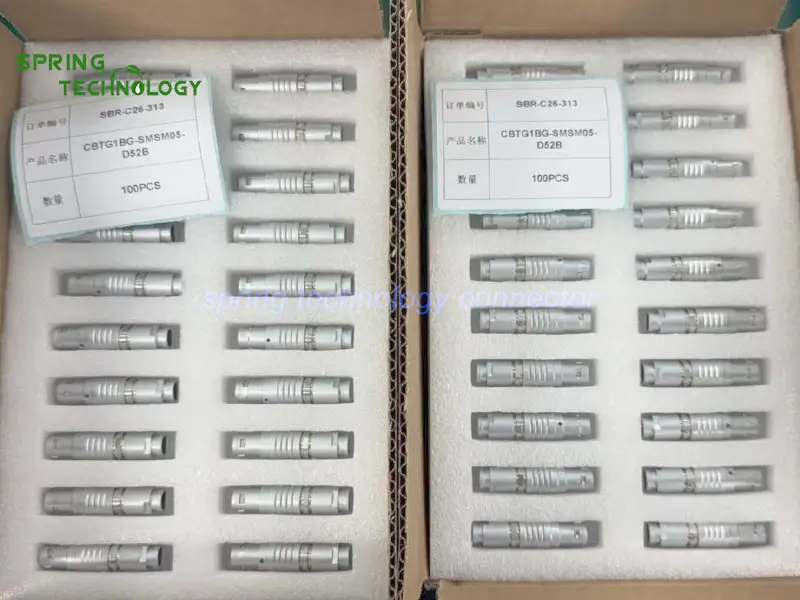
The CBTG1BG-SMSM05-D52B is a CBTG1BG push-pull connector for pantograph strip thickness gauges — a 1B straight cable plug with five low-voltage contacts, a published rated current of 9 A, a maximum contact resistance of 4.8 mΩ, published minimum shielding performance of 75 dB at 10 MHz and 40 dB at 1 GHz, a push-pull self-locking mechanism, a cable collet with a nut for fitting a bend relief, a supported cable outside diameter of 4.30–5.20 mm, a PPS insert, a mechanical endurance of 5,000 mating cycles and IP50 protection. Every specification in this guide is backed by the railway maintenance equipment interconnect engineering of Spring Technology.
Pain point: Sliding a laser probe along a carbon strip on a live depot road — where the head is moved from pantograph to pantograph, the cable flexes against the roof frame, and millivolt measurement signals have to stay clean beside traction and signalling electronics?
Core answer: The CBTG1BG-SMSM05-D52B can be considered for the cable connection between a measurement probe and a handheld processing unit in portable railway pantograph carbon strip thickness measurement equipment. These instruments measure the remaining thickness and wear condition of carbon contact strips installed on railway pantographs — strips that continuously slide against overhead contact wires, so that over time the contact causes material loss, surface damage and uneven wear, and regular inspection helps maintenance teams identify worn or damaged strips before they affect current collection performance. A typical measurement system includes a laser displacement sensor or optical measurement probe, a measurement and signal-processing circuit, a trigger or positioning sensor, a handheld display or data processing unit, and a connecting cable assembly between probe and controller.
1. Technical Parameters & Engineering Standards
The CBTG1BG-SMSM05-D52B is a straight cable plug on the 1B platform, offered with a five-contact configuration.
- Latching Mechanism: Push-pull self-locking mechanism (simple push-pull operation, no threaded coupling rotation)
- Recommended Hardware: Spring Technology Circular Connector and custom cable assembly service
- Key Metric: 5 low-voltage contacts; 9 A; 4.8 mΩ; shielded 75 dB / 40 dB; cable 4.30–5.20 mm; 5,000 cycles; IP50
1.1 Configuration Summary
| Parameter | Value |
|---|---|
| Model | CBTG1BG-SMSM05-D52B |
| Body | 1B straight cable plug, male solder contacts |
| Contacts | 5 low-voltage contacts |
| Rated current | 9 A |
| Maximum contact resistance | 4.8 mΩ |
| Shielding performance | 75 dB at 10 MHz; 40 dB at 1 GHz (published minimum) |
| Cable outside diameter | 4.30–5.20 mm (1B platform range 2.2–7.5 mm) |
| Cable fixation | Cable collet plus nut for fitting a bend relief |
| Insert material | PPS (polyphenylene sulfide) |
| Mating cycles | 5,000 cycles |
| Protection | IP50 |
1.2 Shared 1B Platform Specifications
| Parameter | Value |
|---|---|
| Series | 1B shell — TG straight cable plug |
| Pin counts available | 2–16 pins across the 1B shell, including the five-contact layout used here |
| Cable opening | 2.2–7.5 mm, with cable collet |
| Operating temperature | -45 °C ~ +125 °C |
| Humidity | Up to 95% maximum at 60 °C |
| Vibration resistance | 10~20000 Hz, 15 g |
| Shock resistance | 100 g · 6 ms |
| Salt spray resistance | >48 h |
| Materials | Chrome-plated brass shell, gold-plated brass contacts, PPS insert |
| Keying | Key G or keys A…M and R to prevent mismating |
Note: overall measurement accuracy depends on the sensor, signal-conditioning circuit, cable design and calibration process — connector specification alone does not define system accuracy. IP50 is an indoor or protected-environment rating, not a water-exposure rating.
2. Key Advantages of the CBTG1BG-SMSM05-D52B
One probe, many pantographs. The design advantages below explain why this CBTG1BG push-pull connector for pantograph strip thickness gauges suits portable railway measurement equipment:
2.1 Five Contacts for Multiple Measurement Signals
- The connector provides five low-voltage contacts in a compact 1B configuration. A portable pantograph measurement instrument may need separate electrical paths for sensor power, measurement output, trigger input and auxiliary status signals, and the five-contact arrangement lets designers organise these connections through one circular cable interface — simplifying the wiring between the measurement probe and the handheld controller.
2.2 Push-Pull Self-Locking for Fast Connection
- Railway maintenance personnel may need to inspect multiple pantographs during a maintenance session, so the measurement cable may be connected and disconnected repeatedly. The push-pull self-locking mechanism allows the compatible receptacle to be connected and released through a simple push-pull operation — reducing connection time during inspection, equipment setup and maintenance without repeated rotation of a threaded coupling.
2.3 Low Contact Resistance for Reliable Signal Connections
- The connector has a maximum contact resistance of 4.8 mΩ according to the published technical specifications, helping establish consistent electrical connections between the measurement probe and the processing unit — important for sensor power and measurement signal transmission in precision thickness measurement equipment.
2.4 Cable Collet for Secure Cable Assembly
- The CBTG1BG-SMSM05-D52B includes a cable collet and a nut designed for fitting a bend relief, and supports cable outer diameters from 4.30 to 5.20 mm. This structure secures the cable assembly and organises the connection between probe and instrument, while proper cable fixation helps reduce mechanical stress on the soldered contacts during routine handling.
2.5 Shielding Performance for Measurement Electronics
- The published specification lists minimum shielding performance of 75 dB at 10 MHz and 40 dB at 1 GHz — helping reduce electromagnetic coupling when the connector is used with properly shielded cables and a suitable grounding design, which is beneficial for protecting low-voltage sensor signals from interference generated by nearby electronic circuits.
2.6 PPS Insulator for Electrical Insulation
- The connector uses a PPS (polyphenylene sulfide) insert, supporting the electrical insulation requirements of compact instrumentation connections. The material suits applications where stable insulation performance and dimensional stability are important, and supports the connector’s compact multi-contact configuration.
2.7 Designed for Repeated Mating Operations
- The published specification lists a mechanical endurance of 5,000 mating cycles for the CBTG1BG-SMSM05-D52B — useful for portable inspection equipment that undergoes frequent cable connection, disconnection, testing and maintenance, where a reusable push-pull interface reduces routine connection work and supports long-term equipment upkeep.
3. Why Choose the CBTG1BG-SMSM05-D52B?
Portable railway pantograph inspection instruments require reliable electrical connections between their measurement probes and processing units, and their cable assemblies must support convenient handling, stable signal connections and repeated maintenance operations. This CBTG1BG push-pull connector for pantograph strip thickness gauges combines five low-voltage contacts, a straight cable plug design and a push-pull self-locking mechanism — with a compact configuration that suits connecting optical or displacement measurement probes to handheld processing electronics, and a cable collet that provides a practical solution for assembling and securing the external measurement cable. Final selection should consider the complete mating connector, contact assignment, operating current, cable specifications and environmental protection requirements.
4. 1B Series Connector Family Overview
The 1B shell belongs to Spring Technology’s push-pull connector family for industrial instruments and railway maintenance equipment. The same platform serves this CBTG1BG push-pull connector for pantograph strip thickness gauges and scales across plugs, panel sockets and PCB sockets.
4.1 Available Configurations
- Plugs: TG 1B straight plugs with cable collet, including the five-contact layout used here.
- Panel sockets: ZGG.1B, ZEG.1B and ZCG.1B fixed panel sockets.
- PCB sockets: ZX 1B sockets with PCB contacts, plus straight PCB-contact panel sockets.
- Pin counts: 2–16 contacts across the 1B shell, with key G or keys A…M and R.
4.2 Customization Services
- Custom contact allocations and part numbers (such as the CBTG1BG-SMSM05-D52B) matched to each gauge’s probe wiring.
- Shielded probe cable assemblies with 360° screen termination and bend relief.
- Grounding and EMC support for displacement-sensor and trigger circuits.
- Mating receptacle selection support, including keying and contact-layout confirmation.
5. Frequently Asked Questions (FAQ)
Conclusion & Call to Action
The CBTG1BG-SMSM05-D52B is a potential connector solution for portable railway pantograph carbon strip thickness measurement equipment — its five-contact configuration supports multiple low-voltage measurement and control circuits, while the push-pull locking mechanism allows convenient connection and disconnection. The cable collet, low contact resistance and specified shielding performance further support its use in portable measurement cable assemblies, and for manufacturers developing railway inspection and maintenance instruments it offers a compact connection option between measurement probes and handheld processing units. This connector shows how Spring Technology serves railway maintenance equipment, aligning a shielded 1B plug with the customer’s pantograph gauge requirements, and the company also provides professional customization services for both push-pull connectors and cable assemblies, offering tailored solutions to meet your specific technical requirements.
For more information about our 1B series connectors or to discuss your requirements, contact us at [email protected] or [email protected], or visit our website. Our engineering team will respond to your CBTG1BG push-pull connector for pantograph strip thickness gauges enquiry within 24 hours.
Further Reading
- CBTG0BG Push-Pull Connector for Railway Wheel Profile Gauges 2026: 0B 7-Contact Plug
- CBTG2BG Push-Pull Connector for Railway Track Geometry Trolleys 2026: 2B 10-Contact Plug
- CBTH0BG Push-Pull Connector for Railway Signaling Relay Test Equipment 2026: 0B 5-Contact Elbow Plug
- TGN.103F.303.CLAD72 103F Railway Plug: 560pcs 3-Pin Waterproof Connector for Railway Control System | Russia to Spring Technology
- CBTG2FN Push-Pull Connector for Precision Machine Tools 2026: CBTG2FN-SMSM09-D520 and CBZL2FN-SFPM09-S000 for Multi-Channel Miniature Sensor Aggregation for Russian Client
- TGG.1B Straight Plug — Product Page
- 1B Series Connector