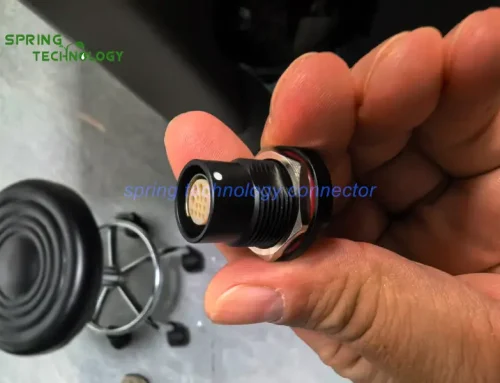


CBTG2BG Push-Pull Connector for Industrial Robot Controllers 2026: 2B Series 19-Pin Connector for Robot Control Cabinets for US Client
The CBTG2BG-SMSM19-D52B is a CBTG2BG push-pull connector for industrial robot controllers — a 19-contact circular connector in a compact 2B size with 19 low-voltage contacts, a 5 A current rating, metal shielding of 75 dB at 10 MHz and 40 dB at 1 GHz, IP50 protection and a lifespan of 5,000 mating cycles. Every specification in this guide is backed by the industrial automation interconnect engineering of Spring Technology.
Pain point: Wiring an industrial robot control cabinet — where motion control, I/O signals, actuator feedback and peripheral communications must all leave one cabinet panel, in a space already filled with PLCs, drives and power modules?
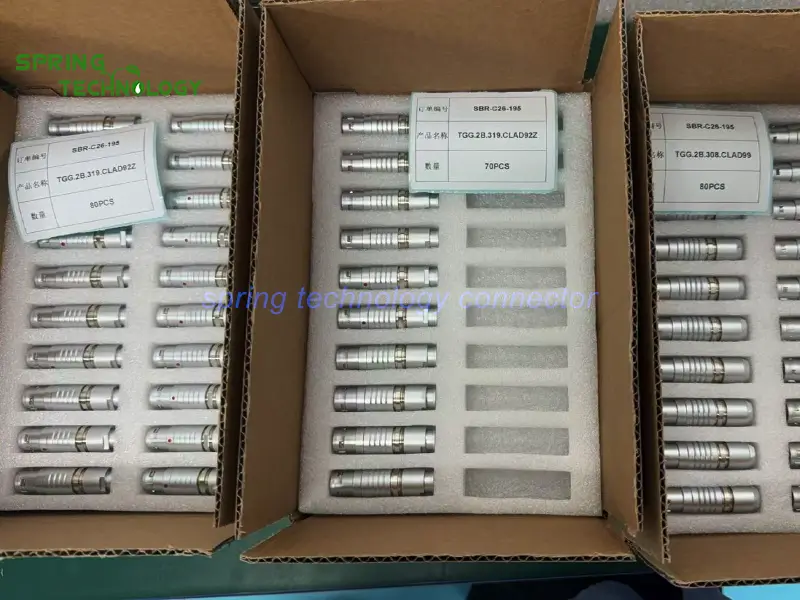
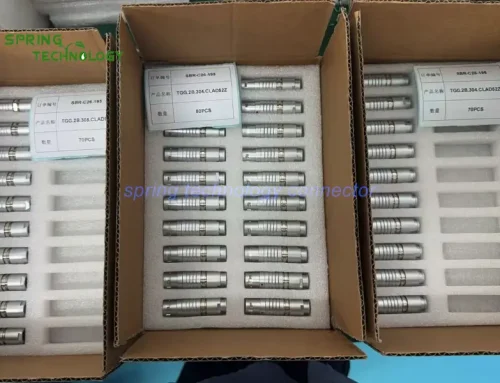
Core answer: For a US client, Spring Technology supplied the CBTG2BG-SMSM19-D52B, a 2B size CBTG2BG push-pull connector for industrial robot controllers. Industrial robot control cabinets are critical control units within robotic systems, responsible for managing robot motion control, I/O signals, actuator feedback and peripheral device communication. In a robotic workstation, the control cabinet typically requires multiple electrical connections to the robot arm, teach pendant, sensors, actuators and peripheral automation equipment, and relying on numerous independent connectors not only increases the number of interface points but also complicates installation and maintenance. For cabinets requiring multiple low-voltage control and signal lines, this 19-pin multi-contact connector provides a more consolidated interface solution.
1. Technical Parameters & Engineering Standards
This robot controller connector is built on the 2B series push-pull platform, a mid-size circular connector family used in industrial control, robotics, test and measurement, and transportation equipment.
- Latching Mechanism: Push-pull self-locking mechanism (locks by insertion, releases quickly for disconnection)
- Recommended Hardware: Spring Technology Circular Connector
- Key Metric: 19 low-voltage contacts; 5 A rated current; 75 dB shielding at 10 MHz; 5,000 mating cycles
| Parameter | Value |
|---|---|
| Connector (this order) | CBTG2BG-SMSM19-D52B — TG plug, 2B shell, key G, 19 contacts |
| Contacts | 19 low-voltage contacts, 0.7 mm contact diameter |
| Rated current | Max. 5 A |
| Wire gauge | 30–22 AWG |
| Shell size | 2B (compact size, high-density 19-pin configuration) |
| Locking | Push-pull self-locking mechanism |
| Protection | IP50 |
| Mating life | 5,000 cycles |
| Shielding | Min. 75 dB at 10 MHz, 40 dB at 1 GHz |
| Shock resistance | 100 g |
| Vibration resistance | 15 g |
| Application | Industrial robot control cabinets and automation control equipment |
| Contact finish | Gold-plated |
2. Robot Controller Connector Design Highlights
Robot cabinets concentrate many signals in very little panel space. The design advantages below explain why this CBTG2BG push-pull connector for industrial robot controllers suits control cabinet wiring:
2.1 19-Pin Design for Multi-Channel Control Signals
- Industrial robot control cabinets handle a large volume of I/O and control signals — sensor feedback, actuator control, status signals and peripheral device interfaces. With 19 low-voltage contacts of 0.7 mm diameter, support for 30–22 AWG wire gauges and a maximum rated current of 5 A, the 19-pin configuration integrates more low-voltage lines into a single connector than connectors with fewer pins, helping reduce the number of external interfaces on the cabinet.
2.2 Push-Pull Quick-Lock for Maintenance Efficiency
- Robot production lines run continuously alongside periodic maintenance, commissioning and equipment replacement. The push-pull self-locking mechanism locks by simple insertion and releases quickly for disconnection, eliminating the repetitive rotation required by traditional threaded connectors — significantly reducing the time spent handling connectors during frequent cabinet wiring, commissioning and maintenance.
2.3 Compact 2B Size for Efficient Cabinet Layout
- Robot control cabinets house PLCs, drives, relays, power modules and communication modules, making space utilization critical. The 2B size with a high-density 19-pin configuration provides a high number of contacts within a relatively compact footprint, minimizing the panel space occupied by multiple individual interfaces.
2.4 Metal Shielding for Industrial Control Environments
- Servo drives, motors and power modules are often located near robot control cabinets, placing high demands on EMC design. The metal housing and shielding structure deliver minimum shielding performance of 75 dB at 10 MHz and 40 dB at 1 GHz, well suited to robot control and industrial automation systems requiring robust electromagnetic compatibility.
2.5 5,000-Mating-Cycle Durability for Long-Term Industrial Use
- Robotic production lines require continuous, long-term operation while control cabinet connectors undergo frequent maintenance and reconnection. A mating durability of 5,000 cycles reduces the need for connector replacement during frequent maintenance, ideal for industrial automation equipment requiring long-term operation.
2.6 Shock and Vibration Resistance for Robotic Control Systems
- Robotic systems generate mechanical motion and vibration during operation, so connectors within the control system must maintain stable mechanical connections. With 100 g shock resistance and 15 g vibration resistance, the connector suits environments such as industrial control, test and measurement, transportation and robotics, serving as a reliable signal interface between the cabinet and external equipment.
2.7 Centralized Multi-Signal Connection Simplifies Interfaces
- Industrial robotic systems incorporate multiple peripheral modules, and a 19-pin connector lets designers consolidate multiple low-voltage control signals into a single interface. Pins can be allocated by system requirements to: robot I/O signals; sensor feedback; actuator control signals; status monitoring signals; auxiliary control lines; and other low-voltage signals — reducing the number of individual connections between the cabinet and peripheral equipment for more centralized system cabling.
3. 2B Series Connector Family Overview
The 2B shell is part of Spring Technology’s push-pull self-locking connector family, used in industrial control, robotics, test and measurement, and transportation equipment. The same platform serves this robot controller connector and scales across pin counts and shell variants.
3.1 Available Configurations
- Shells: 2B shell size, with 0B and 1B siblings for smaller layouts.
- Pin counts: 2 to 26 contacts with solder terminations, including the high-density 19-pin layout.
- Connectors: plugs, free sockets and panel-mount sockets.
- Contacts: gold-plated contacts with wire gauges from 30 to 22 AWG on the 19-pin configuration.
3.2 Customization Services
- Custom contact allocations and part numbers (such as the CBTG2BG-SMSM19-D52B) matched to each cabinet’s I/O and feedback plan.
- Shielding and EMC verification for drive-heavy environments.
- Pre-wired robot arm, teach pendant and peripheral harnesses.
- Key orientation selection to keep power, control and signal circuits segregated.
4. Applications: Industrial Robot Control Cabinets
Robot cells depend on centralized, serviceable cabinet interfaces. This CBTG2BG push-pull connector for industrial robot controllers delivers them.
4.1 Robot Control Cabinets
Motion control, I/O and peripheral signals leave the cabinet through 19-pin interfaces instead of many separate connectors, simplifying installation and maintenance.
4.2 Robot Arms, Teach Pendants and Actuators
Connections to the robot arm, teach pendant, sensors and actuators consolidate into the same multi-contact interface, reducing panel interface points.
4.3 Automation Control Equipment
Other automation control equipment that needs shielded, high-density low-voltage connections benefits from the same 2B platform.
5. Frequently Asked Questions (FAQ)
Conclusion & Call to Action
This 2B connector delivery for the US client shows how Spring Technology serves industrial automation — from the 19 contacts and 5 A rating of the CBTG2BG-SMSM19-D52B to its shielding and centralized signal allocation, every detail was aligned with the customer’s robot control cabinet requirements. Spring Technology also provides professional customization services for both push-pull connectors and cable assemblies, offering tailored solutions to meet your specific technical requirements.
For more information about our 2B series connectors or to discuss your requirements, contact us at [email protected] or [email protected], or visit our website.
Building a robot control cabinet or automation cell? Send us your I/O and feedback requirements — our engineering team will respond with a tailored CBTG2BG push-pull connector proposal for your industrial robot controllers within 24 hours.
Further Reading
- Push-Pull Connector for Industrial Robotics 2026: CBZC0BG-SFSM04, CBZC0BG-SFSM06 and CBTE0BG-SMSM06 for High-Precision Test, Measurement and Industrial Robotics for Russian Customers
- Push-Pull Connector for Control Cabinets 2026: CBTG2BG-SMSM02-D52B and CBME2BG-SFSM10-0000 for Advanced Industrial Automation and Robotics Control Cabinets for Russian Customers
- Push-Pull Connector for Robot Control Panels 2026: CBTG2BG-SMSM08-D990 for Heavy-Duty Teach Pendants and Control Panels for Canadian Distributor
- Push-Pull Connector for Industrial Applications 2026: 24-Model 0B 1B 2B Portfolio for Russian Distributor
- CBZL3FN Push-Pull Connector for Industrial Control Modules 2026: ZL 3F and 5F Receptacles for Compact and High-Power Automation Modules for Russian Clients
- TGG.2B Push-Pull Self-Locking Connector — Product Page
- 2B Series Connector