

CBTG1BG Push-Pull Connector for Force/Torque Sensor Modules 2026: 1B 16-Contact Plug
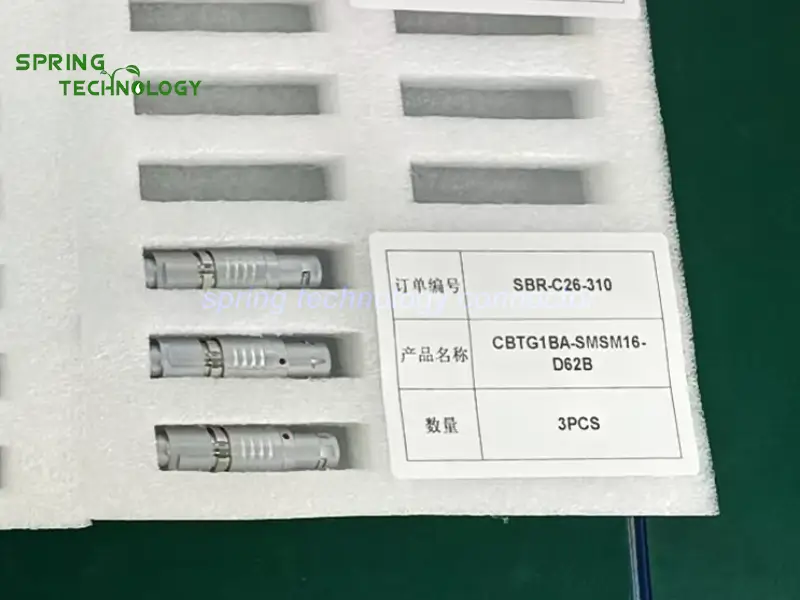
The CBTG1BG-SMSM16-D62B is a CBTG1BG push-pull connector for force/torque sensor modules — a 1B straight cable plug with sixteen low-voltage contacts, a rated current of 2 A, published minimum shielding performance of 75 dB at 10 MHz and 40 dB at 1 GHz, a push-pull self-locking mechanism, a nut for fitting a cable bend relief, a supported cable outside diameter of 5.30–6.20 mm, wire sizes from AWG 34 to AWG 28, 5,000 mating cycles, a shielded construction and IP50 protection. Every specification in this guide is backed by the robotics and sensor interconnect engineering of Spring Technology.
Pain point: Landing sixteen low-level circuits between a sensor on the robot flange and its conditioning electronics — where the cable flexes around tool changers all shift, maintenance swaps end-effectors, and millivolt strain-gauge signals sit next to drives and welding equipment?
Core answer: The CBTG1BG-SMSM16-D62B can support sensor signal and control connections in six-axis force/torque measurement modules for robotic polishing and deburring systems. These modules are important components in precision industrial automation and are commonly integrated into robotic grinding, polishing, deburring and precision assembly equipment. A six-axis force/torque sensor measures forces along three axes (Fx, Fy, Fz) and moments around three axes (Mx, My, Mz), and the measurement data helps the robot controller understand the contact condition between the end tool and the workpiece — with a typical system comprising the sensor, a signal conditioning module, sensor excitation and acquisition electronics, a data transmission interface, and the robot controller or industrial computer. The connector can be considered for the multi-wire electrical interface between a sensor assembly and its signal conditioning or acquisition module, with its sixteen contacts providing options for sensor signals, excitation circuits, temperature compensation and auxiliary control lines depending on the sensor’s electrical architecture.
1. Technical Parameters & Engineering Standards
The CBTG1BG-SMSM16-D62B is a straight cable plug on the 1B platform, offered with a sixteen-contact configuration — the full pin count of the shell.
- Latching Mechanism: Push-pull self-locking mechanism (secure after insertion, convenient disconnection without a threaded coupling)
- Recommended Hardware: Spring Technology Circular Connector and custom cable assembly service
- Key Metric: 16 low-voltage contacts; 2 A; shielded 75 dB / 40 dB; cable 5.30–6.20 mm; AWG 34–28; 5,000 cycles
1.1 Configuration Summary
| Parameter | Value |
|---|---|
| Model | CBTG1BG-SMSM16-D62B |
| Body | 1B straight cable plug, shielded construction |
| Contacts | 16 low-voltage contacts |
| Rated current | 2 A |
| Shielding performance | 75 dB at 10 MHz; 40 dB at 1 GHz (published minimum) |
| Cable outside diameter | 5.30–6.20 mm (1B platform range 2.2–7.5 mm) |
| Wire size | AWG 34 to AWG 28 |
| Cable fixation | Nut for fitting a cable bend relief |
| Mating cycles | 5,000 cycles |
| Protection | IP50 |
1.2 Shared 1B Platform Specifications
| Parameter | Value |
|---|---|
| Series | 1B shell — TG straight cable plug |
| Pin counts available | 2–16 pins across the 1B shell — 16 is the maximum layout, as used here |
| Cable opening | 2.2–7.5 mm, with cable collet |
| Operating temperature | -45 °C ~ +125 °C |
| Vibration resistance | 10~20000 Hz, 15 g |
| Shock resistance | 100 g · 6 ms |
| Salt spray resistance | >48 h |
| Keying | Key G or keys A…M and R to prevent mismating |
Note: for sensors that output six independent analog channels, the actual pin assignment and signal conditioning arrangement must be checked carefully — the connector should not be assumed to carry every raw strain-gauge bridge connection without verifying the wiring requirements. The complete cable assembly and signal conditioning design remain important for achieving accurate measurements.
2. Key Advantages of the CBTG1BG-SMSM16-D62B
Force feedback is only as good as the wiring that carries it. The design advantages below explain why this CBTG1BG push-pull connector for force/torque sensor modules suits modular robotic measurement equipment:
2.1 Sixteen Contacts for Multi-Circuit Sensor Connections
- A six-axis force/torque measurement system may require several electrical circuits between the sensing element and its signal conditioning electronics. The CBTG1BG-SMSM16-D62B provides 16 low-voltage contacts, allowing multiple sensor-related circuits in one connector — assignable to conditioned sensor outputs, excitation lines, temperature compensation, identification and control signals, simplifying cable harness organisation and reducing the number of separate connectors required.
2.2 Push-Pull Locking for Convenient Equipment Maintenance
- Force/torque sensors are often installed between the robot flange and the end-of-arm tool, and during maintenance, tool replacement or sensor calibration technicians may need to disconnect and reconnect the cable assembly. The push-pull self-locking mechanism secures the connector after insertion and allows convenient disconnection without a threaded coupling operation — useful for modular robotic systems where sensor assemblies and end tools change during production-line maintenance.
2.3 Shielding to Help Protect Low-Level Measurement Signals
- Force/torque measurement systems may process low-level electrical signals from strain gauges or other sensing elements, while industrial environments can contain motors, variable-frequency drives, welding equipment and other sources of electromagnetic interference. The published specification lists minimum shielding performance of 75 dB at 10 MHz and 40 dB at 1 GHz for this connector configuration — contributing to electromagnetic compatibility and protecting measurement signal quality when combined with properly shielded cables and a suitable grounding design.
2.4 Cable Bend-Relief Provision for Mechanical Protection
- In robotic applications, cables are routed around robot arms, tool changers and end-effectors, and repeated movement places mechanical stress on the cable near the connector termination. The D62B configuration includes a nut for fitting a cable bend relief, and a suitable accessory reduces excessive bending at the cable exit and improves the mechanical protection of the assembly — particularly relevant to robotic polishing and deburring equipment where the sensor cable moves repeatedly.
2.5 Compact Straight Plug for Modular Sensor Assemblies
- The CBTG1BG-SMSM16-D62B is a straight cable plug in the 1B series. Its compact circular design supports organised cable routing in sensor assemblies and measurement electronics, and the push-pull locking mechanism makes it convenient to integrate into modular equipment that requires regular connection and disconnection — supporting cable outside diameters of 5.30–6.20 mm and wire sizes from AWG 34 to AWG 28.
3. Why Choose the CBTG1BG-SMSM16-D62B?
A force/torque measurement module needs stable electrical connections to deliver reliable feedback to the robot controller, so connector selection affects the mechanical layout, cable assembly and maintenance process. This CBTG1BG push-pull connector for force/torque sensor modules offers:
- 16 low-voltage contacts: supports multiple sensor and control circuits in a compatible wiring architecture.
- Push-pull self-locking: allows convenient connection and disconnection during maintenance.
- Shielded construction: helps manage electromagnetic interference when integrated with a properly designed cable assembly.
- Cable bend-relief provision: helps protect the cable termination from repeated bending.
- Compact 1B-series design: supports organised connections in modular sensor equipment.
- 5,000 mating cycles: provides a defined mechanical endurance specification for repeated connection operations.
These features make the CBTG1BG-SMSM16-D62B a potential connector option for sensor signal and control interfaces in industrial force/torque measurement modules.
4. 1B Series Connector Family Overview
The 1B shell belongs to Spring Technology’s push-pull connector family for robotics and sensor equipment. The same platform serves this CBTG1BG push-pull connector for force/torque sensor modules and scales across plugs, panel sockets and PCB sockets.
4.1 Available Configurations
- Plugs: TG 1B straight plugs with cable collet, including the maximum sixteen-contact layout used here.
- Panel sockets: ZGG.1B, ZEG.1B and ZCG.1B fixed panel sockets.
- PCB sockets: ZX 1B sockets with PCB contacts.
- Pin counts: 2–16 contacts across the 1B shell, with key G or keys A…M and R.
4.2 Customization Services
- Custom contact allocations and part numbers (such as the CBTG1BG-SMSM16-D62B) matched to each sensor’s bridge and excitation wiring.
- Shielded sensor harness builds with 360° screen termination, defined pair routing and bend relief.
- Grounding and EMC support for low-level strain-gauge and excitation circuits.
- Mating receptacle selection support, including keying and contact-layout confirmation.
5. Frequently Asked Questions (FAQ)
Conclusion & Call to Action
Six-axis force/torque measurement modules help industrial robots maintain controlled contact with workpieces during polishing, grinding, deburring and precision assembly, and reliable electrical connections between the sensor assembly and its signal conditioning electronics are important for consistent measurement and control. With 16 low-voltage contacts, push-pull locking, shielding performance and a cable bend-relief provision, the CBTG1BG-SMSM16-D62B is worth evaluating for compatible sensor and control cable assemblies — with final selection based on the sensor’s wiring diagram, signal levels, current requirements, cable dimensions and operating environment. This connector shows how Spring Technology serves robotic force measurement, aligning a sixteen-contact 1B plug with the customer’s sensor module requirements, and the company also provides professional customization services for both push-pull connectors and cable assemblies, offering tailored solutions to meet your specific technical requirements.
For more information about our 1B series connectors or to discuss your requirements, contact us at [email protected] or [email protected], or visit our website. Our engineering team will respond to your CBTG1BG push-pull connector for force/torque sensor modules enquiry within 24 hours.
Further Reading
- CBTG2BG Push-Pull Connector for Industrial Robot Controllers 2026: 2B Series 19-Pin Connector for Robot Control Cabinets for US Client
- Push-Pull Connector for Industrial Robotics 2026: CBZC0BG-SFSM04, CBZC0BG-SFSM06 and CBTE0BG-SMSM06 for High-Precision Test, Measurement and Industrial Robotics for Russian Customers
- CBTG1BG Push-Pull Connector for CMM Probe Heads 2026: 1B Series 16-Contact 2 A Plug for Motorised Probe Head Cable Assemblies
- CBTG2BG Push-Pull Connector for Hydraulic Torque Wrench Pumps 2026: 2B Series 4-Contact 15 A Plug for Industrial Bolting Control Interfaces
- CBTG2FN Push-Pull Connector for Precision Machine Tools 2026: CBTG2FN-SMSM09-D520 and CBZL2FN-SFPM09-S000 for Multi-Channel Miniature Sensor Aggregation for Russian Client
- TGG.1B Straight Plug — Product Page
- 1B Series Connector