

What is Industrial Control Equipment?
Industrial control equipment refers to industrial automation control systems that integrate electronics, electrical engineering, mechanical systems, and software to achieve factory automation. These systems utilize computer technology, microelectronics, and electrical methods to make production processes more automated, efficient, accurate, controllable, and visible.
Industrial control equipment is essentially an industrial control computer – a comprehensive term for tools that use bus architecture to detect and control production processes, electromechanical equipment, and process equipment. Key characteristics include:
- Computer CPU, hard disk, memory, and peripheral interfaces
- Real-time operating systems
- Control networks and protocols
- Advanced computing functions
- User-friendly human-machine interfaces (HMI)
According to market research from 2025, the global industrial control systems market reached USD 127.8 billion and is projected to grow at a CAGR of 7.8% through 2030, driven by Industry 4.0 adoption, IoT integration, and smart manufacturing initiatives worldwide.
The five main types of industrial control equipment are: IPC (PC Bus Industrial Computer), PLC (Programmable Logic Controller), DCS (Distributed Control System), FCS (Fieldbus Control System), and CNC (Computer Numerical Control System).
1. IPC – PC Bus Industrial Computer
IPC (Industrial Personal Computer) represents a cornerstone of modern industrial control equipment. According to IDC statistics, PCs account for more than 95% of general-purpose computers. Due to their cost-effectiveness, high quality, extensive production volume, and rich software/hardware resources, IPCs have gained widespread acceptance among technical professionals.
Core Components
An IPC system consists of:
- Industrial chassis: All-steel construction for durability
- Passive backplane: Enables modular expansion
- Insertable boards: CPU cards, I/O cards, and specialized interface cards
- EMC protection: Machine card filters, dual positive pressure fans for electromagnetic interference, vibration, and dust resistance
Four Key Characteristics of IPC
Real-Time Performance
Industrial PCs perform real-time online detection and control of industrial production processes, responding rapidly to changing conditions. They collect data and adjust outputs promptly while maintaining self-reset capabilities to ensure continuous system operation.
High Reliability
IPCs are designed for harsh industrial environments including dust, smoke, extreme temperatures, humidity, vibration, and corrosive conditions. Key reliability metrics:
- MTTR (Mean Time To Repair): Generally 5 minutes
- MTTF (Mean Time To Failure): Exceeds 100,000 hours (compared to 10,000-15,000 hours for ordinary PCs)
Compatibility
IPCs support multiple bus standards simultaneously, including ISA, PCI, and PICMG resources. They accommodate various operating systems, multi-language programming, and multi-tasking environments.
Scalability
The backplane + CPU card architecture provides powerful I/O capabilities. IPCs can expand up to 20 boards and connect to diverse peripherals such as road controllers, video surveillance systems, vehicle detectors, and specialized industrial equipment.
2. PLC – Programmable Logic Controller
A PLC (Programmable Logic Controller) is a digital computing electronic system specifically designed for industrial environments. It uses programmable memory to store programs that execute logical operations, sequence control, timing, counting, and arithmetic functions to control machinery and production processes through digital or analog I/O.
Evolution and Capabilities
Programmable controllers represent a new generation of universal automatic control equipment that merges computer technology with automation control. Originally developed as a replacement for traditional relay systems, modern PLCs have evolved to incorporate advanced computer functions including:
- Logic control
- Data processing
- Communication and networking
- Motion control
- PID control
Key Advantages
PLCs offer significant benefits for industrial control applications:
- Software-based control: Control processes can be modified without hardware changes
- Compact design: Small footprint for space-constrained installations
- Easy maintenance: Modular design simplifies troubleshooting and replacement
- Simple programming: Ladder logic and other user-friendly programming languages
- High reliability: Robust construction for industrial environments
- Strong anti-interference: Excellent electromagnetic compatibility
Popular PLC Product Lines (2026)
- Schneider Electric: Quantum, Premium, Momentum series
- Rockwell Automation (AB): SLC, MicroLogix, ControlLogix series
- Siemens: SIMATIC S7-400/300/200, S7-1200, S7-1500 series
- GE Fanuc: PACSystems, VersaMax series
- Japanese manufacturers: Omron, Mitsubishi, Fuji, Panasonic
The PLC market continues to grow with the global PLC market size reaching USD 15.2 billion in 2025, driven by demand from automotive, manufacturing, and energy sectors.
3. DCS – Distributed Control System
DCS (Distributed Control System) is a high-performance, high-quality, cost-effective distributed control system with flexible configuration capabilities. DCS can form various independent control systems and distributed control networks, including SCADA (Supervisory Control and Data Acquisition) systems, meeting the process control and information management needs across diverse industrial sectors.
System Architecture
DCS features modular design with rational software and hardware function configuration, enabling easy expansion. The distributed architecture typically includes:
- Field Control Stations: Distributed I/O and control modules
- Operator Stations: HMI interfaces for monitoring and operation
- Engineering Stations: Configuration and programming workstations
- Communication Networks: High-speed data highways connecting all components
Formulários
DCS systems are widely deployed in:
- Power generation: Large, medium, and small power plants; power plant automation retrofits
- Steel industry: Process control for smelting and rolling
- Petrochemical: Refinery and chemical plant automation
- Paper manufacturing: Process control and quality management
- Cement production: Kiln control and material handling
- Water treatment: Municipal and industrial water/wastewater facilities
2026 Market Trends
The DCS market is experiencing significant transformation with:
- Integration of AI and machine learning for predictive maintenance
- Cloud-based DCS solutions for remote monitoring
- Cybersecurity enhancements for critical infrastructure protection
- Hybrid DCS-PLC architectures for flexible deployment
4. FCS – Fieldbus Control System
FCS (Fieldbus Control System) is a fully digital, serial, bidirectional communication system that interconnects, monitors, and controls field devices such as sensors, actuators, and controllers. In factory network hierarchies, FCS serves not only as a process control local network (connecting PLCs, LCs, etc.) but also integrates intelligent instruments (inverters, valves, barcode readers) and enables distributed control of application-specific functions.
Fieldbus Advantages
- Digital communication: Eliminates analog signal degradation
- Bidirectional data flow: Enables device diagnostics and configuration
- Device interoperability: Multi-vendor device integration
- Reduced wiring: Multi-drop topology minimizes cable requirements
- Enhanced diagnostics: Real-time device health monitoring
Major Fieldbus Standards
Currently, more than 40 fieldbus protocols are recognized internationally. The most prominent include:
- Foundation Fieldbus (FF): Process industry standard
- Profibus: PROFIBUS-DP for factory automation, PROFIBUS-PA for process automation
- LONworks: Building automation and control networks
- CAN/CANopen: Automotive and embedded control applications
- HART: Hybrid analog-digital protocol for process instruments
- CC-Link: Asian market industrial network
- Modbus TCP/RTU: Widely adopted open protocol
- EtherNet/IP: Ethernet-based industrial protocol
- PROFINET: Industrial Ethernet standard
Industry Adoption
Due to its broad application prospects, major manufacturers worldwide are investing heavily in fieldbus product development. The transition from traditional 4-20mA analog systems to digital fieldbus architectures continues to accelerate, particularly in process industries seeking improved efficiency and data visibility.
5. CNC – Computer Numerical Control System
CNC (Computer Numerical Control) systems represent the modern evolution of numerical control technology. Contemporary CNC systems utilize microprocessors or specialized microcomputers, with control programs implemented through system programs stored in memory. These systems realize partial or complete numerical control functions and connect to peripheral devices through standardized interfaces.
CNC Machine Tool Components
A complete CNC machine tool system comprises:
- Host (Machine Tool): Mechanical structure including bed, columns, spindles, and slides
- CNC Device: Control unit with CPU, memory, and I/O interfaces
- Drive Devices: Servo motors and amplifiers for axis motion control
- Auxiliary Devices: Coolant systems, tool changers, workpiece handlers
- Programming Equipment: CAM software and programming stations
- Measurement Systems: Encoders, scales, and probes for feedback
CNC System Capabilities
- Multi-axis interpolation (linear, circular, helical)
- Tool compensation and wear adjustment
- Adaptive feed control
- Error compensation (thermal, geometric)
- Network connectivity for DNC and Industry 4.0 integration
- Advanced HMI with 3D visualization
Market Outlook
The global CNC market reached USD 109.4 billion in 2025, with strong growth driven by:
- Precision manufacturing demands in aerospace and medical industries
- Adoption of multi-axis machining centers
- Integration of AI for adaptive machining optimization
- Growth of electric vehicle component manufacturing
2026 Industrial Control Equipment Trends
o industrial control equipment landscape is rapidly evolving with several key trends:
Industry 4.0 and IIoT Integration
Modern control systems increasingly incorporate Industrial Internet of Things (IIoT) connectivity, enabling real-time data collection, predictive maintenance, and cloud-based analytics.
Edge Computing
Processing data at the edge reduces latency and bandwidth requirements while enabling faster local decision-making in critical control applications.
Cybersecurity Focus
With increasing connectivity, industrial control systems require robust cybersecurity measures including encrypted communications, access controls, and intrusion detection.
AI and Machine Learning
AI-powered control systems can optimize processes, predict failures, and adapt to changing conditions autonomously, improving efficiency and reducing downtime.
Sustainable Manufacturing
Energy-efficient control systems and smart monitoring help manufacturers reduce carbon footprints while maintaining productivity.
Conclusion
Understanding the five main types of industrial control equipment – IPC, PLC, DCS, FCS, and CNC – is essential for selecting the right automation solution for your specific application. Each system offers unique advantages:
- IPC: Best for data-intensive applications requiring computing power and flexibility
- PLC: Ideal for discrete manufacturing and logic-based control
- DCS: Optimal for large-scale process industries with complex control requirements
- FCS: Perfect for distributed device networks requiring digital communication
- CNC: Essential for precision machining and manufacturing
As we advance through 2026, the convergence of these technologies with IIoT, AI, and cloud computing continues to reshape industrial automation. For applications requiring reliable connectivity in industrial control equipment, selecting appropriate connector solutions is critical to ensure signal integrity, environmental protection, and long-term system reliability.
Perguntas frequentes (FAQ)
What is the difference between PLC and DCS?
PLCs are typically used for discrete control applications with fast scan times and simple logic, while DCS is designed for continuous process control with distributed architecture, advanced regulatory control, and integrated safety systems. DCS is preferred for large-scale process plants, while PLCs excel in manufacturing and machine control.
Which industrial control system is best for small factories?
For small factories, PLC-based systems often provide the best balance of cost, flexibility, and ease of use. Modern PLCs offer sufficient I/O capacity, networking capabilities, and HMI integration for most small-scale automation needs.
How long do industrial control systems last?
Well-maintained industrial control equipment typically operates for 10-20 years. However, technology obsolescence may drive upgrades sooner. PLCs and IPCs generally have 10-15 year lifecycles, while DCS systems may operate for 15-20 years with proper maintenance and periodic upgrades.
What is the role of HMI in industrial control?
Human-Machine Interface (HMI) provides operators with visual representation of the control process, enabling monitoring, control adjustments, alarm management, and data visualization. Modern HMIs incorporate touchscreens, trend displays, and remote access capabilities.
How does Industry 4.0 affect industrial control equipment?
Industry 4.0 drives integration of cyber-physical systems, IoT connectivity, cloud computing, and AI into industrial control. This enables smart factories with real-time data analytics, predictive maintenance, adaptive production, and autonomous decision-making capabilities.
Related Reading
- Push-pull Connectors for Robotic Arm – Connector solutions for industrial automation and robotic control systems
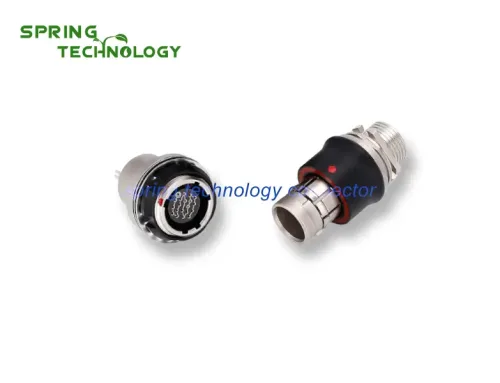
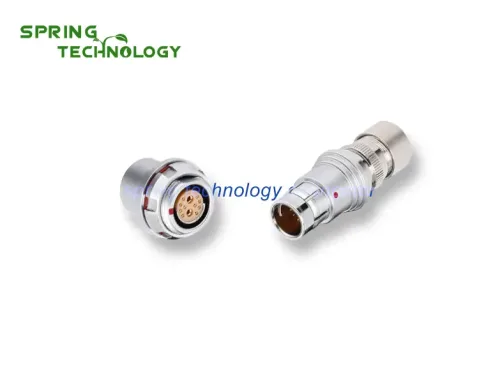
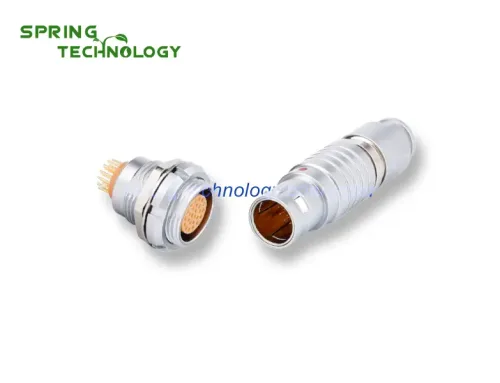
- B Series Circular Push-Pull Self-Locking Connectors – Reliable connectors for industrial control equipment (2-26 pins available)
- Push-pull Connectors for Unmanned Aerial Systems – Industrial-grade connectors for UAV control systems
- Signal Push-pull Connectors – High-performance connectivity for control and instrumentation
XI'AN SPRING TECHNOLOGY CO., LTD is a professional manufacturer of circular push-pull self-locking connectors for industrial control equipment applications. We offer connectors from 2 to 26 pins for various industrial automation needs. Contact us for customized connector solutions.
Xi’an spring technology Co., Ltd. is a professional push pull connector manufacturer integrating connector research and development, production and sales.
Contact me for more info and best price: [email protected], [email protected]
Visit our website: https://www.spring-connectors.com/