

Spring Technology Push-pull Connectors for Robotic Arm: Reliable Connectivity for Modern Automation
Spring Technology Push-pull connectors for robotic arm are engineered to deliver fast locking, vibration-resistant connectivity in environments where precision, durability, and rapid maintenance are essential.
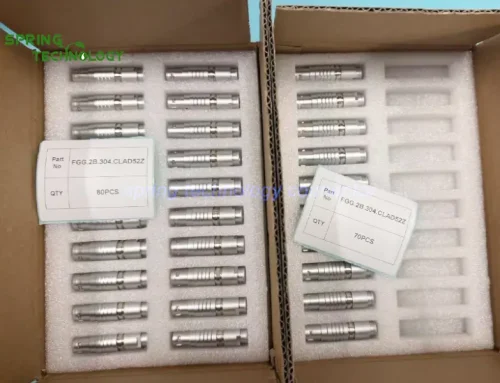
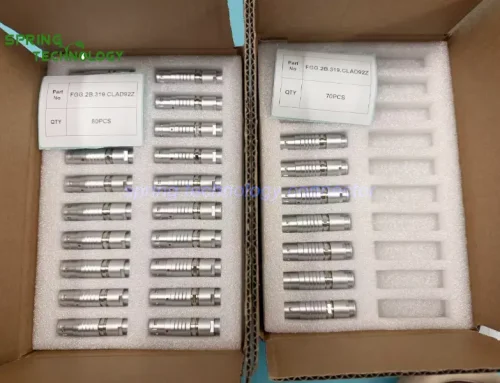
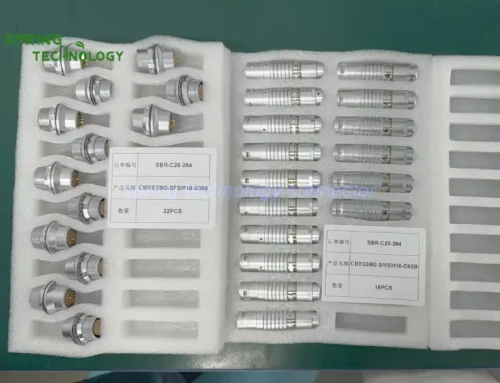
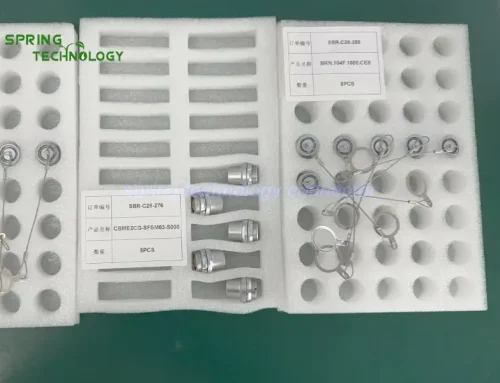
The customer in USA ordered our 105F straight plug TLN.105F.324.CLAD85 and rear panel mounted receptacle ZLN.105F.324.CLLNP-65 for the Robotic arms. This robotic arm will be deployed in automated production lines within the automotive manufacturing sector. Our connectors will ensure stable signal transmission for program instructions.
1. Understanding Push-Pull Connectors in Robotic Arm Systems
Robotic arms are integral to today’s manufacturing, inspection, medical, and service robotics industries. They depend on safe and stable cabling interfaces to transfer power, sensor data, and control signals across multiple moving joints. Push-pull connectors provide a compact, secure, and easy-to-operate interface that withstands continuous motion and mechanical stress.
With their intuitive latch mechanism—engaging when pushed in, releasing only when intentionally pulled—they offer a superior connection standard for high-cycling robots that demand reliability and fast servicing.
2. Key Performance Benefits of Push-Pull Connectors for Robotics
2.1 Unmatched Vibration Resistance
Industrial robots produce constant rotational and linear motions. Push-pull connectors are designed with locking grooves and precision latching elements that prevent loosening, even under extreme vibration or high-speed movement.
2.2 Accelerated Assembly and Maintenance
Traditional screw-type or bayonet connectors require manual threading. Push-pull systems reduce installation time to seconds, supporting:
- Quick robotic arm tool changes
- Fast replacement of sensor modules
- Minimal downtime in production lines
2.3 Enhanced Signal Integrity
Modern robotic arms include vision systems, force sensors, torque encoders, and AI-enabled modules. Push-pull connectors maintain stable electrical contact and support:
- High-speed data transmission
- EMI/RFI shielding
- Low noise for precision control
2.4 Ruggedness for Harsh Industrial Environments
Whether a robot operates on an automotive assembly line or in a cleanroom facility, push-pull connectors are built from durable housings such as stainless steel or reinforced polymer, offering:
- Wear resistance
- Corrosion protection
- Longevity across thousands of mating cycles
3. Where Push-Pull Connectors Are Used on Robotic Arms
• Joint-to-Joint Cable Routing
Ensures stable connectivity for motors and position sensors.
• End-Effector Tools
Grippers, welding tools, polishing heads, and 3D-printing nozzles often require detachable, quick-lock interfaces.
• Vision and Inspection Modules
Push-pull connectors support high-speed cameras and scanning sensors used in AI-powered robotics.
• Collaborative Robot (Cobot) Systems
Safe, repeatable, and easy-disassemble connectors are essential for human-robot interaction and training.
• Autonomous Mobile Robot Arms
AMR-mounted manipulators need connectors that handle movement, vibration, and rapid battery changes.
4. What to Consider When Choosing Push-Pull Connectors for Robotic Arms
4.1 Electrical & Data Specifications
Match connector capabilities to system needs, including:
- High-speed data rates
- Power requirements
- Contact configuration
- EMI shielding
4.2 Mechanical Endurance
Look for connectors rated for:
- Tens of thousands of mating cycles
- Torsional cable stress
- High vibration loads
4.3 Environmental Conditions
Robotic arms may face dust, oil, splatter, and cleaning agents. High IP-rated connectors (IP65–IP68) are recommended.
4.4 Cable Management Compatibility
Robot cables must support bending and twisting. Ensure the connector integrates with high-flex, drag-chain-rated cables.
4.5 Custom Design Needs
Some robotic applications require custom:
- Pin layouts
- Hybrid (signal + power) contacts
- Overmolded cable assemblies
- Locking collar shapes
Customization improves fit and longevity.
5. How Push-Pull Connectors Improve Robotic Automation Efficiency
Robotic arms often operate continuously, and even minor connection issues can halt production. Push-pull connectors minimize failures caused by accidental disconnection, signal interruptions, or cable strain. Their combination of speed, durability, and connection stability directly enhances:
- System uptime
- Precision and control accuracy
- Maintenance efficiency
- Long-term reliability
Conclusion
Spring Technology Push-pull connectors are a vital component in robotic arm systems, providing secure, vibration-resistant, and easy-to-use connectivity that supports the demands of high-performance automation. Their compact design, superior signal integrity, and rapid mating capabilities make them ideal for industrial, collaborative, and mobile robotic applications. Selecting the right connector ensures maximum reliability and optimized performance across the robot’s entire lifecycle.


Perguntas frequentes
1. Why are push-pull connectors preferred for robotic arms?
They provide a strong locking mechanism that prevents accidental disconnection caused by vibration and movement.
2. Do push-pull connectors support high-speed data for robotic sensors?
Yes. Many models include shielding and contact designs for high-speed digital communication.
3. Are push-pull connectors suitable for cleanroom robotics?
Absolutely. Non-outgassing materials and sealed housings can meet cleanroom and medical robot standards.
4. Can they be used for modular end-effector attachments?
Yes. Push-pull connectors enable ultra-fast tool changes, making them ideal for modular robotic tooling.
5. What materials are recommended for robotic push-pull connectors?
Metal housings for high-shock areas; reinforced polymers for lightweight, compact robotic joints.
O conector micro circular de alta densidade da série F é uma estrutura de push-pull tipo push-pull dividida. Tem uma função de auto-travamento após o plug-in e usa uma peça de posicionamento semicircular por dentro para evitar erros. O sistema de posicionamento multiparte da peça de posicionamento impede a inserção e remoção incorretas no mesmo número de núcleo, e também possui a função de inserção cega, que é conveniente e rápida de usar. Esta série de conectores se caracteriza por uma inserção rápida, alta densidade, impermeabilidade, tamanho pequeno, inserção cega e longa vida útil. É especialmente adequado para instalações de alta densidade, instalações de espaço relativamente pequeno e locais onde é difícil separar por rotação. Pode ser aplicado a ambientes adversos no campo, classe de proteção IP68. O conector garante uma conexão confiável com o conector correspondente da Fischer e o conector de outras empresas do mesmo tipo, tornando-o uma escolha ideal para Médico, Teste e medição, Pesquisar, Comunicações, Conector de transmissão, Máquinas, Defesa, Robótica, Aeroespacial, setor público, Sistemas de informação, Automobilismo, Aplicações diversas. Estes conjuntos de cabos com conectores de alta qualidade da Spring Technology podem ser fornecidos. Eles podem cruzar diferentes variações e tamanhos de Fischer.
- segurança do sistema de travamento automático Push-Pull
- tipos multipolares 2 a 40 contatos
- Acoplamento fácil, pode ser acoplado cego (mecanismo de guia garante alinhamento preciso)
- Maior vida útil do equipamento (mecanismo de guia protege perfeitamente os contatos)
- Robusto e resistente a choques (projetos ideais para equipamentos usados em campo)
- conexão estanque (IP 68/IP 66), impermeável e à prova de areia;
- solda, impressão (reta ou cotovelo) contatos
- alta densidade de embalagem para economia de espaço
- Blindagem de 360° para blindagem EMC completa.
Xi'an spring technology co., ltd. é um fabricante profissional de conectores push pull que integra pesquisa e desenvolvimento de conectores, produção e vendas. Entre em contato comigo para mais informações e melhor preço.
Visite o nosso site: https://www.spring-connectors.com/